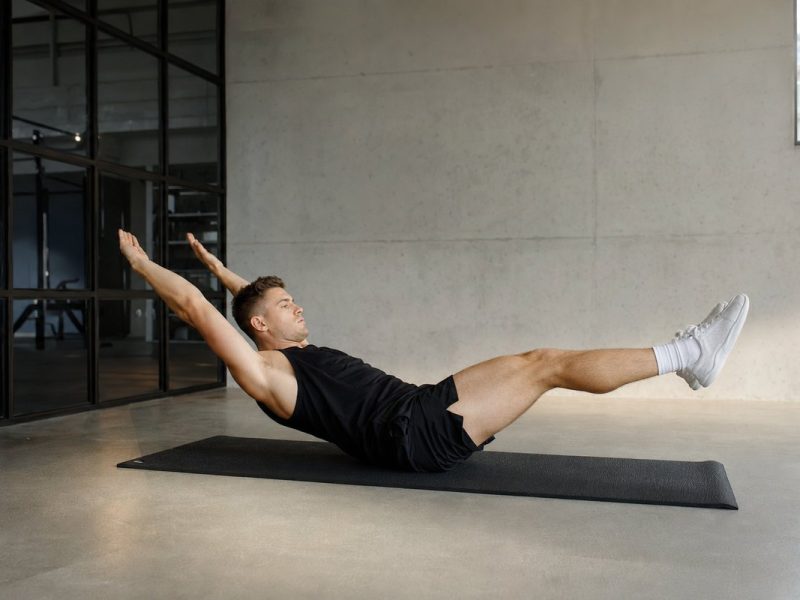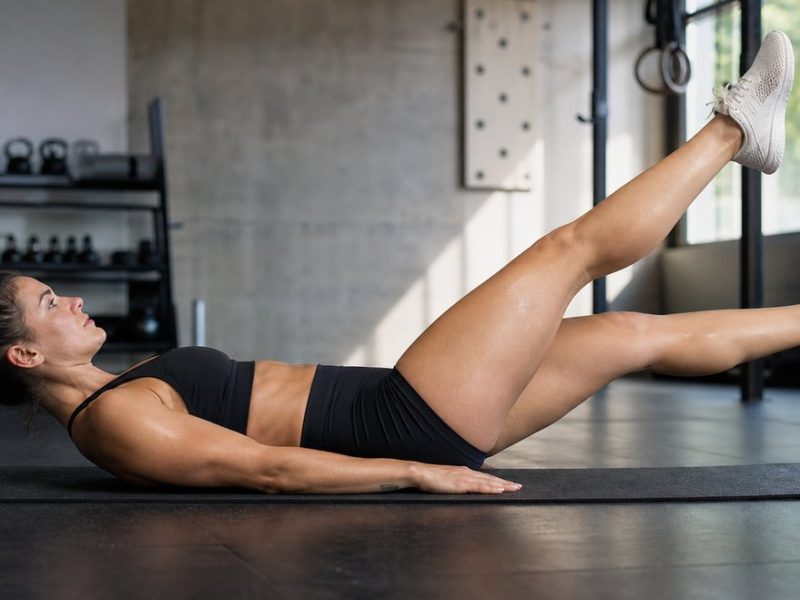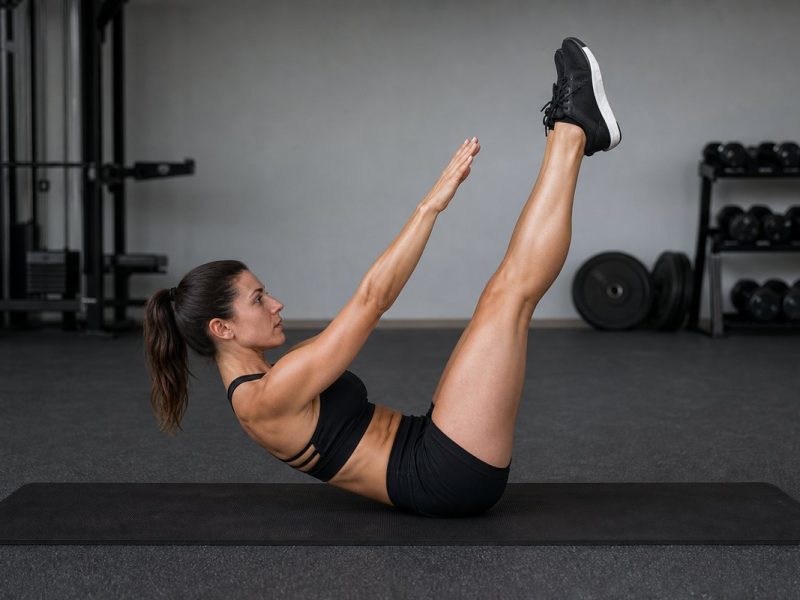

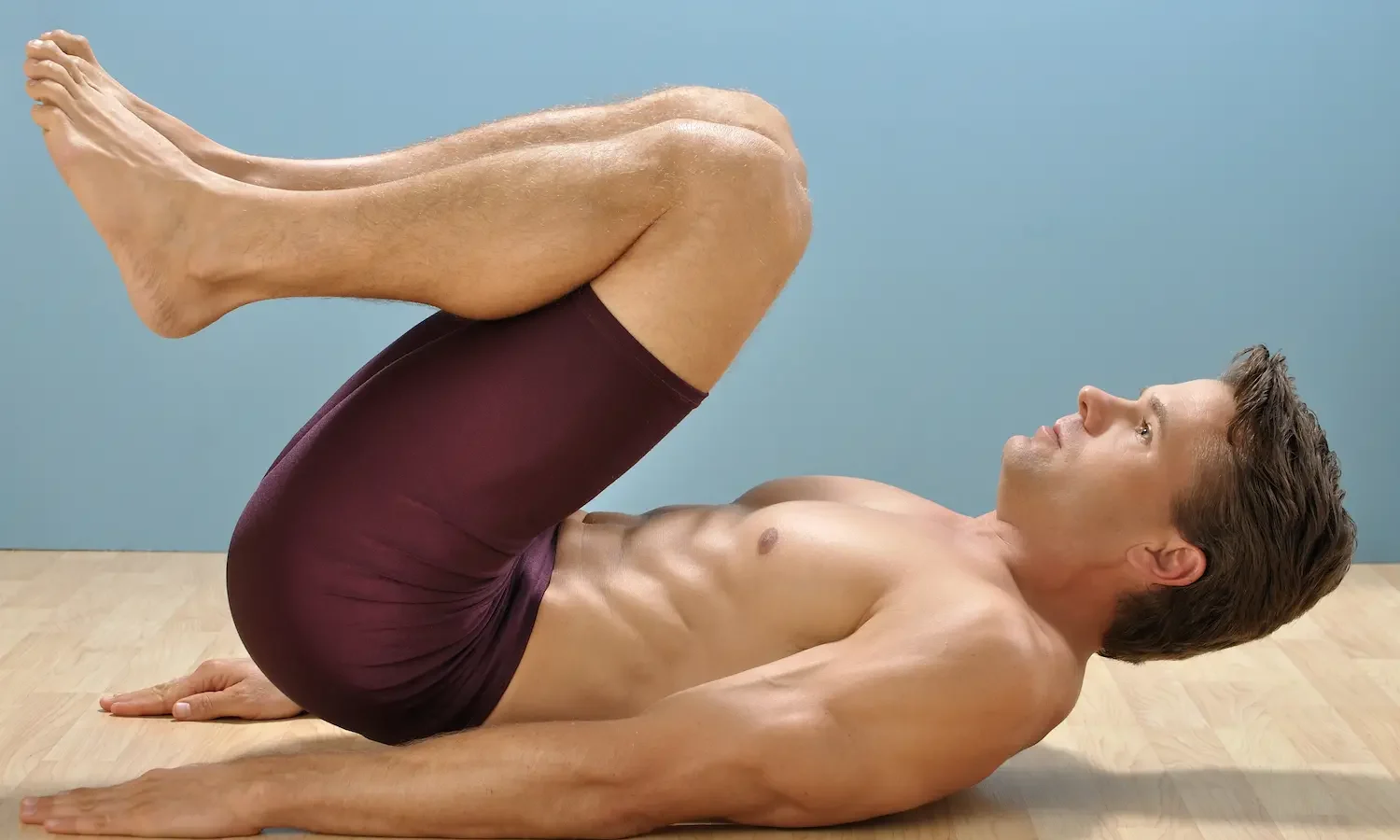
The reverse crunch is the lower-ab specialist that the standard crunch can’t replicate. Where the regular crunch lifts the head and shoulders toward the hips (training the upper rectus abdominis), the reverse crunch lifts the hips toward the head — biasing the lower portion of the same muscle, which is notoriously stubborn for most lifters.
This guide covers the strict bodyweight version. Done correctly, it’s brutal. Done sloppy with hip flexors taking over, it’s just a leg raise that swings around.
What is the reverse crunch?
The reverse crunch is an ab exercise performed lying on your back, in which you lift your hips off the floor by curling the pelvis up toward the chest, then lower under control. The knees are bent at about 90°. The motion is the opposite of a regular crunch — the hips move toward the chest instead of the chest toward the hips.
Despite the name, the reverse crunch trains the same muscle as the standard crunch — the rectus abdominis. The key difference is which portion of the muscle gets emphasised: the upper rectus dominates the standard crunch, while the lower rectus and posterior pelvic tilt dominate the reverse crunch.
Muscles worked
| Muscle group | Role | Contribution |
|---|---|---|
| Rectus abdominis (lower portion) | Primary mover, posterior pelvic tilt | ~70 % |
| Hip flexors (iliopsoas) | Stabilisation (minimal in strict version) | ~15 % |
| Obliques · Transverse abdominis | Stabilisation | ~15 % |
The “lower abs” are technically just the lower portion of the rectus abdominis (the muscle is one continuous unit, not separate sections). But anatomical research shows that the lower portion can be selectively activated more by exercises like the reverse crunch and hanging leg raise.
How to reverse crunch: 5 steps
-
Set the start position
Lie on your back, arms at your sides palms down (for stability). Knees bent at ~90°, feet hovering above the floor or planted lightly.
-
Brace the core
Pull the belly button toward the spine. Lower back stays in contact with the floor — slight neutral arch only.
-
Curl the pelvis up
**Tilt the pelvis toward the ceiling** by contracting the lower abs. The hips lift off the floor and the knees travel slightly toward the chest. The motion is small — about 15-20 cm of hip lift.
-
Pause at the top
Half-second pause, abs fully contracted. Don't use momentum — pause is when the work is done.
-
Lower in 2-3 seconds
Controlled descent. Hips return to the floor with the lower back staying in contact throughout. Don't crash down — control the eccentric.
Common mistakes to avoid
Variations
- Decline reverse crunch. On a decline bench. Greater range of motion at the bottom for stretch.
- Weighted reverse crunch. Light dumbbell or ankle weights. Adds resistance once bodyweight feels easy.
- Hanging knee raise. Hanging from a pull-up bar, knees curled to chest. Same muscle target with a different start position.
- Hanging leg raise. Advanced progression — straight legs.
- Cable reverse crunch. With ankle straps and a low cable. Constant tension throughout.
- Swiss ball reverse crunch. Knees pulling a swiss ball toward the chest. Adds instability.
Sample workout: 4-week lower-ab block
Reverse crunches 3 times per week. Pair with standard crunches and planks for full ab coverage.
| Week | Sets × reps | Tempo |
|---|---|---|
| 1 | 3 × 10 | 2 sec eccentric |
| 2 | 3 × 12 | 2 sec eccentric + 1 sec pause at top |
| 3 | 4 × 10 | 3 sec eccentric + 1 sec pause |
| 4 (deload) | 3 × 10 | Smooth |
Frequently asked questions
Reverse crunch or hanging leg raise?
Different difficulty levels. Reverse crunch is the foundational version — lying on the floor, easier on the body. Hanging leg raise is the advanced progression. Most lifters should master reverse crunches before moving up.
Why don’t I feel it in my abs?
You’re probably using hip flexors instead of the abs. The cue is “**curl the pelvis up**”, not “lift the legs”. Tilt the tailbone toward the ceiling — that’s what fires the lower abs. The legs barely move.
Is it normal to feel it more in my hip flexors?
It means you’re doing it slightly wrong. Slow down, focus on tilting the pelvis (not lifting the legs), and reduce the range of motion until you feel the abs contract. The mind-muscle connection improves quickly.
Can I add weight?
Yes, with light ankle weights or a small dumbbell held between the feet. Start with 1-2 kg per ankle. Heavy weight isn’t the goal — slow tempo and full range matter more.
How often should I do reverse crunches?</h3
2-3 times per week. The lower abs recover fast. Daily moderate volume is fine for most people.
Related exercises
- Crunch: upper ab targeting
- Hanging Leg Raise: advanced progression
- Plank: anti-extension complement
- Dead Bug: anti-extension supine
- Hanging Knee Raise: bridge to advanced work