
The push press is the overhead press‘s explosive cousin. Same start position, same finish position, but with a slight knee dip and explosive leg drive to launch the bar overhead. The result: heavier loads possible, faster bar speed, more total power developed per rep.
The push press is the bridge between strict pressing and Olympic-style lifts. It teaches lifters to use leg drive efficiently, builds explosive overhead strength, and lets you train heavier than your strict press allows. This guide covers the standard barbell push press.
What is the push press?
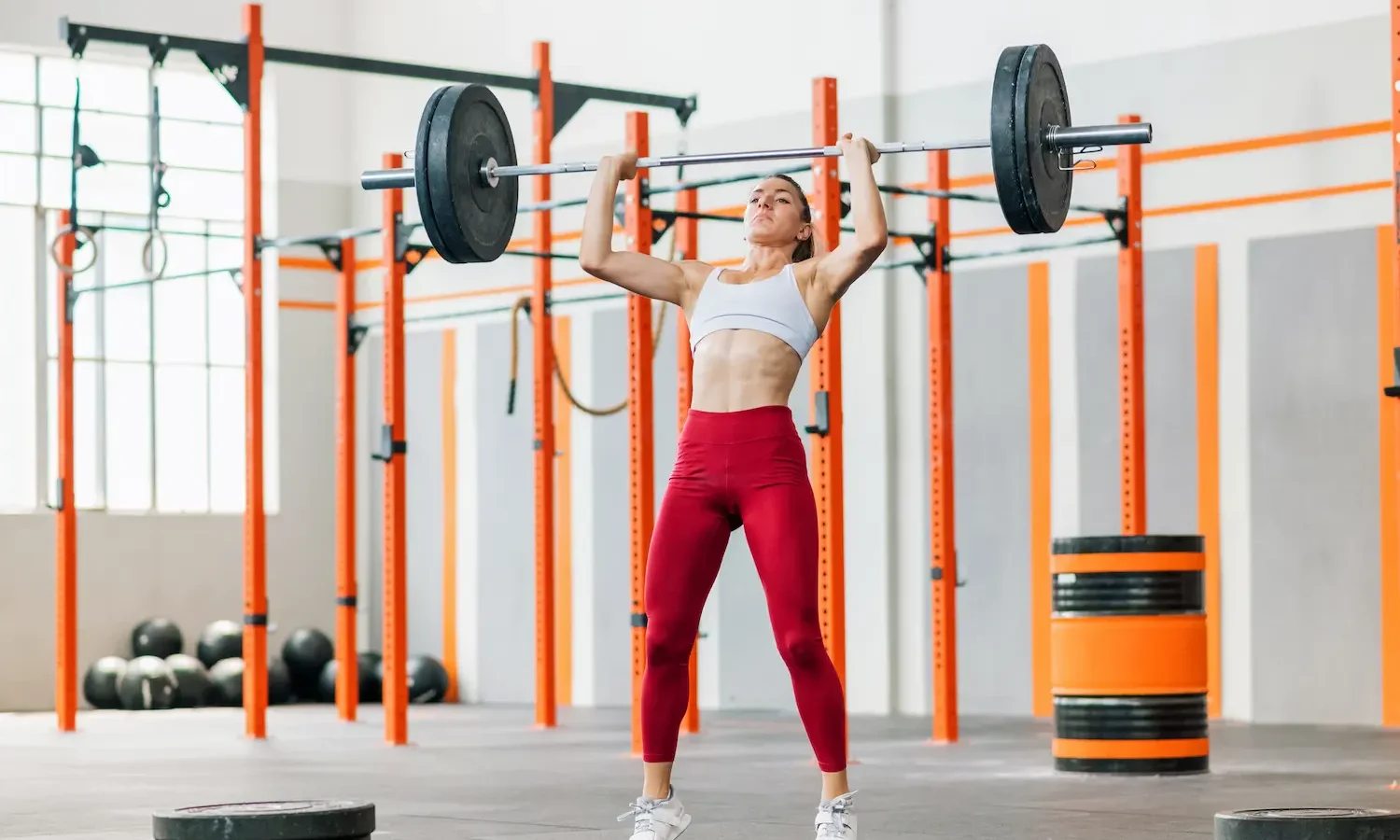
The push press is a vertical pushing exercise performed standing, in which a barbell is pressed from the front rack to overhead lockout using both upper-body strength and explosive leg drive. The motion: small knee dip, explosive hip and knee extension, finish with the press — using the leg drive to overcome the bar’s inertia.
Compared to the strict overhead press, the push press allows 15-25 % heavier loads. The leg drive gets the bar moving quickly past the sticking point, then the upper body finishes the lockout. It’s a common Olympic weightlifting accessory and a hybrid power-strength exercise.
Muscles worked
| Muscle group | Role | Contribution |
|---|---|---|
| Anterior + lateral deltoids | Press | ~35 % |
| Triceps brachii | Lockout | ~20 % |
| Quadriceps, glutes | Leg drive | ~30 % |
| Upper chest, traps | Press support | ~10 % |
| Core, calves | Stabilisation, foot drive | ~5 % |
The push press is one of the most “complete” upper-body exercises — it trains the shoulders, triceps and legs together in a coordinated movement. It also trains explosive force production, which transfers to nearly every athletic activity.
How to push press: 5 steps
-
Set up the front rack
Bar in the rack at upper-chest height. Step under and rack the bar on the front shoulders. Hands slightly wider than shoulder width. Elbows pointing forward and slightly up. Lift the bar off with a small leg drive.
-
Set the body and brace
Stand tall, feet shoulder-width. Brace the core hard. Squeeze the glutes. Take a deep breath. Body forms a vertical column, ribs down. **No arch in the lower back.**
-
Quick knee dip
Bend the knees about 10-15 cm — a small, quick dip. **Heels stay planted.** Torso stays vertical — don't lean forward. The dip is the loading phase.
-
Explosive leg drive + press
Drive through the heels, **explosively extend** hips and knees. As the bar leaves the shoulders, press it overhead. Push your head through the bar at the top — bar locks out over the back of the skull.
-
Lock out and lower
Stand fully upright with arms locked out, bar over mid-foot. Pause briefly. Lower the bar to the front rack with control — don't crash on the shoulders. Reset, repeat.
Common mistakes to avoid
Variations
- Strict overhead press. No leg drive. The pure pressing strength variant.
- Push jerk. Like push press but you also re-bend the knees to “catch” the bar overhead. Allows even heavier loads. Olympic lifting technique.
- Dumbbell push press. Two dumbbells. More balance demand, friendly on shoulders.
- Single-arm push press. One dumbbell or kettlebell. Adds anti-rotation work.
- Behind-the-neck push press. Bar starts on upper back. Olympic accessory. Demanding shoulder mobility.
- Thruster. Front squat + push press combined. Brutal CrossFit favorite.
Sample workout: 4-week strength + power block
Push press once or twice per week. Pair with strict overhead press on alternate days for balanced shoulder strength.
| Week | Sets × reps | Intensity |
|---|---|---|
| 1 | 5 × 3 | 70 % 1RM |
| 2 | 5 × 3 | 78 % |
| 3 | 6 × 2 | 85 % |
| 4 (deload) | 4 × 3 | 60 % |
Frequently asked questions
Push press or strict press?
Both. Strict press builds shoulder strength specifically. Push press allows heavier loads and trains power. Most balanced shoulder programs include both — strict for absolute strength, push press for power and to break strict-press plateaus.
How heavy can I push press compared to strict press?
15-25 % more. So if your strict overhead press max is 60 kg, expect a push press max around 70-75 kg.
How deep should the dip be?
Small. About 10-15 cm — just a quick knee bend. A deep dip turns the lift into a thruster (which is its own exercise). Quick dip, explosive drive.
Why does my back hyperextend during the press?
You’re leaning back to “press” the bar overhead instead of using the leg drive. Squeeze the glutes and brace the core hard before the dip. The hips drive forward, not the back back.
Push press or push jerk?
Push press finishes with arms locked out from the press. Push jerk re-dips the knees to “catch” the bar overhead with a slight squat. Push jerk allows even heavier loads but is more technical. Most lifters should master push press first.
Related exercises
- Strict Overhead Press: pure pressing strength
- Push Jerk: Olympic-style with second dip
- Thruster: front squat + push press
- Clean and Jerk: full Olympic lift
- Lateral Raise: shoulder isolation
Published by: Jay — Writer covering shoulder exercises
Reviewed, corrected and approved by: Martin Wood — Editor-in-chief
Updated on May 10, 2026