
The lunge is the most underrated lower-body exercise. While the squat gets all the attention, the lunge does something the squat can’t: train each leg independently. That matters because most humans have a stronger leg and a weaker leg, and the squat lets the strong side carry the weak side. The lunge doesn’t.
If you’ve ever felt your right glute working harder than your left during squats, the lunge is the fix. This guide covers the standard forward lunge, the variations worth knowing, and how to fit them into a balanced lower-body program.
What is the lunge?
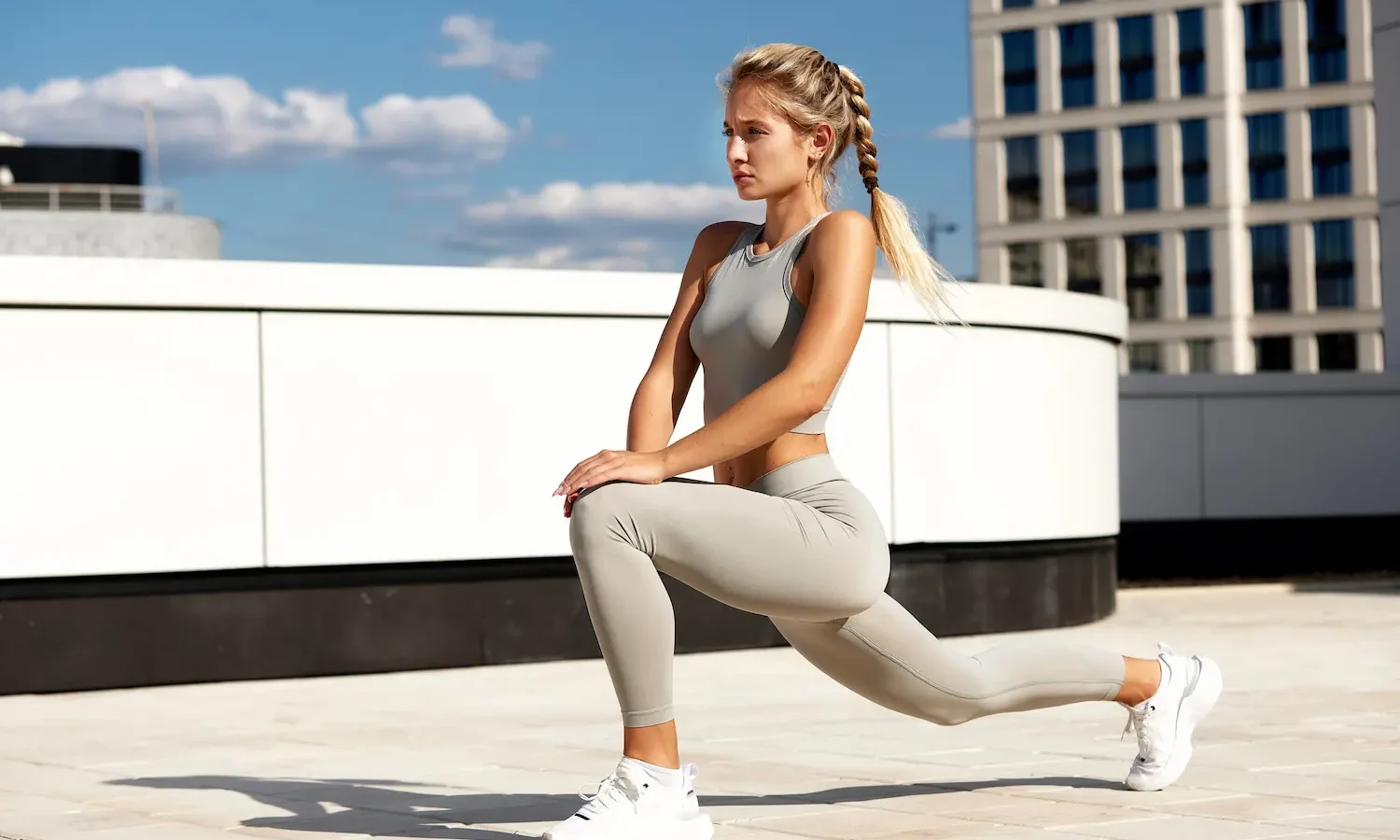
The lunge is a unilateral lower-body exercise in which one leg steps forward (or backward, or to the side), and you lower your body until both knees form roughly 90° angles, then push back to standing. The leg that steps does most of the work — both quad and glute.
The forward lunge is the foundational version. The reverse lunge (stepping back instead of forward) is gentler on the knees and often easier to learn. Other variations — walking lunges, lateral lunges, curtsy lunges — each target slightly different muscles or planes of motion.
Muscles worked
| Muscle group | Role | Contribution |
|---|---|---|
| Quadriceps (front leg) | Primary mover, knee extension | ~40 % |
| Glutes (front leg) | Hip extension | ~30 % |
| Hamstrings (front leg) | Hip extension support | ~15 % |
| Calves · Adductors · Core | Stabilisation, balance | ~15 % |
The trailing leg does very little — it acts as a kickstand. The lunge is essentially a single-leg exercise. The quads and glutes of the front leg do nearly all the work.
How to lunge: 5 steps
-
Set the stance
Stand tall, feet hip-width apart, hands on hips (bodyweight) or holding dumbbells at your sides. Engage the core, chest proud.
-
Step forward into the lunge
Take a long step forward — about 60-90 cm. Plant the front foot flat. Let the back heel rise as the back knee bends. Both knees aim for ~90° angles.
-
Lower with control
Descend until the back knee hovers just above the floor. **Front knee tracks over the foot** (not collapsing inward, not past the toes). Front shin stays roughly vertical at the bottom.
-
Pause briefly at the bottom
Half-second pause. Most of the load is on the front leg.
-
Drive back to standing
Push through the front heel to return to the start position. Both legs together at the top. Switch legs (or alternate based on the variation).
Common mistakes to avoid
Lunge variations
- Reverse lunge. Step backward instead of forward. Easier on the knees, often easier to balance. The recommended starting variant for beginners.
- Walking lunge. Continuous forward steps, alternating legs. Builds endurance and coordination. Brutal at moderate volume.
- Bulgarian split squat. Rear foot elevated on a bench. The most demanding lunge variant — pure unilateral hypertrophy.
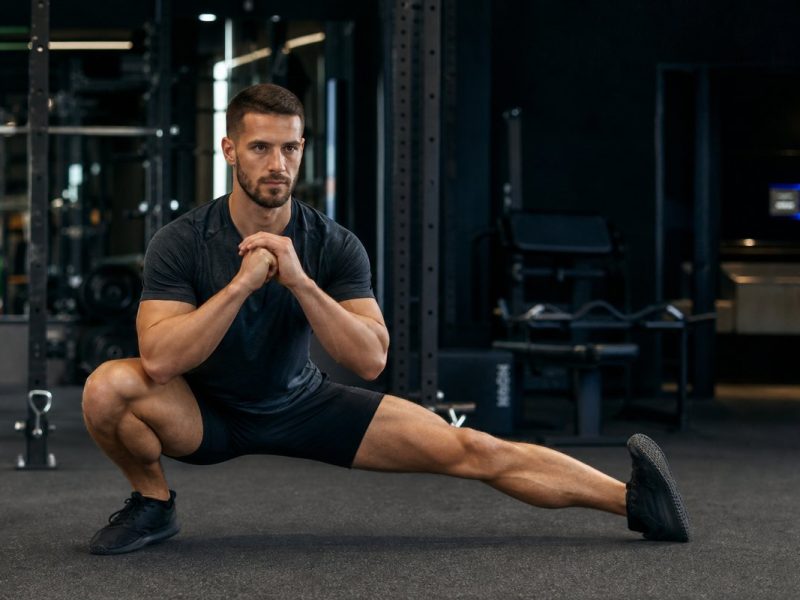
- Lateral lunge (side lunge). Stepping sideways instead of forward. Trains adductors and frontal-plane strength.
- Curtsy lunge. Stepping diagonally behind. More glute medius involvement.
- Jumping lunge. Plyometric switch between legs. Conditioning + power.
Sample workout: 4-week unilateral block
Lunges twice per week, on days you don’t squat heavy. Reps below are per leg.
| Week | Sets × reps/leg | Variation |
|---|---|---|
| 1 | 3 × 10 | Bodyweight reverse lunge |
| 2 | 3 × 10 | Goblet reverse lunge (one dumbbell) |
| 3 | 4 × 8 | Dumbbell forward lunge |
| 4 (deload) | 3 × 8 | Bodyweight reverse lunge |
Frequently asked questions
Forward lunge or reverse lunge?
Reverse lunge is gentler on the knees and easier to balance. Forward lunge teaches deceleration and is more athletic. Beginners should start with reverse lunges; advanced lifters can use both.
How heavy should I lunge?
Lunges aren’t a strength lift — they’re a unilateral hypertrophy and stability lift. Goblet hold of 12-20 kg, or two dumbbells of 8-15 kg each, for 8-10 reps per leg. If you can lunge heavier than that for clean reps, you’re a strong unit.
My knees hurt during lunges. What should I do?
Switch to reverse lunges first — they’re gentler. Make sure your front knee tracks over (not past) the toes. Take a longer step. If pain persists, reduce load and check ankle/hip mobility.
Lunges or squats — which is better?
Both. Squats are your bilateral compound for absolute strength; lunges are your unilateral work for symmetry and stability. Most balanced lower-body programs include both.
Why are my lunges so much harder than my squats?
Because each leg has to balance + produce force on its own. Lunges expose every weakness the squat hides — single-leg strength deficits, ankle instability, glute medius weakness. Welcome to unilateral training.
Related exercises
- Squat: bilateral compound, primary leg lift
- Bulgarian Split Squat: most demanding unilateral variant
- Reverse Lunge: knee-friendlier variant
- Walking Lunge: continuous forward stepping
- Step-Up: another single-leg quad/glute exercise
Published by: Jay — Writer covering quad exercises
Reviewed, corrected and approved by: Martin Wood — Editor-in-chief
Updated on May 8, 2026