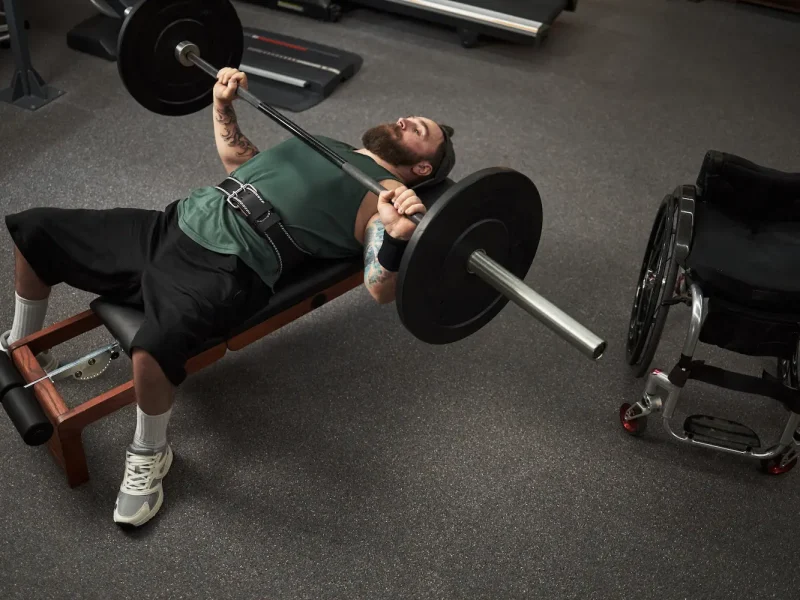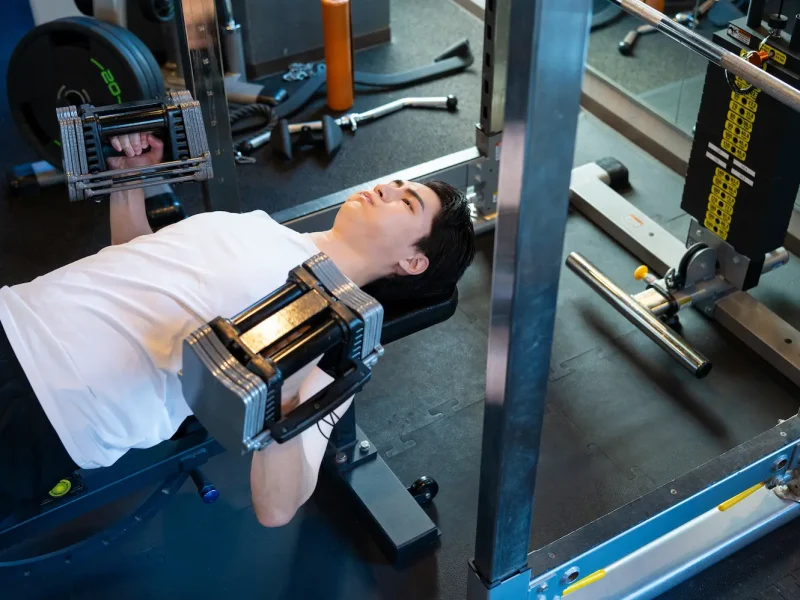

The Larsen press is the bench press with the feet up — typically resting on the bench or held in the air. With no leg drive available, the upper body has to do 100 % of the work, eliminating the common bench press cheats and exposing exactly how strong your chest, shoulders, and triceps are without help.
What it is
The Larsen press is a barbell bench press performed with the feet not on the floor — either resting flat on the bench, held in the air (knees bent), or extended straight out. Without floor contact, leg drive is impossible — the lifter’s upper-body strength alone presses the bar. Same grip, same path, same depth as standard bench; only the leg position changes.
Muscles worked
| Muscle | Contribution |
|---|---|
| Pectoralis major | ~45 % |
| Triceps brachii | ~25 % |
| Anterior deltoid | ~15 % |
| Core, scapular stabilisers | ~15 % |
How to Larsen press: 5 steps
-
Set up on the bench
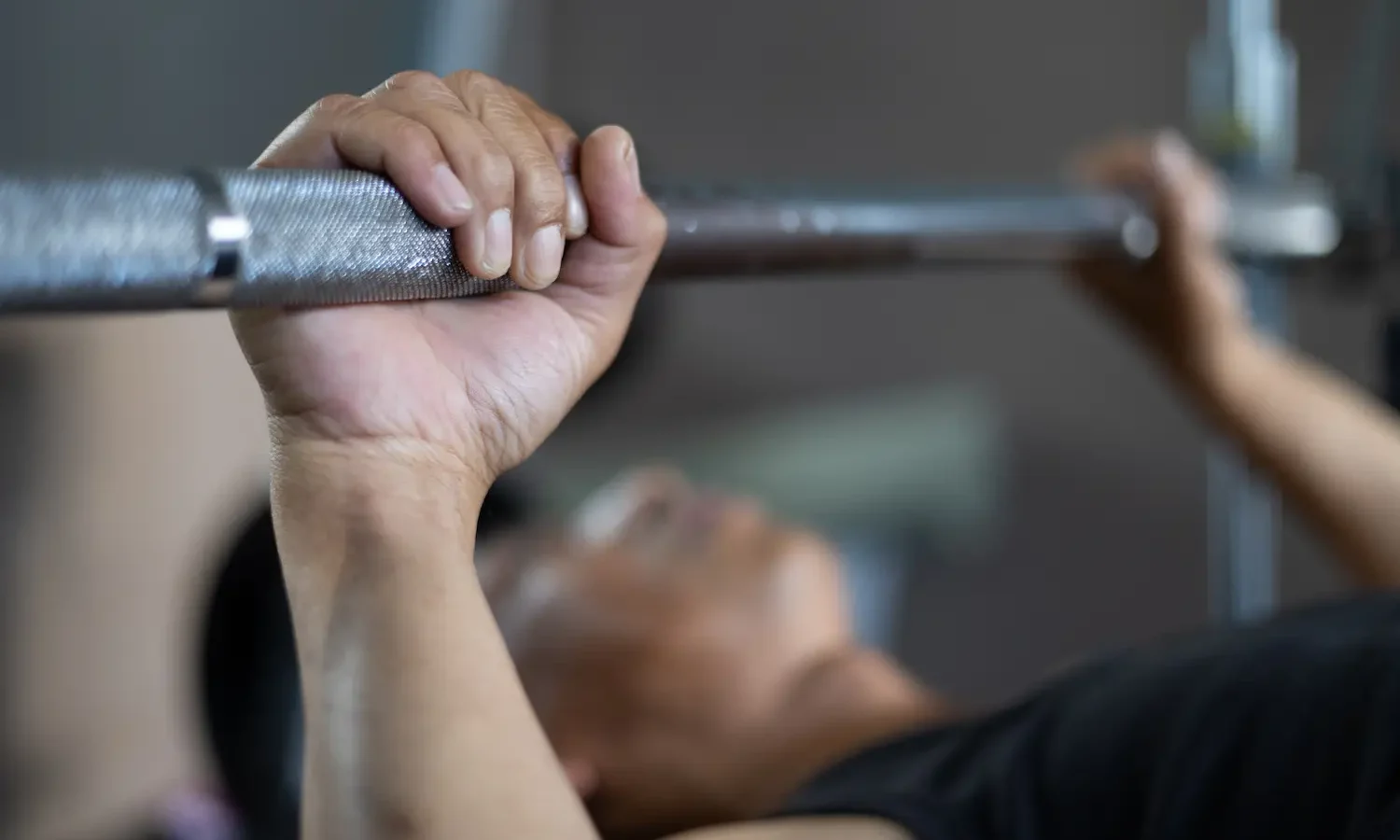
Lie on the bench. Retract scapulae, slight upper-back arch. Grip the bar slightly wider than shoulder-width.
-
Place the feet on the bench
**Lift the feet onto the bench**, knees bent at about 90°. Feet rest flat on the bench (not over the end). Alternative: knees toward chest, feet in the air.
-
Unrack and brace
**Brace the core hard** — no leg drive means core stability is critical. Unrack the bar with a spotter if heavy.
-
Lower with control
Lower the bar in 2-3 seconds to the lower chest. **Elbows tuck at 45-60°**. Maintain scapular retraction.
-
Press up to lockout
**Drive the bar straight up** — chest, shoulders and triceps do all the work. No leg drive available. Lock out, reset, lower again.
How it differs from bench press
- No leg drive. Standard bench press uses leg drive into the floor to create whole-body tension. Larsen press removes this entirely.
- Pure upper-body strength. Exposes weakness that leg drive normally hides. If your bench press relies heavily on leg drive, your Larsen-press number will be a wake-up call.
- More core demand. Without foot contact, the core has to brace harder to maintain back tension.
- Lower max load. Most lifters Larsen-press 80-85 % of their competition bench (with leg drive). The gap reveals how much leg drive contributes.
Common mistakes
When to use this variation
Use the Larsen press when your bench press feels great in training but misses at meets, when leg drive is something you “always have to remember”, or as accessory work to genuinely strengthen the upper body. 4-6 week blocks at 80-90 % of regular bench load, 3-4 sets of 4-6 reps, often produce a 5-10 kg bench PR after the block.
FAQ
Larsen press or floor press?
Different goals. Floor press shortens the range (triceps emphasis); Larsen press keeps full range but removes leg drive (pure upper-body strength). Combine both in a bench-accessory program.
Where should I put my feet?
Most commonly: flat on the bench, knees bent at 90°. Alternative: feet held up in the air (knees toward chest). The bench-flat position is more stable and most lifters’ default.
How heavy should I Larsen press?
About 80-90 % of regular bench for the same reps. Build over a 4-6 week block. Don’t chase parity with the competition bench — the gap is the whole point of the exercise.
Related exercises
- Bench Press: standard with leg drive
- Pause Bench Press: chest-pause variant
- Floor Press: range-limited variant
- Spoto Press: mid-air pause variant
Published by: Jay — Writer covering chest exercises
Reviewed, corrected and approved by: Martin Wood — Editor-in-chief
Updated on May 19, 2026