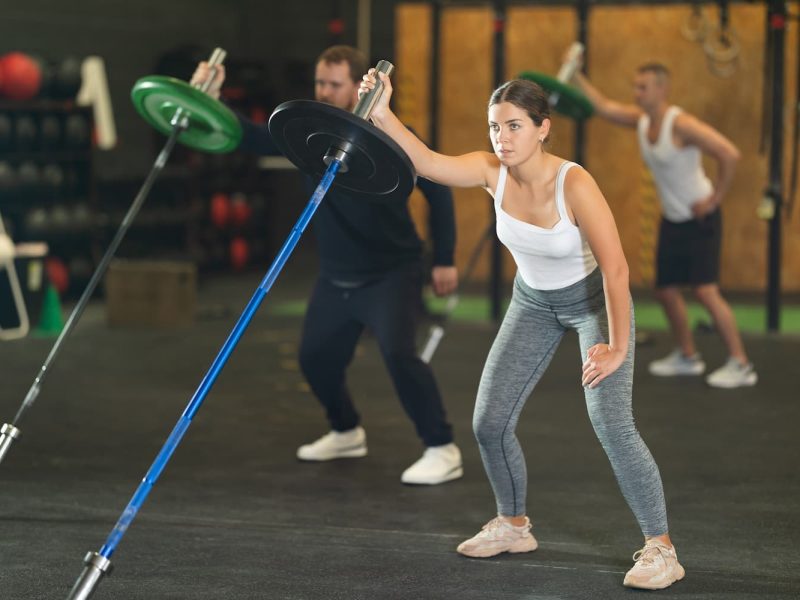

The landmine deadlift anchors one end of a barbell in a landmine attachment and loads the other, so the bar swings on a fixed arc instead of moving straight up. That arc guides the lift, making it remarkably easy to learn and gentle on the lower back. It is a brilliant first deadlift for beginners and a low-stress posterior-chain option for anyone managing a cranky back.
What it is
The landmine deadlift is a deadlift performed with a barbell secured in a landmine — a pivoting sleeve fixed to the floor or a rack. The lifter loads the free end, straddles or stands behind it, and pulls. Because the anchored end controls the path, the bar travels on a guided arc, reducing balance and skill demands while still training the hips, hamstrings, and glutes.
Muscles worked
| Muscle | Contribution |
|---|---|
| Glutes, hamstrings | ~45 % |
| Quadriceps | ~20 % |
| Erector spinae | ~20 % |
| Core, forearms | ~15 % |
How to landmine deadlift: 5 steps
-
Set up the landmine
Anchor one end of the barbell in a landmine sleeve. **Load the free end** and stand behind it.
-
Hinge and grip
**Push the hips back, bend the knees, and grip the loaded end** with both hands stacked or a landmine handle.
-
Brace the trunk
**Chest up, flat back, core braced.** Set your position before you move.
-
Drive up along the arc
**Push through the legs and extend the hips,** letting the bar follow its guided arc to a tall finish.
-
Lower under control
**Hinge back down along the same arc** until the plate touches the floor. Reset and repeat.
How it differs from conventional deadlift
- Guided arc. The anchored end fixes the bar path, so balance and bar control are far easier.
- Lower back demand. The supported path reduces lumbar stress for the same training effect.
- Lower skill ceiling. Beginners can learn the hinge quickly without worrying about bar drift.
- Capped loading. The arc and single-end load mean it is not a maximal-strength tool — it suits learning and volume.
Common mistakes
When to use this variation
Use the landmine deadlift to teach beginners the hip hinge, to keep training the posterior chain when the lower back needs a lighter option, or as accessory volume. Program 3-4 sets of 8-15 reps. Hold the loaded end of the bar with both hands, or use a landmine handle. Once the pattern feels solid and you want heavier loading, progress toward the trap bar or conventional deadlift.
FAQ
How do I hold the bar?
Grip the loaded sleeve end with both hands stacked, or attach a dedicated landmine handle. Stand behind the bar so it travels up between or in front of your legs.
Is the landmine deadlift good for bad backs?
It is often a gentler option because the guided arc reduces balance demand and lumbar load. It is not medical advice — anyone with a back injury should clear training with a professional first.
Landmine deadlift or trap bar deadlift?
Both are beginner-friendly. The trap bar deadlift loads heavier and feels closer to a barbell pull; the landmine version is even easier to control and lighter on the back.
Related exercises
- Deadlift: the standard barbell pull
- Trap Bar Deadlift: another easy-to-learn pull
- Dumbbell Deadlift: beginner-friendly hinge
- Kettlebell Deadlift: simple posterior-chain pull