
The dumbbell deadlift swaps the barbell for a pair of dumbbells, one in each hand. It is the most accessible way to learn the hip hinge: no bar to load, no need for a full rack, and the dumbbells can travel beside the legs instead of around the shins. Beginners use it to groove the pattern; home and hotel-gym lifters use it because it is all they need.
What it is
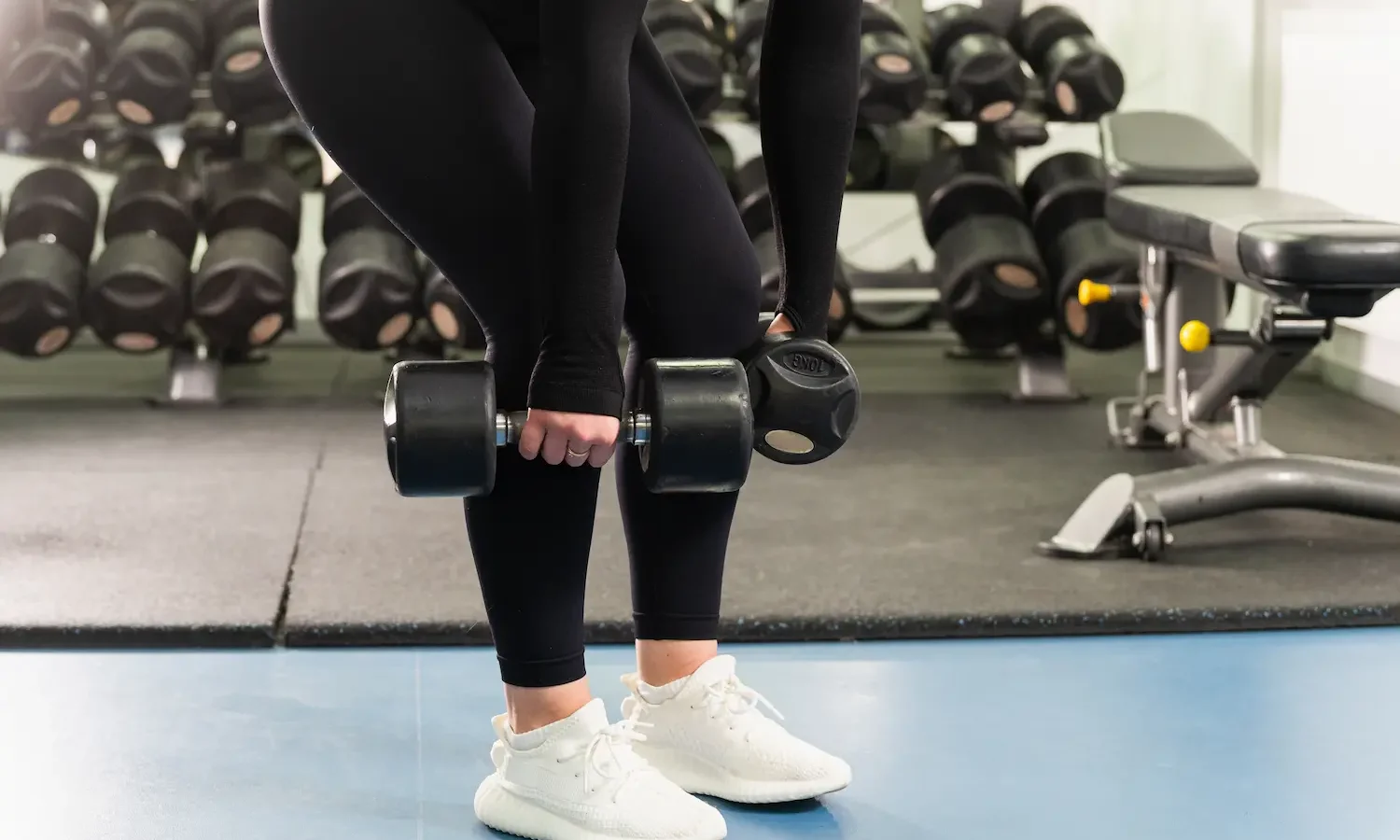
The dumbbell deadlift is a deadlift done with a dumbbell in each hand rather than a barbell. The lifter hinges at the hips, lowers the dumbbells alongside the legs, and stands back up. Because the weights sit at the sides of the body, the path is more natural and the lower-back demand is gentler, making it an ideal entry point and a solid hamstring-and-glute builder.
Muscles worked
| Muscle | Contribution |
|---|---|
| Glutes, hamstrings | ~45 % |
| Quadriceps | ~20 % |
| Erector spinae | ~20 % |
| Forearms, traps, core | ~15 % |
How to dumbbell deadlift: 5 steps
-
Set your stance
Stand with feet hip-width, a dumbbell resting on the floor just outside each foot.
-
Hinge and grip
**Push the hips back, bend the knees, and grip a dumbbell in each hand.** Chest up, flat back.
-
Brace the trunk
**Take a breath, brace the core, and pull the lats down.** Set a flat-back position before you move.
-
Stand up
**Drive through the legs and push the hips forward.** Keep the dumbbells sliding up close to the legs.
-
Lower under control
**Hinge back down** with a flat back until the dumbbells touch the floor. Reset and repeat.
How it differs from conventional deadlift
- Dumbbells at the sides. The weights travel beside the legs, not in front, giving a more natural bar path.
- Lower skill demand. No bar to set up over mid-foot — easier to learn the hinge.
- Lighter total load. Dumbbell deadlifts cap out well below a barbell pull, so they suit volume and learning, not maximal strength.
- Grip works each side. Holding two separate dumbbells trains the grip evenly without a mixed grip.
Common mistakes
When to use this variation
Use the dumbbell deadlift to learn the hip hinge, train at home with limited equipment, or add hamstring-and-glute volume without taxing the lower back. Program 3-4 sets of 8-15 reps. It works well as a main lift for beginners and as accessory volume for more advanced lifters. Once you can move heavy dumbbells comfortably, graduating to the barbell deadlift unlocks far more loading potential.
FAQ
Where should the dumbbells be?
At your sides, level with the outside of the thighs. Let them slide down the legs as you hinge — they should not drift out in front of you.
Dumbbell deadlift or Romanian deadlift?
The dumbbell deadlift starts from the floor with more knee bend; the RDL stays in the top range with straighter knees for a hamstring focus. Beginners often start with the dumbbell deadlift.
When should I switch to a barbell?
Once the dumbbells available to you feel light for your work sets, or grip becomes the only limit. A barbell lets you load far heavier and progress for years.
Related exercises
- Deadlift: the barbell version
- Dumbbell Romanian Deadlift: dumbbell hip hinge
- Kettlebell Deadlift: similar beginner-friendly pull
- Trap Bar Deadlift: another easy-to-learn pull
Published by: Jay — Writer covering back exercises
Reviewed, corrected and approved by: Martin Wood — Editor-in-chief
Updated on September 29, 2026