
The incline bench press is what fills out the upper chest — that area below the collarbone that the flat bench press doesn’t fully reach. If you bench heavy and notice your lower chest growing while the upper chest stays flat, the incline is the missing piece.
This guide covers the standard 30-45° incline barbell press. The movement pattern mirrors the flat bench, but the angle changes everything: more upper chest, more anterior delt, less lower chest. It’s also slightly harder per kilo lifted — most lifters incline bench about 15-20 % less than they flat bench.
What is the incline bench press?
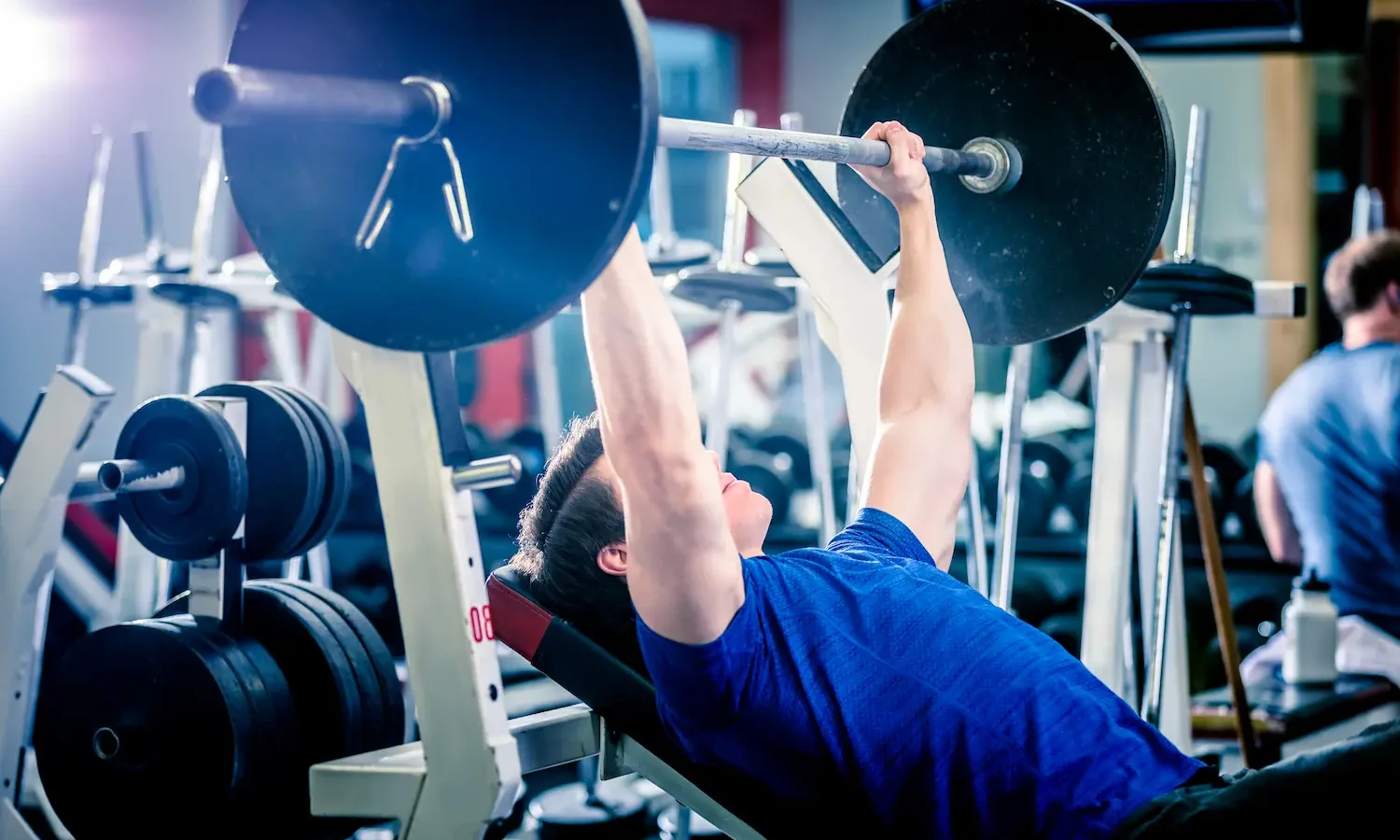
The incline bench press is a horizontal pushing movement performed on a bench inclined between 15° and 60° from horizontal, in which a barbell is lowered to the upper chest and pressed back to lockout. The most common angle is 30-45°, which is the sweet spot for upper chest emphasis without excessive front-delt takeover.
Steeper angles (50-60°) shift the work increasingly toward the front delts. Shallower angles (15-25°) approach a flat bench. For most lifters, 30° is the right starting point — enough incline to bias the upper chest, not so much that the shoulders take over.
Muscles worked
| Muscle group | Role | Contribution |
|---|---|---|
| Pectoralis major (clavicular head / upper chest) | Primary mover | ~50 % |
| Anterior deltoid | Press initiation, shoulder flexion | ~25 % |
| Triceps brachii | Lockout | ~20 % |
| Serratus anterior · Core | Stabilisation | ~5 % |
The upper chest (clavicular head of the pectoralis major) is the area most commonly underdeveloped in lifters who only train flat bench. The incline press is the most efficient way to load it. The anterior delt contribution increases compared to flat bench — at 45° the press is roughly 50/50 chest/shoulder.
How to incline bench press: 5 steps
-
Set the bench angle and grip
Adjust the bench to 30-45° (most commonly 30°). Lie back, eyes directly below the bar. Plant feet firmly on the floor. Grip slightly wider than shoulder width, wrists stacked over forearms.
-
Set up the upper back
Pull the shoulder blades together and down. Slight arch in the upper back, glutes still on the bench. Take a deep breath, brace the core. Unrack the bar with arms locked out.
-
Lower to the upper chest
Bring the bar to the upper chest (collar bone area, not the lower chest as in flat bench). **Elbows tucked at 45-60° from the torso.** Controlled 2-second descent. Touch the chest gently.
-
Press up and slightly back
Drive the bar up and slightly back toward the rack pillars. Bar path is a shallow arc, ending over the upper chest, not over the face. **Soft lockout** — not hyperextended.
-
Pause and reset
Half-second hold at the top, reset breath and brace. Don't bounce out of the bottom.
Common mistakes to avoid
Incline bench press variations
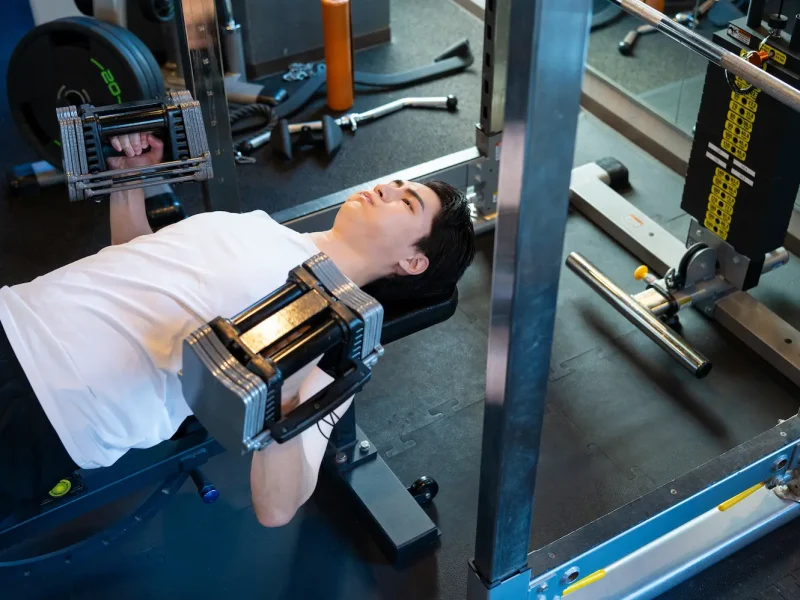
- Incline dumbbell press. Two dumbbells. Greater range of motion, exposes asymmetries. Often the better choice for hypertrophy.
- Low-incline bench press (15-25°). Shallower angle. Closer to flat but still hits upper chest. Useful for beginners.
- High-incline bench press (50-60°). Steeper angle. More front-delt emphasis. Bridge to overhead press patterns.
- Smith machine incline press. Fixed bar path. Useful for safety on heavy sets without a spotter.
- Close-grip incline bench press. Hands shoulder-width. More triceps emphasis on an incline plane.
- Incline press machine. Plate-loaded or selectorised. Good for high-volume work.
Sample workout: 4-week upper chest block
Incline bench once or twice per week. If you also flat bench, do flat first, incline second. If you only have one chest day, do incline as the primary.
| Week | Sets × reps | Intensity | RPE |
|---|---|---|---|
| 1 | 3 × 8 | 65 % 1RM | 6-7 |
| 2 | 4 × 6 | 72 % | 7 |
| 3 | 5 × 5 | 78 % | 8 |
| 4 (deload) | 3 × 5 | 65 % | 6 |
Frequently asked questions
Incline bench or flat bench — which should I prioritise?
Both. Flat bench builds total chest mass and is the heavier lift. Incline targets the upper chest specifically. Most balanced programs include both, often on different days. If you can only do one, choose flat bench as your primary; if you have aesthetic goals (upper chest), prioritise incline.
What angle is best?
30° for most lifters. 45° if you want more shoulder involvement. Above 60° you’re basically doing an overhead press at a strange angle — skip it.
How heavy should I incline bench compared to flat?
Most lifters incline 80-85 % of their flat bench. If you flat bench 100 kg for 5, expect to incline 80-85 kg for 5. Don’t expect parity.
Why do my shoulders hurt during incline?
Either the angle is too steep (50°+ puts more strain on the front delt) or your bar path is too vertical. Try a 30° angle and lower the bar to the upper chest, not the throat.
Incline barbell or incline dumbbell?
Both. Barbell allows heavier loads and is the strength lift. Dumbbells allow greater range of motion and better for hypertrophy. Many programs alternate them across blocks.
Related exercises
- Bench Press: foundational flat-angle pressing
- Incline Dumbbell Press: dumbbell variant, more ROM
- Decline Bench Press: lower-chest emphasis
- Dumbbell Bench Press: flat dumbbell variant
- Dips: bodyweight chest complement