
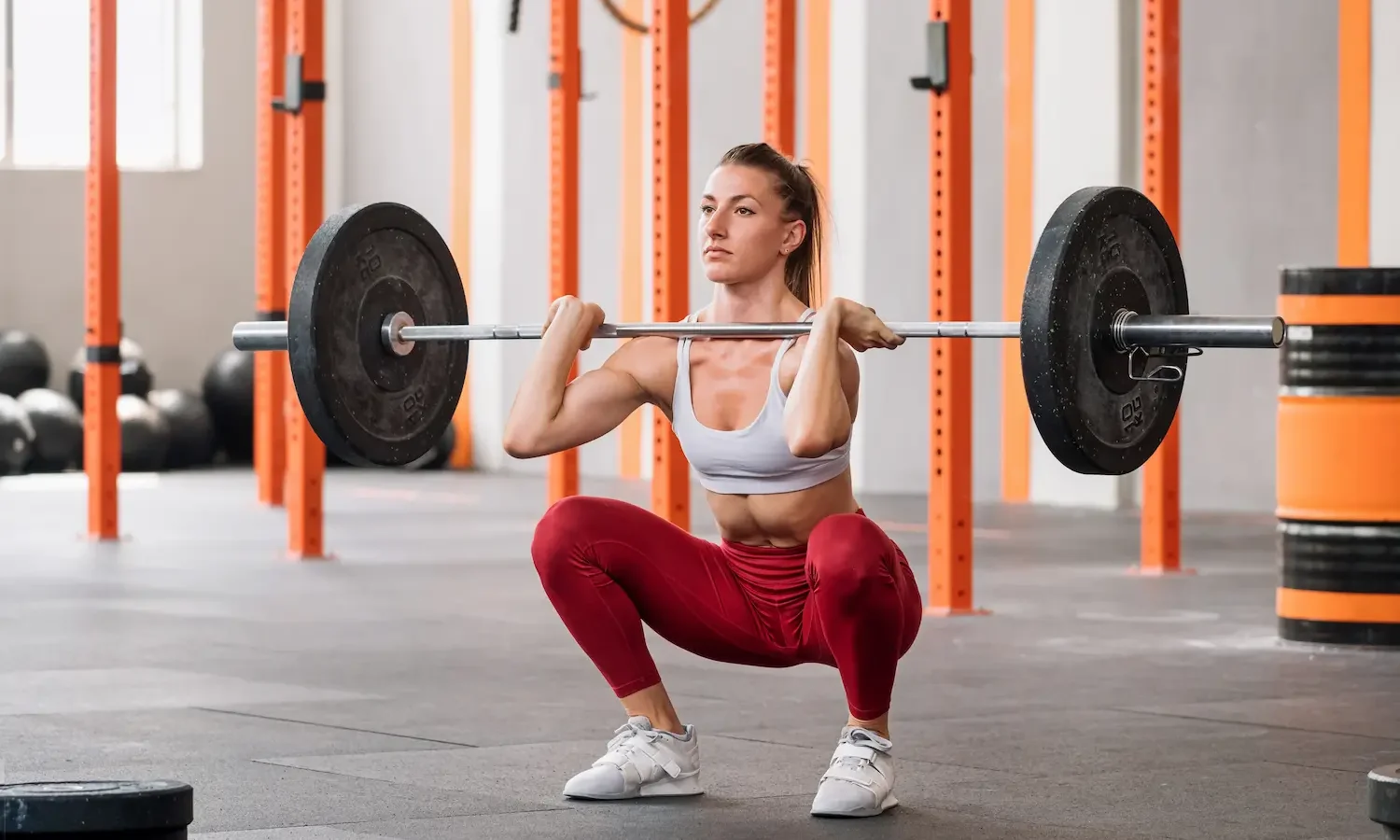
The front squat is the squat for people who want bigger quads and a more upright torso. By moving the bar from the back of the shoulders to the front of the shoulders, the front squat forces the body into a more vertical squat — which means more knee flexion, more quad activation, and less posterior chain involvement.
It’s also more humbling than the back squat. Most lifters can front squat about 70-85 % of their back squat for the same reps. The bar is held in a less stable position, the wrists and shoulders need decent mobility, and the upper back has to stay rigid throughout. Get it wrong and the bar simply rolls off your shoulders.
What is the front squat?
The front squat is a bilateral squat performed with the barbell racked across the front of the shoulders, in the “front rack” position. From this position you squat down to depth and stand back up. The forward bar position forces a more upright torso than the back squat, biasing the work toward the quads.
Two grip variants exist: the clean grip (used in Olympic weightlifting — fingertips under the bar, elbows pointing forward) and the cross-arm grip (arms crossed, hands on top of the bar). Clean grip is more secure but demands wrist mobility; cross-arm is more accessible but the bar can slip.
Muscles worked
| Muscle group | Role | Contribution |
|---|---|---|
| Quadriceps | Primary mover, knee extension | ~55 % |
| Glutes | Hip extension | ~25 % |
| Upper back · Core | Holding the front rack position | ~15 % |
| Hamstrings · Calves | Stabilisation | ~5 % |
Compared to the back squat, the front squat shifts ~15 % of the load away from the posterior chain (glutes, hamstrings) and toward the quads. The upper back works as hard as in any other lift to keep the bar from rolling forward.
How to front squat: 5 steps
-
Set up the front rack
Bar in the rack at upper-chest height. Step under, place the bar on the front of the shoulders (the shelf at the front delts). Clean grip: hands just outside shoulder width, fingertips under the bar, elbows pointed forward and high. Cross-arm grip: arms crossed, hands on top of the bar.
-
Set the stance and unrack
Lift the bar off the rack with elbows up. Take 2-3 controlled steps backward. Feet shoulder-width to slightly wider, toes turned out 15-30°. **Elbows stay high** throughout the entire lift.
-
Brace and descend
Deep breath into the belly, brace the core. Initiate the descent by breaking at the hips and knees together. Sit straight down (not back like a back squat). Torso stays as upright as possible — that's the whole point.
-
Hit depth
Descend until **hip crease drops below the top of the knee**. Don't round the lower back. Brief turnaround at the bottom — no bounce. **Elbows up, chest up.**
-
Stand back up
Drive through the whole foot. Lead with the chest and elbows — keep them pointing up. Lock out hips and knees at the top. Reset breath, repeat.
Common mistakes to avoid
Front squat variations
- Cross-arm front squat. Arms crossed, hands on top of the bar. More accessible than clean grip but bar can slip more easily.
- Zercher squat. Bar held in the crook of the elbows. The most extreme front-loaded squat. Brutal on the upper back.
- Paused front squat. 2-3 second pause at the bottom. Olympic weightlifting accessory.
- Heels-elevated front squat. Heels on small plates. Even more quad emphasis. Useful for those with limited ankle mobility.
- Safety bar squat. Specialty bar that combines back squat position with front squat-like quad emphasis. Good for those with shoulder/wrist mobility issues.
- Back squat. The bilateral compound counterpart — heavier loads, more posterior chain.
Sample workout: 4-week quad block
Front squats once or twice per week. Pair with back squats on alternate days, OR replace back squats entirely if quad emphasis is the goal.
| Week | Sets × reps | Intensity | RPE |
|---|---|---|---|
| 1 | 3 × 8 | 65 % 1RM | 7 |
| 2 | 4 × 6 | 72 % | 7-8 |
| 3 | 5 × 5 | 78 % | 8 |
| 4 (deload) | 3 × 5 | 65 % | 6 |
Frequently asked questions
Front squat or back squat?
Both. Back squat for total leg mass and absolute strength; front squat for quad emphasis, more upright posture, and Olympic-style transfer. Most balanced programs include both, often in different blocks.
How much should I front squat compared to my back squat?
About 70-85 %. If you back squat 100 kg for 5, expect to front squat 70-85 kg for 5. The lift is harder per kilo because the bar position is less stable and the upper back has to work harder.
My wrists hurt during the front rack — what should I do?
Front rack mobility takes time. Daily wrist mobility drills (wall push-ups with palm flat, fingertip stretches, wrist circles) usually unlock it within 4-6 weeks. In the meantime, use the cross-arm grip — it doesn’t require wrist flexibility.
Why does my upper back round during front squats?
Either insufficient upper-back strength, or the bar is too heavy. Reduce the load and focus on keeping the elbows high through the entire rep — this fights the rounding tendency.
Can beginners front squat?
Better to master the back squat first. The front squat demands wrist, shoulder and ankle mobility that most beginners haven’t developed. After 6-12 months of back squatting, add front squats as accessory work.
Related exercises
- Back Squat: bilateral primary leg lift
- Goblet Squat: dumbbell front-loaded variant
- Zercher Squat: extreme front-loaded variant
- Bulgarian Split Squat: unilateral leg work
- Leg Press: machine quad accessory