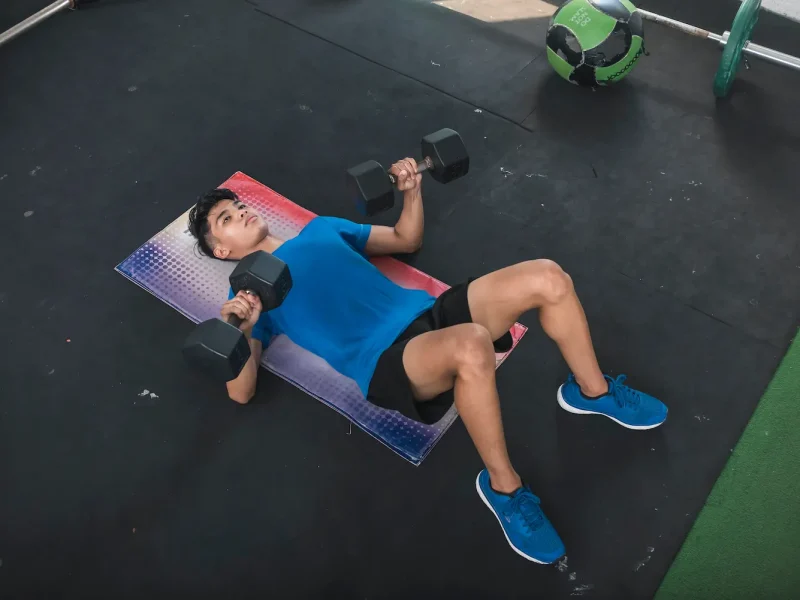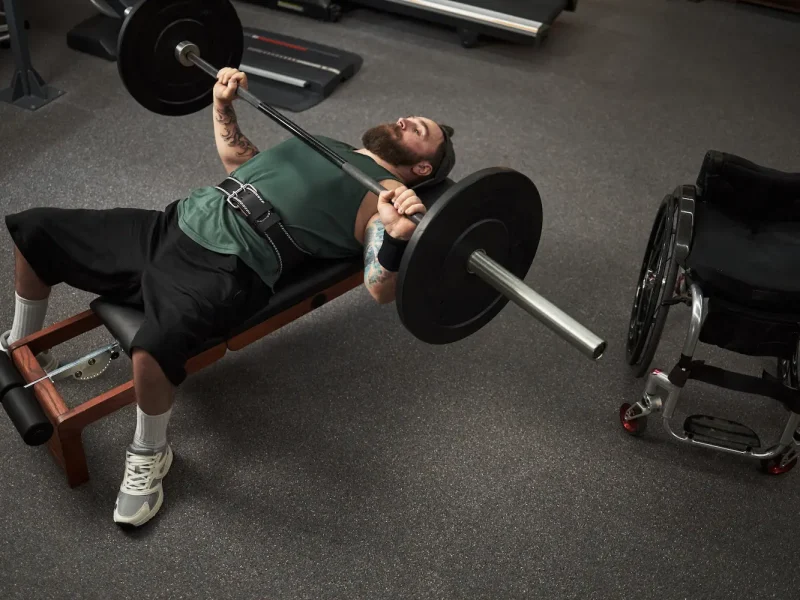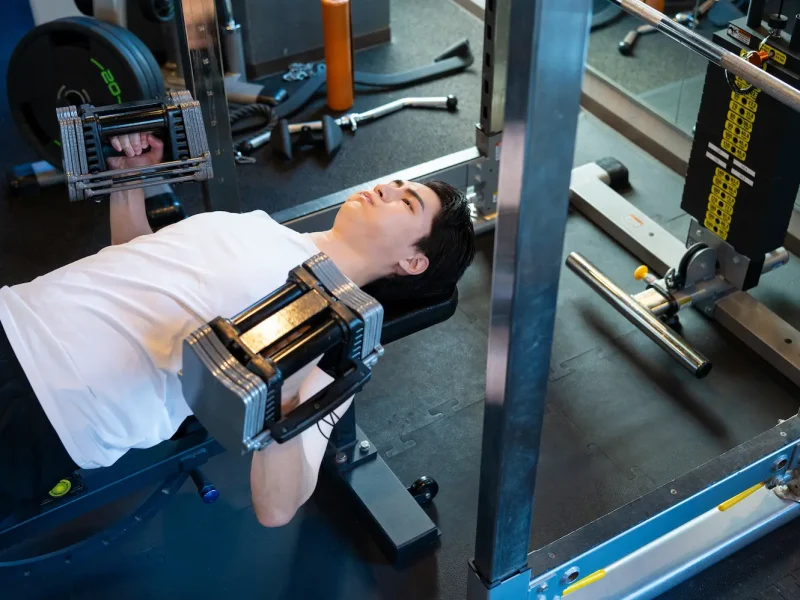

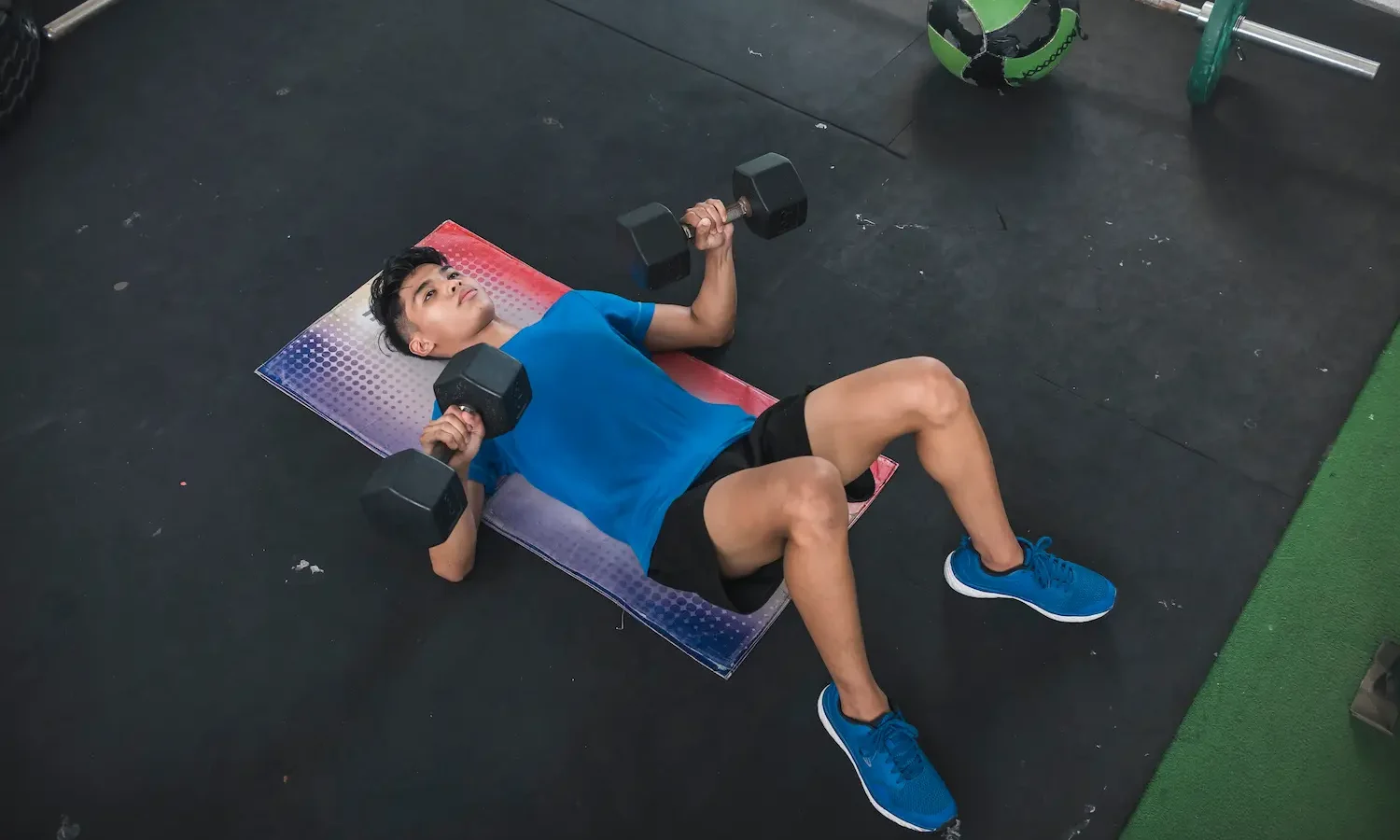
The floor press is the bench press done on the floor — no bench, the elbows resting briefly on the floor at the bottom of each rep. The limited bottom range eliminates the deepest part of the press (where shoulder discomfort usually shows up) and emphasises the lockout portion. It was the standard bench-style press in the 1890s before the bench existed; today, it’s a smart accessory for triceps emphasis and shoulder-friendly pressing.
What it is
The floor press is a chest pressing exercise performed lying on the floor with a barbell (or dumbbells). The bar is lowered until the back of the upper arms touches the floor — at that point, the elbows are at roughly 90° and the bar is paused briefly. From the dead-stop floor position, the bar is pressed back up to lockout. Range is about 75-80 % of a full bench press; the bottom stretch is cut off.
Muscles worked
| Muscle | Contribution |
|---|---|
| Triceps brachii | ~35 % |
| Pectoralis major | ~35 % |
| Anterior deltoid | ~15 % |
| Lats, traps, core | ~15 % |
How to floor press: 5 steps
-
Set up on the floor
Lie supine on the floor with the barbell directly above the chest in a power rack (with the safety pins set just above floor-arm level). Grip just outside shoulder-width. Legs either flat on the floor or bent at the knees.
-
Unrack and set position
**Retract scapulae**, brace the core. Press the bar off the pins to set the start position above the chest. Slight gap between back and floor at the lumbar curve.
-
Lower until upper arms touch the floor
Lower the bar in 2-3 seconds. **Stop when the back of the upper arms touches the floor** — at this point the elbows are at roughly 90°. Don't crash; control the contact.
-
Pause briefly on the floor
**1-2 second pause** with the upper arms resting on the floor. Maintain shoulder retraction. Don't bounce the bar off the floor.
-
Press up to lockout
**Drive the bar straight up** to full elbow extension. Lock out, reset the brace, lower for the next rep. Triceps fire hard here.
How it differs from bench press
- Limited range. Range stops when the upper arms hit the floor — about 75-80 % of full bench ROM. The deepest, most shoulder-stressful portion is eliminated.
- More triceps. The limited range emphasises the lockout half of the press, where the triceps do most of the work.
- No leg drive. Legs lie flat on the floor (or bent at 90°) — no driving foot pressure available, so the upper body has to do all the work.
- Shoulder-friendly. Skipping the bottom range protects shoulders from the position where impingement typically occurs.
Common mistakes
When to use this variation
Use the floor press when your bench press lockout is the weak point, or when shoulder discomfort prevents heavy bench pressing through full range. It’s also an excellent accessory for raw and equipped powerlifters whose touch-point varies; the floor press isolates the top half of the lift.
FAQ
Floor press or close-grip bench for triceps?
Both work. Close-grip bench uses grip width to emphasise triceps through full ROM. Floor press uses range limitation. For pure lockout strength, floor press wins. For overall triceps mass, close-grip.
How heavy should I floor press?
Most lifters can floor press about 85-90 % of their full bench 1RM for the same reps — the limited range allows slightly more load than full ROM.
Should I pause on the floor?
Yes — a 1-2 second pause when the upper arms touch the floor. Without the pause it becomes a bouncing motion that uses the floor to “rebound” the bar up — defeats the strict purpose.
Related exercises
- Bench Press: full-ROM standard
- Dumbbell Floor Press: DB version
- Close-Grip Bench Press: triceps emphasis
- Board Press: limited-range bench variant