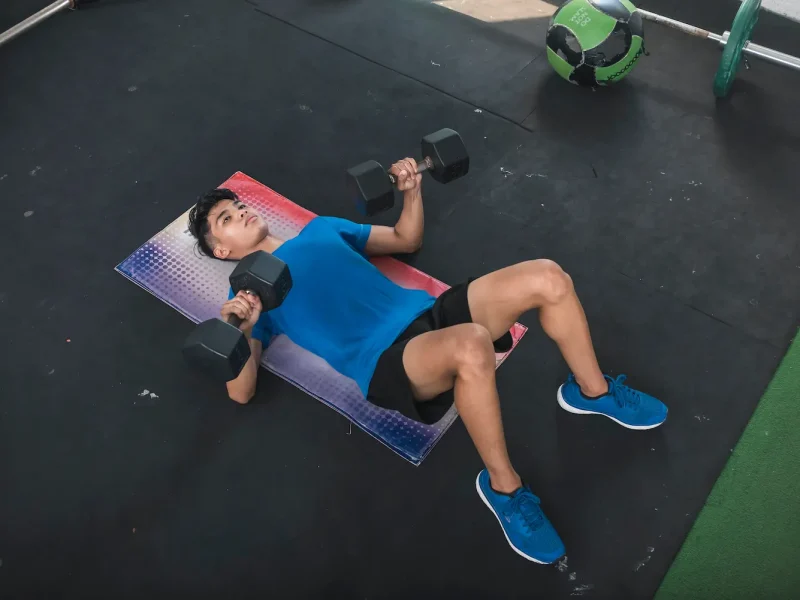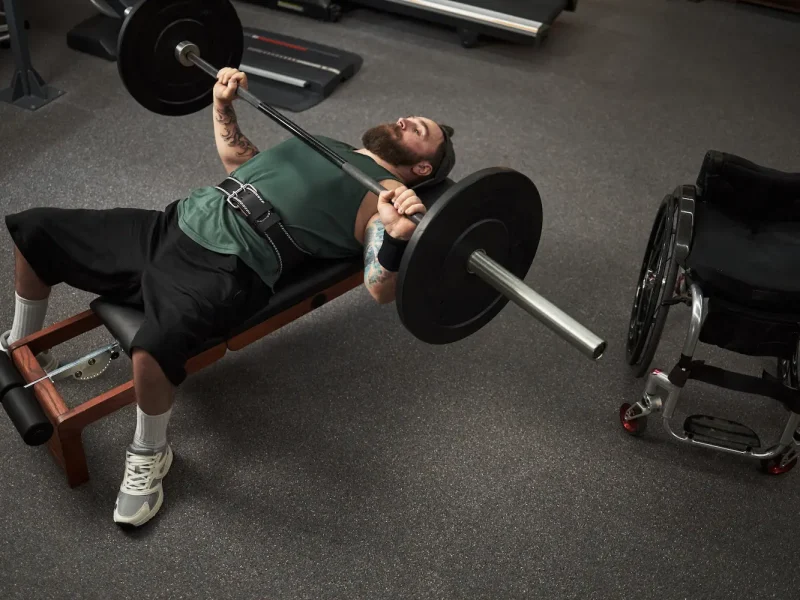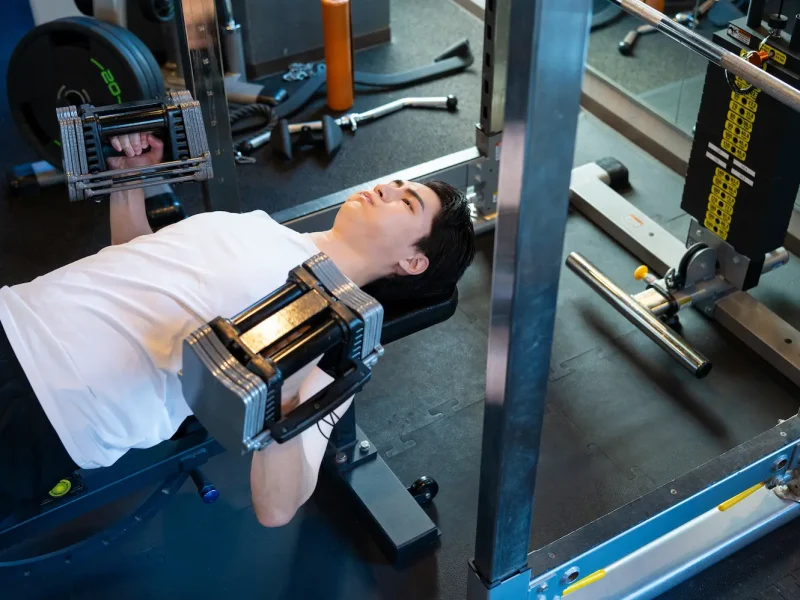

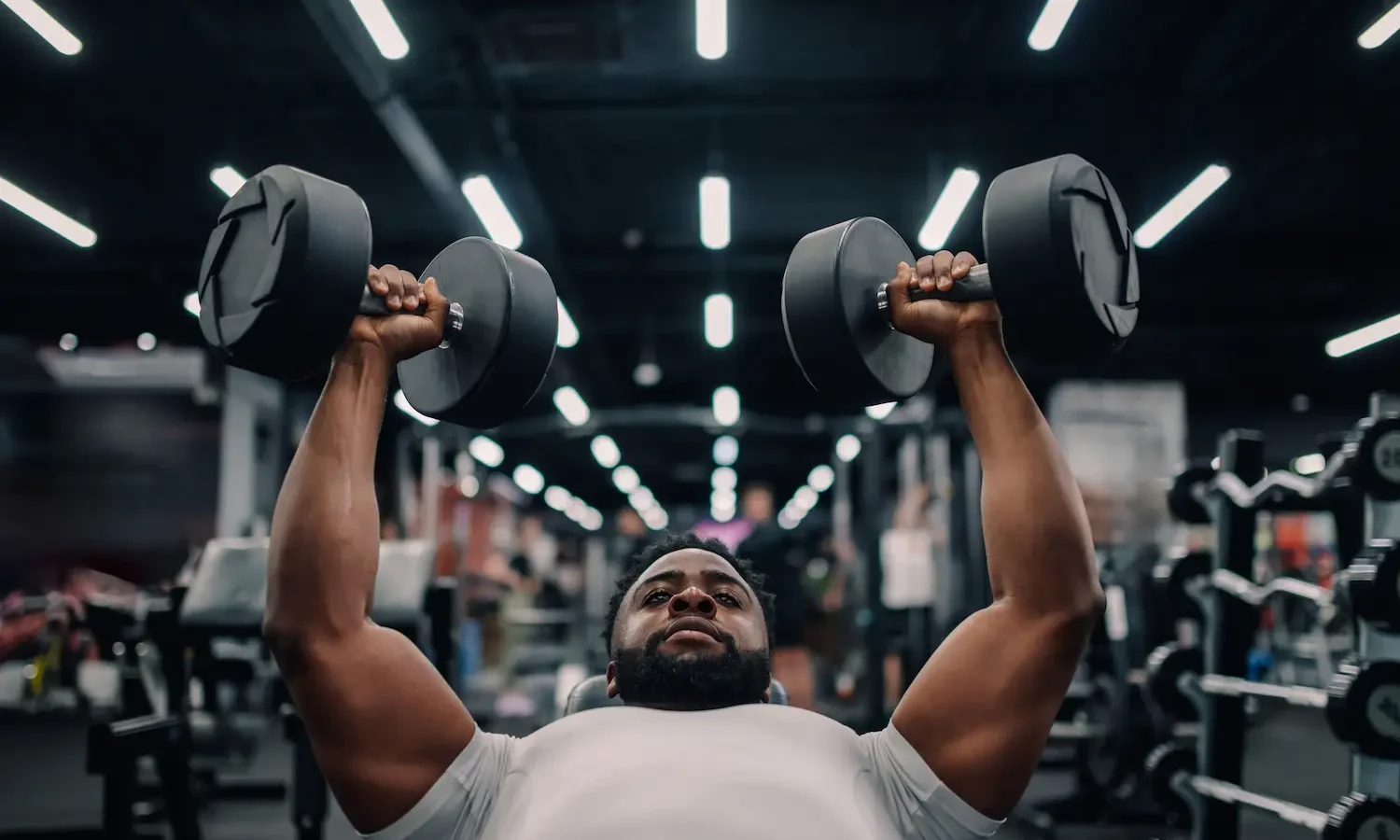
The dumbbell bench press is the dumbbell version of the barbell bench press — same pressing pattern, but with independent dumbbells in each hand instead of a fixed bar. The free-hand path lets the chest go through a deeper stretch, forces both sides to do equal work, and removes the bar-pressing-against-the-chest depth limit.
For lifters with shoulder discomfort on barbell bench, asymmetric pressing strength, or just wanting more chest stretch, the dumbbell bench is often the better main pressing exercise.
What it is
The dumbbell bench press is a chest compound performed lying on a flat bench, a dumbbell in each hand pressed from chest height to overhead lockout. Unlike the barbell version, the dumbbells move independently — each side bears its own load, and the bottom position allows a deeper chest stretch.
Muscles worked
| Muscle | Contribution |
|---|---|
| Pectoralis major (sternal head) | ~50 % |
| Anterior deltoid | ~20 % |
| Triceps brachii | ~20 % |
| Stabilisers (scapular, core) | ~10 % |
How to dumbbell bench press: 5 steps
-
Get the dumbbells into position
Sit on the end of a flat bench with the dumbbells on your thighs. **Kick each dumbbell up to the shoulder with the thigh** as you lie back. End with both dumbbells held at shoulder height, palms facing forward.
-
Set the bench position
**Retract scapulae**, slight arch in the upper back, feet planted firmly. Dumbbells at chest level, elbows tucked at 45-60° from the torso.
-
Lower with control
Lower the dumbbells in 2-3 seconds until they reach **chest level or slightly below** (deeper stretch than barbell). Maintain shoulder retraction. **Wrists stacked over elbows.**
-
Press up explosively
**Drive both dumbbells up** in a slight arcing path — they converge slightly at the top but don't need to touch. Press until elbows are nearly locked.
-
Lock out and reset
Brief pause at the top with arms nearly extended. Lower under control for the next rep. To finish: bring dumbbells to chest, sit up safely (use legs to kick them back to the thighs).
How it differs from barbell bench press
- Deeper stretch. Dumbbells can travel below chest level — barbell stops at the chest. More pec activation at the bottom.
- Both sides work equally. No strong side carrying the weak side, as can happen with the barbell.
- More stabiliser work. Each dumbbell wants to wobble independently — the rotator cuff and scapular stabilisers fire much harder.
- Less absolute load. Most lifters dumbbell bench about 70-80 % of their barbell bench total. The setup also gets harder — pressing 40 kg dumbbells into position requires real strength.
Common mistakes
When to use this variation
Choose dumbbell bench press over the barbell version when: you have a shoulder issue with the barbell, your bench mirror shows clear left-right asymmetry, you have no spotter for heavy barbell work, or you simply want to emphasise the bottom-stretch portion of the press for chest hypertrophy. Many programs run barbell on heavy days and dumbbells on volume days — best of both.
FAQ
How much should I dumbbell bench press vs barbell bench?
Most lifters dumbbell bench 70-80 % of their barbell bench for the same reps. So a 100 kg barbell bench typically corresponds to 35-40 kg per dumbbell.
How do I get heavy dumbbells into position?
Sit on the end of the bench, dumbbells on the thighs. Kick one dumbbell up at a time using the thigh (knee drive) as the dumbbell rolls back, then lie back smoothly with both arms loaded. For very heavy loads, have a spotter hand them to you.
How low should the dumbbells go?
Until you feel a strong stretch in the chest — typically slightly below chest level. Don’t force extreme range if the shoulders complain.
Related exercises
- Bench Press: parent barbell version
- Incline Dumbbell Press: incline counterpart
- Dumbbell Floor Press: range-limited dumbbell variant
- Dumbbell Fly: chest isolation