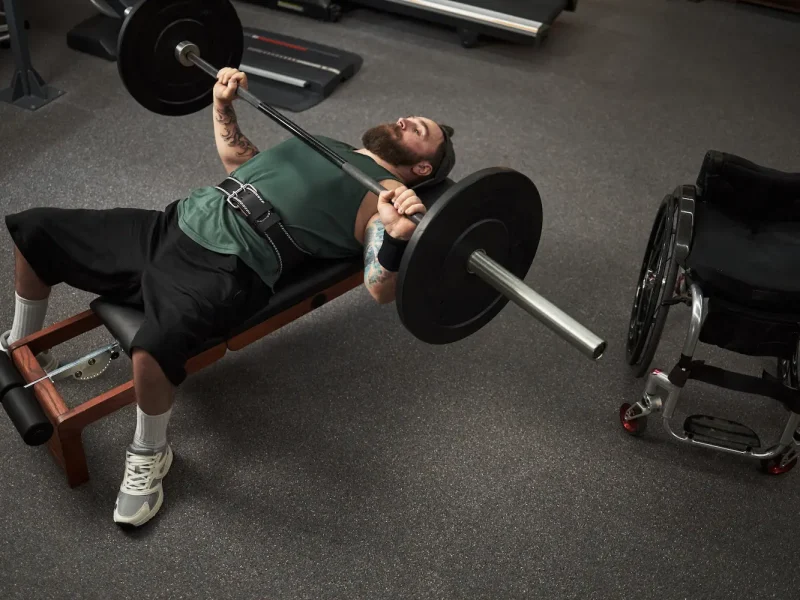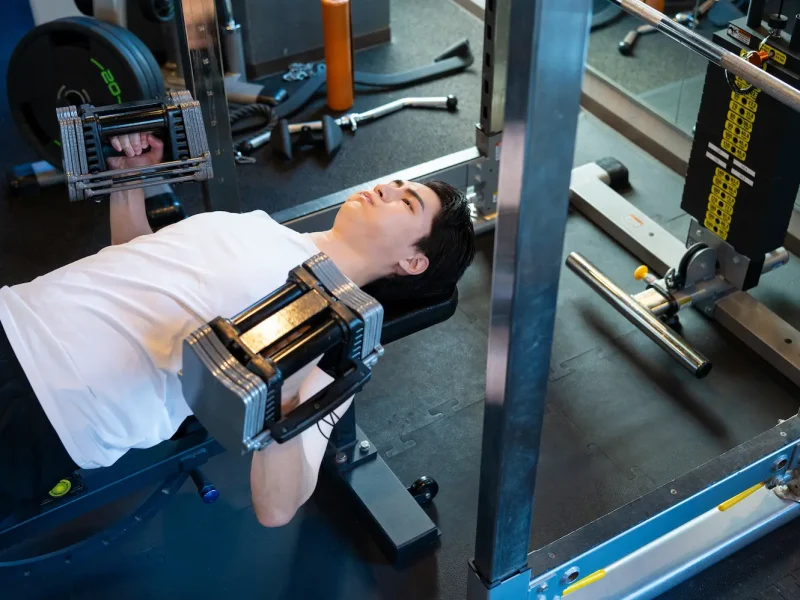


The decline bench press is the third member of the bench press family — alongside the flat bench and incline bench. Where the flat bench builds the bulk of the chest and the incline targets the upper chest, the decline targets the lower chest specifically. It’s also one of the few presses kind to the front shoulder.
The decline bench has fallen out of fashion in modern strength training because most lifters can build complete chest development with flat + incline. But for lifters with shoulder issues or specific lower-chest goals, the decline still earns its place.
What is the decline bench press?
The decline bench press is a horizontal pushing exercise performed on a bench tilted downward 15-30°, in which a barbell is lowered to the lower chest and pressed back to lockout. The decline angle shifts the work toward the lower chest fibres and reduces front-deltoid involvement compared to the flat bench.
Most lifters can decline bench press 5-10 % more than their flat bench because the reduced ROM and less shoulder demand make it mechanically easier per kilo. That said, getting in and out of the decline position safely is a real consideration — always use a spotter on heavy decline sets.
Muscles worked
| Muscle group | Role | Contribution |
|---|---|---|
| Pectoralis major (lower / sternal head) | Primary mover | ~60 % |
| Triceps brachii | Lockout | ~25 % |
| Anterior deltoid | Press initiation (less than flat bench) | ~10 % |
| Stabilisers | Bar control | ~5 % |
The decline angle reduces front-deltoid involvement compared to the flat or incline bench. For lifters with shoulder pain on regular bench, the decline is often the friendliest pressing variation. The cost: you don’t get the full chest activation that flat and incline benches provide.
How to decline bench press: 5 steps
-
Set up the bench
Adjust the bench to 15-30° below horizontal. Lock your feet under the leg pads. Lie back carefully — the inverted position can feel disorienting at first.
-
Set the upper back and grip
Pull shoulder blades together and down. Grip the bar slightly wider than shoulder width. Wrists stacked over forearms. Take a deep breath, brace the core. Have a spotter help unrack on heavy sets.
-
Lower to the lower chest
Bring the bar to the lower chest (around the bottom of the sternum or upper abs). **Elbows tucked at 45-60° from torso** — not flared. Controlled 2-second descent.
-
Touch and press
Touch the bar to the chest gently — no bouncing. Drive the bar up and slightly back toward the rack pillars. **Soft lockout** at the top.
-
Reset and continue
Half-second hold at the top. Reset breath. Don't exit the inverted position too quickly between sets — sit up slowly to avoid lightheadedness.
Common mistakes to avoid
Variations
- Decline dumbbell press. Two dumbbells. Greater range of motion at the bottom, asymmetry-fixing.
- Decline dumbbell fly. Same angle, fly motion. Pure lower-chest stretch isolation.
- Decline push-up. Bodyweight version — feet elevated, hands on floor. Easier setup, similar muscle target.
- Dips. Bodyweight compound that hits the lower chest hard. Often a better lower-chest option than the decline bench.
- Bench press. Foundational flat-angle compound.
- Incline bench press. Upper-chest counterpart.
Sample workout: 4-week lower-chest block
Decline bench once per week, after main flat bench work. Or as the primary chest lift on alternate sessions for variety.
| Week | Sets × reps | Intensity |
|---|---|---|
| 1 | 3 × 8 | 65 % 1RM |
| 2 | 4 × 6 | 72 % |
| 3 | 5 × 5 | 78 % |
| 4 (deload) | 3 × 5 | 65 % |
Frequently asked questions
Decline bench or dips?
Both target the lower chest. Dips are bodyweight, more functional, and often produce better hypertrophy. Decline bench allows heavier loading. If you can do dips well, prioritise them. If shoulder mobility limits dips, decline bench is the alternative.
Do I need decline if I do flat and incline?
Probably not. The flat bench already trains the lower chest as part of its broader pec activation. Most balanced programs include flat + incline + dips, skipping the decline. Add decline only if the lower chest specifically lags or shoulder issues prevent flat benching.
What angle should the bench be?</h3
15-30° below horizontal. Steeper angles aren’t more effective and make getting in/out awkward. 15° is mild; 30° is the lower limit that still feels like a bench press.
How heavy can I decline bench compared to flat?</h3
5-10 % more than flat bench, typically. Most lifters use the decline as a heavy variation — slightly more weight, slightly less ROM than flat.
Why does my head feel weird during decline?</h3
Blood pressure to the head increases when you’re inverted (or partially inverted). Take it slow on the first set, sit up between sets, and don’t hold breath excessively. If you have blood pressure issues, skip the decline entirely.
Related exercises
- Bench Press: foundational flat compound
- Incline Bench Press: upper-chest counterpart
- Dips: bodyweight lower-chest builder
- Decline Dumbbell Press: dumbbell variant
- Pec Deck: chest isolation machine
Published by: Jay — Writer covering chest exercises
Reviewed, corrected and approved by: Martin Wood — Editor-in-chief
Updated on May 10, 2026