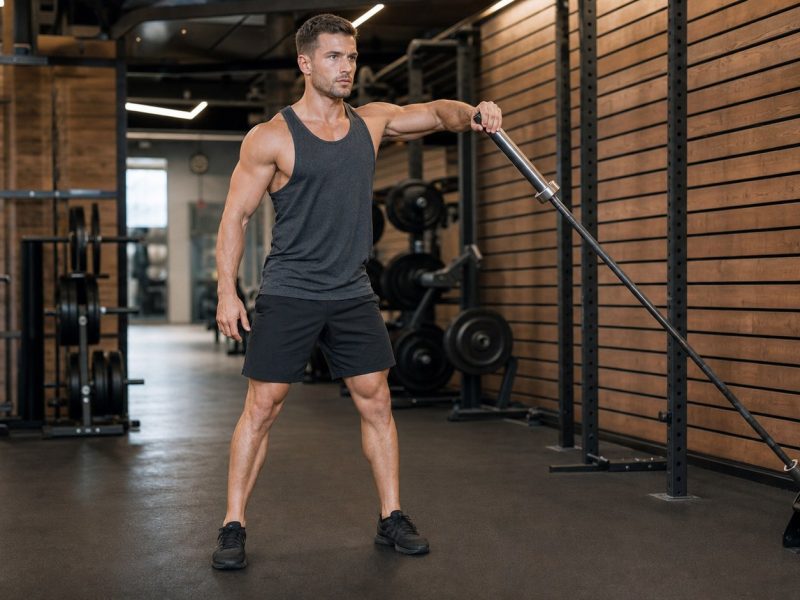


The cable front raise is the cable version of the dumbbell front raise — and a clear upgrade. Where dumbbells lose almost all tension at the top of the rep, the cable keeps the front deltoid loaded through the entire range of motion. For lifters who feel their dumbbell front raises “lose it” at the top, the cable variant is the fix.
It’s a direct anterior deltoid isolation: shoulder flexion against constant resistance, no biceps cheating, no rebound from gravity. This guide covers the standard single-arm cable front raise.
What is the cable front raise?
The cable front raise is a cable isolation exercise for the anterior (front) deltoid. Standing with the cable set at the lowest pulley, you grip a single-handle attachment and raise the arm straight forward and up until the hand reaches shoulder height. The cable’s constant tension makes every inch of the range count — top, bottom, and the back half of the eccentric.
For anyone doing a lot of bench pressing or overhead pressing, the anterior delts are already well-trained. The cable front raise is best used as a finisher or for lifters whose front delts genuinely lag behind their side and rear delts.
Muscles worked
| Muscle group | Role | Contribution |
|---|---|---|
| Anterior deltoid | Primary mover, shoulder flexion | ~70 % |
| Pectoralis major (clavicular) | Shoulder flexion assist | ~15 % |
| Serratus anterior | Scapular protraction | ~10 % |
| Core, traps | Stabilisation, anti-extension | ~5 % |
The cable front raise is a clean isolation. The anterior deltoid does almost all the work, with the upper chest assisting. Compared to dumbbells, the cable keeps tension constant — better for hypertrophy in the top half of the range.
How to cable front raise: 5 steps
-
Set up the cable
Attach a single-handle to the lowest pulley setting. Stand with your back to the cable column, about 50-70 cm away. Grip the handle in one hand (working arm), arm fully extended down beside you, palm facing the thigh.
-
Set the body position
Feet shoulder-width, slight knee bend, **brace the core hard**. The cable should pull behind you with mild tension at the start. Free hand at the hip or holding the frame for stability.
-
Raise the arm with control
**Lift the arm straight forward and up** in 2 seconds. Elbow stays at the same slight bend (~15°). Hand travels from beside the thigh to **shoulder height** in front of you. Lead with the front delt — don't swing.
-
Pause and squeeze at the top
1-second pause at shoulder height. **Squeeze the anterior delt** at peak contraction. Body remains upright, no leaning back.
-
Lower with control
Lower the arm in 3 seconds back to the starting position. **Maintain tension on the cable throughout** — don't let it slack. Reset, repeat. Switch arms after the set.
Common mistakes to avoid
Variations
- Two-arm cable front raise. Using a straight bar attachment, both arms raise together. Heavier load possible.
- Rope cable front raise. Rope attachment, hands rotating internally at the top. Greater peak tension.
- Crossover cable front raise. Cable from the opposite-side low pulley, arm crosses the body. Targets the deltoid from a different angle.
- Incline cable front raise. Lying back on a low-incline bench. Removes lower-back cheating, extra strict.
- Dumbbell front raise. The free-weight version.
- Cable lateral raise. Side-delt counterpart.
Sample workout: 4-week front-delt block
Cable front raises 1-2 times per week. As an accessory, after main pressing. Reps moderate-to-high, load moderate. Form > weight.
| Week | Sets × reps | Tempo |
|---|---|---|
| 1 | 3 × 12 per arm | 2 sec up + 2 sec down |
| 2 | 3 × 15 per arm | 2 sec up + 3 sec down |
| 3 | 4 × 10 per arm | 1 sec up + 3 sec down + 1 sec squeeze |
| 4 (deload) | 3 × 12 per arm | Smooth |
Frequently asked questions
Cable or dumbbell front raise?
Cable wins for constant tension and top-of-range loading. Dumbbell is more accessible but tension drops at the top. Choose cable if your dumbbell raises feel “easy” at the top half. Choose dumbbell if you don’t have access to a cable stack.
Do I even need direct front-delt work?</h3
Most lifters don’t. The anterior delt is heavily worked by all bench press and overhead press variations. Add direct front-delt work only if it genuinely lags behind your lateral and rear delts. Otherwise prioritise side delts and rear delts.
How high should I raise?</h3
Hand to shoulder-height — about 90° of shoulder flexion. Going higher recruits more upper traps and reduces anterior-delt tension. Stop at horizontal for maximum delt focus.
Should the elbow be straight or slightly bent?</h3
Slightly bent — about 15-20° at the elbow throughout. Locked-out elbow puts unnecessary stress on the joint. Maintain the same bend from start to finish.
Why do I feel it in my biceps?</h3
Either you’re bending the elbow during the rep (cheating) or gripping too hard. The elbow stays at a fixed slight bend, the grip stays neutral. If biceps still take over, lower the load.
Related exercises
- Lateral Raise: side-delt counterpart
- Cable Lateral Raise: cable side-delt
- Overhead Press: compound shoulder builder
- Face Pull: rear-delt complement
- Reverse Pec Deck: rear-delt machine