
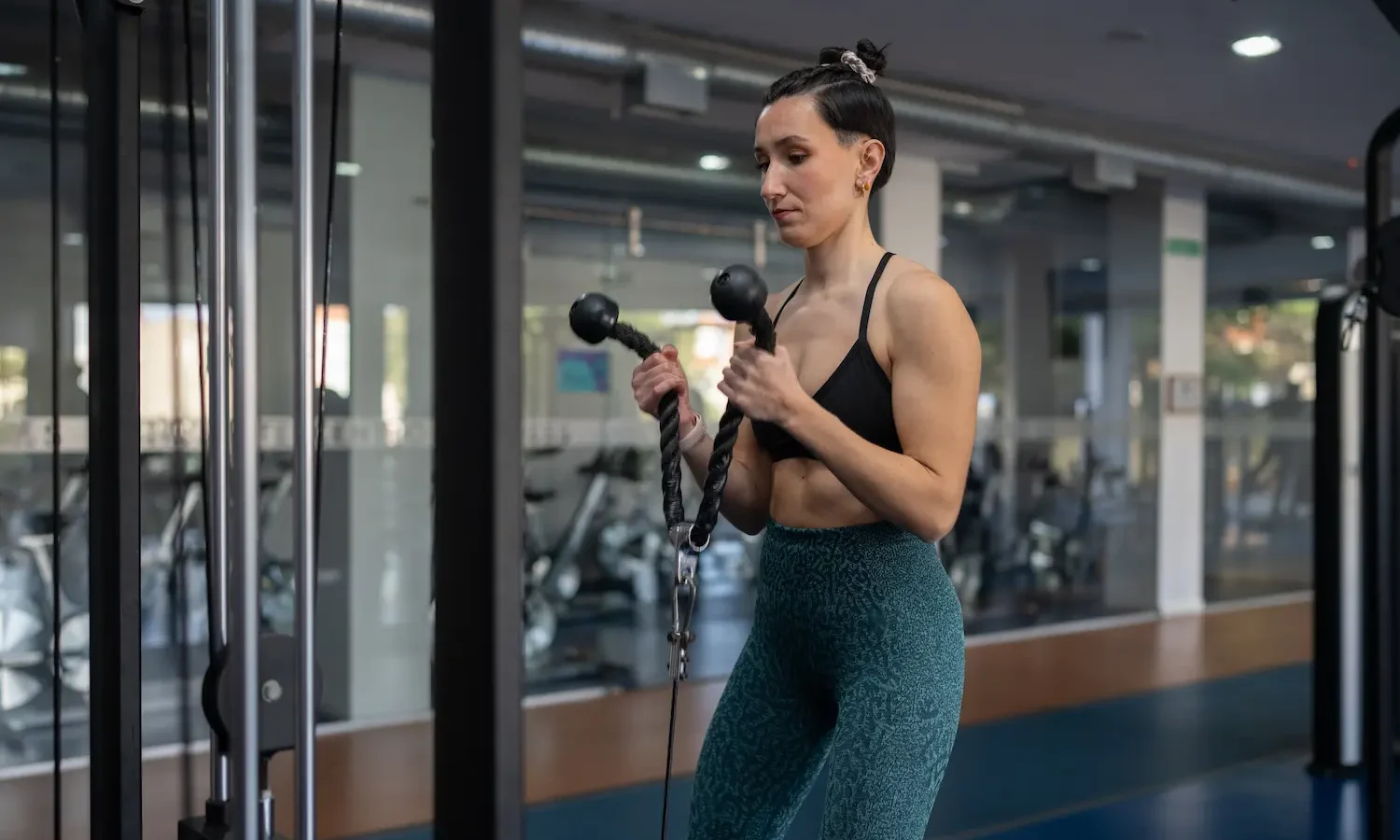
The cable curl is the dumbbell curl’s better-tension cousin. Where the dumbbell curl loses tension at the top of the rep (the dumbbell rests on bone), the cable curl maintains constant resistance through the entire range. For pure biceps hypertrophy, that’s a significant edge.
This guide covers the standard standing cable curl with a straight bar attachment. Variations with rope, EZ bar, or single-arm D-handle exist and are covered at the end.
What is the cable curl?
The cable curl is an isolation exercise for the biceps performed at a low cable machine, in which you grip a bar attachment with both hands palms up and curl it toward your shoulders by bending the elbows. The cable provides constant tension throughout the range — unlike free weights, which lose load at certain angles.
The cable curl is best used as a hypertrophy finisher after compound back work and a few sets of dumbbell curls. It’s not meant to replace the dumbbell curl — it complements it.
Muscles worked
| Muscle group | Role | Contribution |
|---|---|---|
| Biceps brachii (long + short heads) | Primary mover, elbow flexion | ~75 % |
| Brachialis | Elbow flexion (under biceps) | ~15 % |
| Brachioradialis (forearm) | Forearm flexion | ~10 % |
The supinated grip and constant cable tension hit the biceps brachii harder than most variations. The brachialis and brachioradialis assist but contribute less than in hammer curls.
How to cable curl: 5 steps
-
Set up at the low cable
Stand facing a low cable with a straight bar attachment. Grip with both hands shoulder-width apart, palms up. Step back so the cable is taut at the start. Stand tall, slight bend in the knees.
-
Set the elbow position
Pull shoulder blades back. **Elbows pinned to your ribs** throughout — they do not drift forward, backward or out. Slight bend already at the start (cable should already have tension).
-
Curl up with intent
Bend the elbows to lift the bar toward your shoulders. **Squeeze the biceps hard** at the top. Stop near the front of the shoulders — peak contraction.
-
Pause at the top
Half-second pause, biceps fully contracted. No bouncing.
-
Lower in 2-3 seconds
Controlled eccentric. Fully extend the arms at the bottom. Don't let the cable yank your hands down — control the descent.
Common mistakes to avoid
Variations
- Rope cable curl. Rope handle. Allows palms to spread at the top for stronger contraction.
- Single-arm cable curl. One arm at a time with D-handle. Mind-muscle focus, asymmetry-fixing.
- Cable hammer curl. Rope handle, neutral grip. Hits brachialis with constant tension.
- High cable curl. Cable set high, arms out to the sides. Bias the long head of the biceps.
- Lying cable curl. Lying flat on the floor, cable from a low pulley. Eliminates body English entirely.
- Dumbbell curl. Free-weight equivalent — different load curve.
Sample workout: 4-week biceps block
Cable curls 2 times per week, after compound back work or main biceps lift.
| Week | Sets × reps | Tempo |
|---|---|---|
| 1 | 3 × 12 | 2 sec eccentric |
| 2 | 4 × 10 | 3 sec eccentric |
| 3 | 4 × 10 + 1 dropset | 3 sec eccentric + 1 sec pause at top |
| 4 (deload) | 3 × 10 | Smooth |
Frequently asked questions
Cable curl or dumbbell curl?
Both. Dumbbells allow heavier loads and free-weight stabilisation. Cable provides constant tension throughout the range. Most balanced biceps programs include both.
How heavy should I cable curl?
For a healthy male intermediate: 25-40 kg on the cable for 10 strict reps. For females: 12-20 kg. The right load lets you do strict reps without leaning back or shrugging.
Why don’t I feel my biceps during cable curls?
You’re probably leaning back or using elbow drift to help. Pin elbows to ribs, stand vertical, and slow the tempo. The mind-muscle connection improves quickly.
Should I lock out hard at the top?
Squeeze the biceps fully but don’t fight to bring the bar to the shoulders. Stop where peak contraction feels strongest — usually around 90° elbow flexion.
Can I do cable curls every day?
Light volume yes, heavy training no. Twice a week with hard work + a third light session is the sweet spot. More than that and the biceps don’t recover.
Related exercises
- Dumbbell Curl: free-weight foundational
- Hammer Curl: brachialis emphasis
- Preacher Curl: bottom-range biceps
- Concentration Curl: strict isolation
- Chin-Up: bodyweight compound biceps
- Bayesian Curl: behind-the-body cable curl for long-head biceps tension.