
The cable crunch is the only ab exercise that allows real progressive overload. Where bodyweight crunches plateau quickly (you can’t add weight without holding a plate awkwardly), the cable crunch lets you stack 50-100 kg of resistance and train the abs like any other muscle group.
If you want abs that show through and produce real strength, the cable crunch deserves a place in your program. This guide covers the kneeling cable crunch — the standard variation.
What is the cable crunch?
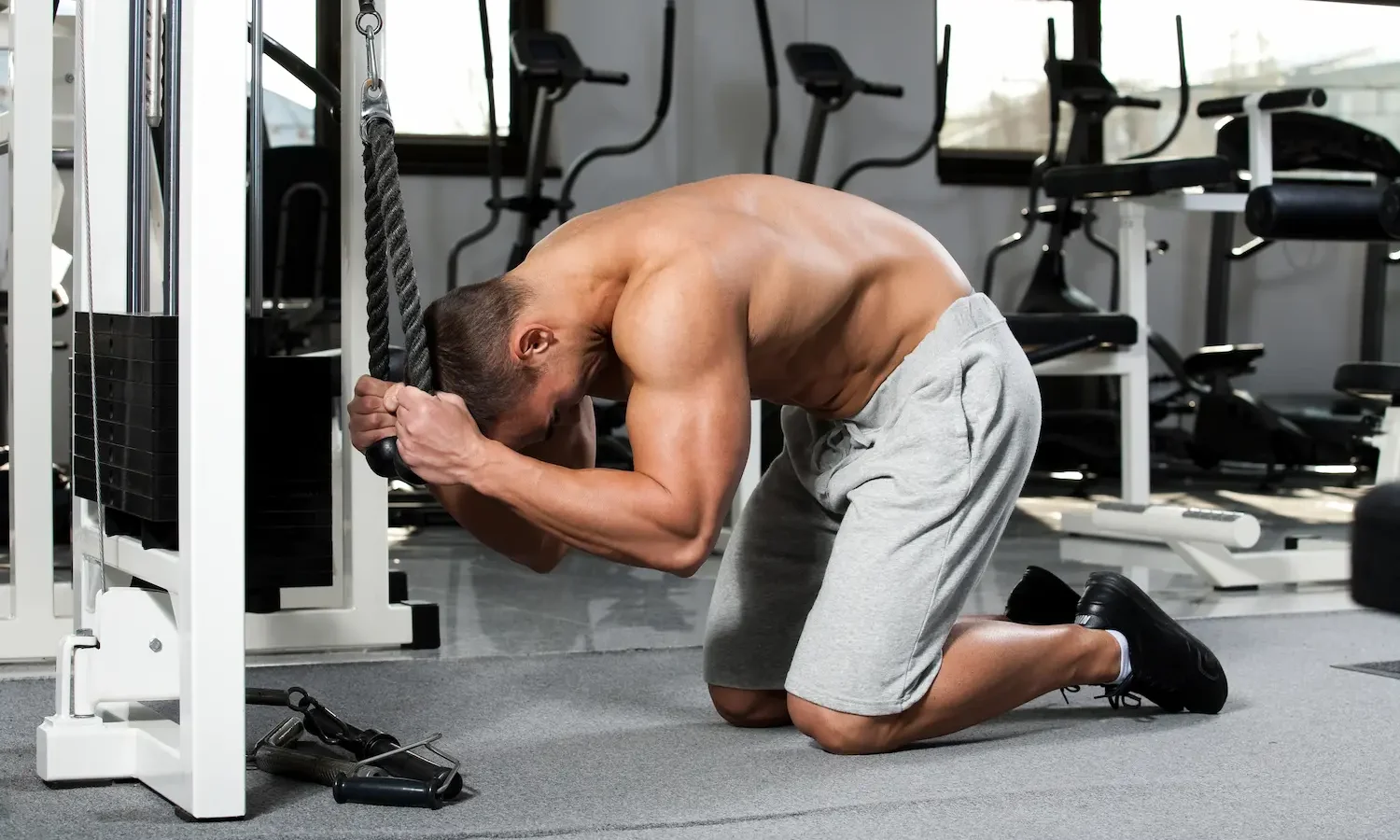
The cable crunch is a loaded ab exercise performed kneeling at a high cable machine, in which you grip a rope attachment, pull it down beside your face, and crunch forward by contracting the abs to bring the elbows toward the knees. The motion is the same as a standard crunch but inverted — the cable resists the spinal flexion.
The cable’s constant tension throughout the rep makes it superior to bodyweight crunches for hypertrophy. You can also progressively load it like any strength exercise — moving from 30 kg to 60 kg to 80 kg over months as the abs grow stronger.
Muscles worked
| Muscle group | Role | Contribution |
|---|---|---|
| Rectus abdominis | Primary mover, spinal flexion | ~75 % |
| Obliques | Stabilisation | ~15 % |
| Hip flexors | Stabilisation (more in heavy variations) | ~10 % |
Like the standard crunch, the cable crunch loads the rectus abdominis specifically. The added resistance lets you train in lower rep ranges (8-12 reps) which produces more hypertrophy than endless bodyweight reps. For visible abs, it’s the most efficient exercise.
How to cable crunch: 5 steps
-
Set up the cable
Attach a rope handle to a high cable. Kneel on the floor about 30-50 cm in front of the cable, facing the machine. Grip the rope with both hands and pull it down to the sides of your face — the rope ends up next to your ears.
-
Set the start position
Knees on a pad if available. Hips slightly hinged forward (not fully upright). Cable taut, rope at your ears, elbows pointing forward and slightly down. Brace the core.
-
Crunch down with the abs
**Contract the abs** to crunch your torso downward toward your knees. The motion comes from the spine flexing — not from pulling with the arms. Elbows travel down toward the knees.
-
Pause at peak contraction
1-second pause at the bottom, abs fully contracted. Don't bounce — feel the squeeze.
-
Reverse with control
Slowly reverse the motion in 2-3 seconds back to the starting position. Maintain tension on the cable throughout — don't fully relax. Reset, repeat.
Common mistakes to avoid
Variations
- Standing cable crunch. Standing, cable from a high pulley. Less common but works. Different angle.
- Oblique cable crunch. Crunch toward one side instead of straight forward. Hits the obliques.
- Single-arm cable crunch. Anti-rotation focused. Works obliques and rectus together.
- Seated cable crunch. On a bench with the cable from above. Lower-back-friendly variant.
- Bodyweight crunch. No equipment alternative. Easier to learn but plateaus fast.
- Hanging leg raise. Lower-ab focused complement.
Sample workout: 4-week ab block
Cable crunches 2-3 times per week. Pair with planks and hanging leg raises for full ab coverage.
| Week | Sets × reps | Tempo |
|---|---|---|
| 1 | 3 × 12 | 2 sec eccentric + 1 sec squeeze |
| 2 | 4 × 10 | 2 sec eccentric + 2 sec squeeze |
| 3 | 4 × 8 + 1 dropset | 3 sec eccentric + 2 sec squeeze |
| 4 (deload) | 3 × 10 | Smooth |
Frequently asked questions
Cable crunch or bodyweight crunch?
Cable crunch wins for hypertrophy and progressive overload. Bodyweight crunch wins for accessibility (no equipment). For visible abs, the cable crunch is the more efficient exercise.
How heavy should I cable crunch?</h3
Heavier than people expect. The abs are a muscle like any other and respond to progressive overload. Start with 25-40 kg and build up. Many lifters reach 60-100 kg for 10 reps over months. The right weight is what lets you do strict reps with full ROM and abs squeeze.
Why does my back hurt during cable crunches?</h3
Either you’re extending too far at the top (lower back arching) or rounding the spine excessively at the bottom. Maintain a neutral spine — abs do the work, not the back. Reduce the load and rebuild form.
Should I touch my elbows to my knees?</h3
Close, yes — full crunch range. The elbows travel toward (or just past) the knees at peak contraction. Don’t round the back excessively to force the elbows further — that’s where the back tweaks.
How often should I do cable crunches?</h3
2-3 times per week. Abs recover in 48-72 hours like any muscle. More frequency = overtraining. Pair with anti-extension work (planks) and dynamic ab work (hanging leg raises) for balance.
Related exercises
- Standard Crunch: bodyweight version
- Plank: anti-extension complement
- Hanging Leg Raise: lower-ab focus
- Side Plank: oblique work
- Russian Twist: rotational work