
The Bulgarian split squat is the lift that humbles people who think their legs are strong. It’s a single-leg squat with the rear foot elevated, and it does what no bilateral squat can do: it forces each leg to do its own work, with no help from the other side.
It’s also one of the most efficient hypertrophy exercises in the gym. Per minute spent training, the Bulgarian split squat builds quad and glute muscle as fast or faster than the barbell squat — without spinal load, without a power rack, with just two dumbbells and a bench. The trade-off: it hurts. A lot.
What is the Bulgarian split squat?
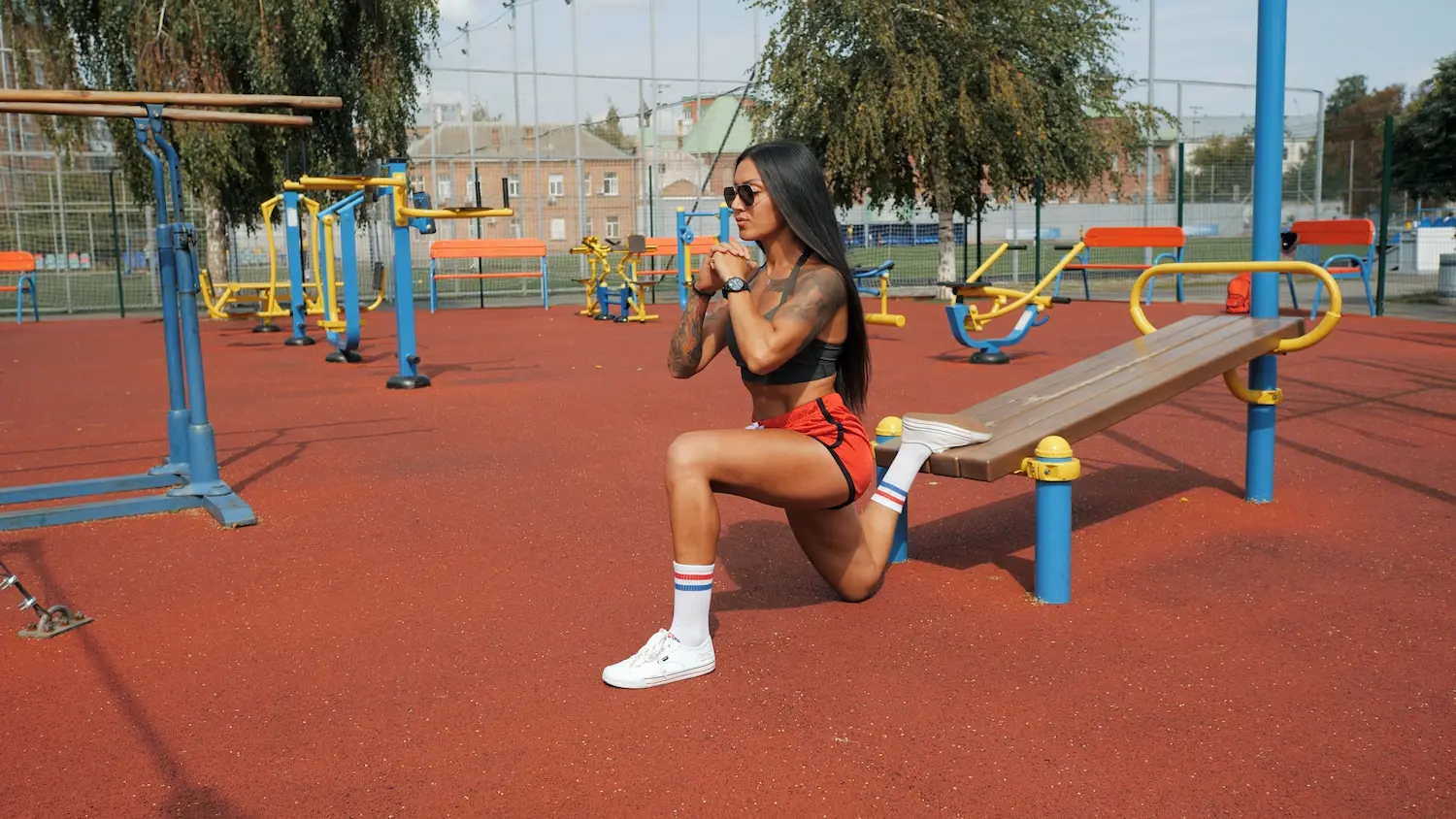
The Bulgarian split squat is a unilateral lower-body exercise in which one foot is elevated behind you on a bench (the “rear foot”), and you squat down on the front leg until the rear knee approaches the floor, then drive back up. It looks like a lunge that doesn’t move. The front leg does nearly all the work; the rear foot is mostly for balance.
It’s called “Bulgarian” because the Bulgarian Olympic weightlifting team in the 1980s reportedly used it heavily as accessory work. The name stuck. Most modern strength and physique programs include it as a primary unilateral leg exercise, alongside or in place of lunges.
Muscles worked
| Muscle group | Role | Contribution |
|---|---|---|
| Quadriceps (front leg) | Primary mover, knee extension | ~45 % |
| Glutes (front leg) | Hip extension | ~30 % |
| Hamstrings (front leg) | Hip extension support | ~10 % |
| Adductors · Calves · Core | Stabilisation, balance | ~15 % |
The exact quad/glute distribution depends on torso angle. An upright torso biases the quads. A forward lean biases the glutes. Most lifters benefit from cycling through both styles.
How to Bulgarian split squat: 5 steps
-
Set up the bench and stance
Stand with a bench (or sturdy chair) about 60-90 cm behind you. Place the top of your rear foot on the bench (laces down). Hop forward until the front foot is far enough that, at the bottom, your front shin stays vertical. Hold dumbbells at your sides.
-
Set the torso angle
Stand tall with the chest proud. For quad emphasis, stay upright. For glute emphasis, lean the torso forward 15-20°. Pick one and stay consistent.
-
Lower with control
Bend the front knee in a controlled 2-3 second descent. The rear leg follows passively (knee descends toward the floor). **Front knee tracks over the foot.** Lower until the rear knee hovers just above the floor, or until you reach a comfortable depth.
-
Pause briefly at the bottom
Half-second pause. Don't bounce off the bench with the rear knee.
-
Drive back to the top
Push through the front heel to return to the start position. Squeeze the front glute at the top. Front leg fully extended (soft lockout). Reset breath, repeat.
Common mistakes to avoid
Bulgarian split squat variations
- Dumbbell Bulgarian split squat. Two dumbbells held at your sides. Most common variation. Works up to about 25 kg per dumbbell before the grip becomes the limiting factor.
- Goblet Bulgarian split squat. Single dumbbell or kettlebell at chest level. Easier on the grip, slightly different balance demand.
- Barbell Bulgarian split squat. Bar across the upper back. Allows much heavier loads. Demanding on balance.
- Smith machine Bulgarian split squat. Fixed bar path, removes balance demand. Useful for very heavy loading or when learning.
- Deficit Bulgarian split squat. Front foot elevated on a small platform. Greater range of motion and stretch on the front leg.
- Paused Bulgarian split squat. 2-3 second pause at the bottom. Brutal hypertrophy variation.
Sample workout: 4-week unilateral leg block
Bulgarian split squats once or twice per week. Either as your primary unilateral leg work, or as an accessory to squats on heavy days.
| Week | Sets × reps/leg | RPE |
|---|---|---|
| 1 | 3 × 8 | 7 (bodyweight) |
| 2 | 3 × 8 | 7-8 (light dumbbells) |
| 3 | 4 × 6 | 8 (moderate dumbbells) |
| 4 (deload) | 3 × 6 | 6 (lighter) |
Frequently asked questions
Bulgarian split squat or lunge — which should I do?
Both. Lunges are more dynamic (stepping motion) and easier to learn. Bulgarian split squats are more focused on a single leg with a fixed position — better for hypertrophy and harder on balance. Many programs include both.
How heavy should I go?
Start with bodyweight only for at least a week. Then progress to 8-12 kg per dumbbell for 8 reps per leg. Most lifters max out around 20-25 kg per dumbbell before the grip becomes limiting — at that point, switch to barbell or goblet variations.
How far should the bench be?
Far enough that when you’re at the bottom of the rep, the front shin stays roughly vertical. Too close and the front knee shoots past the toes. Too far and you can’t reach depth without falling forward. Adjust until the bottom feels balanced.
My back leg is sore after BSS — is that normal?
Some quad stretch in the rear leg is normal. Severe pain or a feeling of “tweak” usually means the bench is too high or too far. Lower the bench (a low step works) or move it closer.
Why are Bulgarian split squats so brutal?
Because they remove all the help from the other leg. Squatting bilateral lets the strong leg compensate for the weak leg; BSS exposes the weak leg for what it is. Plus the longer time under tension on a single leg = more local fatigue per set.
Related exercises
- Squat: bilateral compound, primary leg lift
- Lunge: dynamic unilateral variant
- Step-Up: unilateral knee dominant
- Goblet Squat: bilateral with similar quad emphasis
- Single-Leg RDL: hinge counterpart