
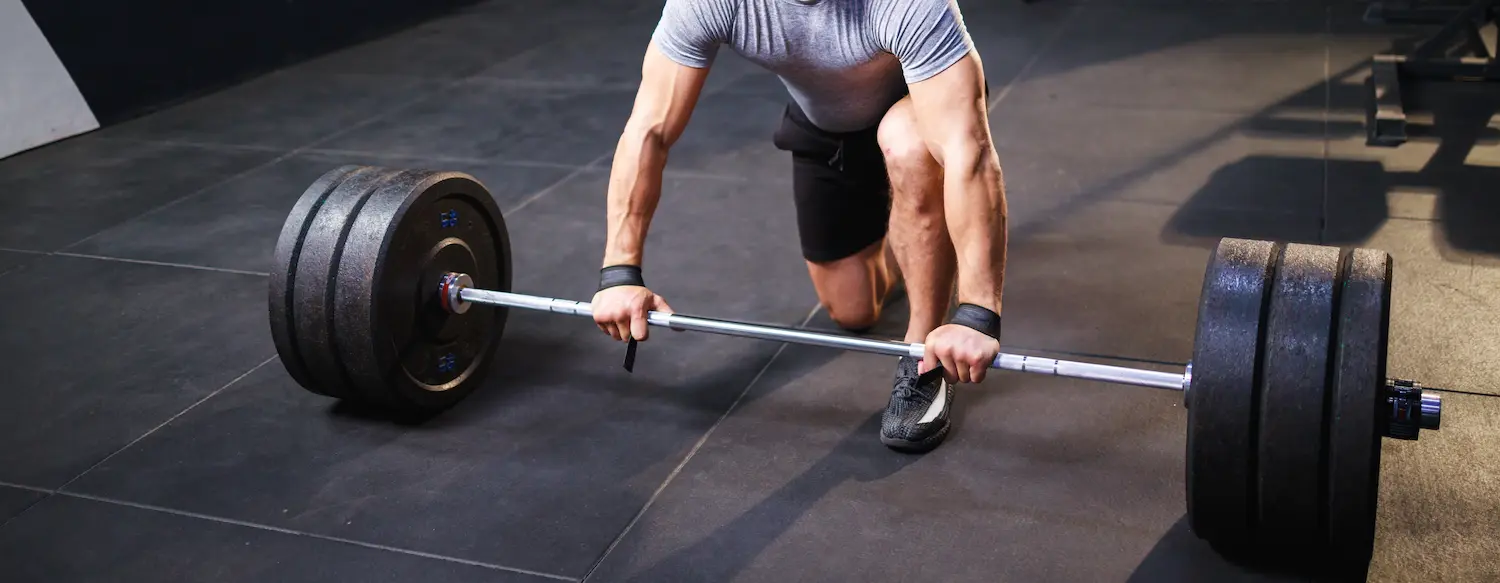
The block pull is the deadlift started with the bar resting on blocks or low boxes, raising it a few inches off the floor. Shortening the range of motion lets you handle heavier weight and train the top half of the lift hard. It is the powerlifter’s answer to a weak lockout — and a smart way to keep pulling heavy while sparing the lower back the deepest, most demanding part of the lift.
What it is
The block pull is a deadlift performed from blocks that elevate the bar 2-6 inches above the floor. Unlike the rack pull, where the bar rests inside a power rack, blocks let the plates sit on a free-standing surface, so the bar can still flex and the setup feels closer to a true pull. Loads run 105-120 % of your standard deadlift depending on block height.
Muscles worked
| Muscle | Contribution |
|---|---|
| Glutes, hamstrings | ~40 % |
| Erector spinae | ~25 % |
| Lats, traps | ~20 % |
| Forearms, core | ~15 % |
How to block pull: 5 steps
-
Set the block height
Place blocks so the bar sits **just below your sticking point** — below or at knee height for most lifters.
-
Set your stance
Feet hip-width, bar over mid-foot, shins close. Grip just outside the legs.
-
Brace and set the back
**Chest up, lats tight, flat back.** Pull the slack out of the bar before you move it.
-
Pull to lockout
**Drive through the floor and extend the hips.** Keep the bar close to the body all the way to a tall lockout.
-
Lower to the blocks
Lower under control and **let the plates settle fully on the blocks** before resetting for the next rep.
How it differs from conventional deadlift
- Shorter range of motion. Starting 2-6 inches higher removes the hardest part of the pull off the floor.
- Heavier loads possible. Most lifters block pull 105-120 % of their standard deadlift, overloading the back and grip.
- Lockout focus. The block pull trains hip extension and the top of the lift, the opposite of a deficit pull.
- Easier on the lower back. Skipping the deep start position reduces lumbar demand for the same load.
Common mistakes
When to use this variation
Use block pulls when your deadlift stalls above the knee, when you want to overload the back without grinding the floor pull, or when a tweaky lower back needs a break from the deepest range. Program 3-4 sets of 2-5 reps at 105-120 % of standard deadlift. Set the block height just above your sticking point so every rep trains the range you need.
FAQ
Block pull or rack pull?
Very similar. The block pull lets the bar flex naturally, so it transfers a little better to the competition deadlift. The rack pull is more convenient if you only have a power rack.
How high should the blocks be?
Set the bar just below your sticking point. Below the knee for a mid-range weakness, at knee height for a lockout weakness. Match the height to the range you actually want to strengthen.
Will block pulls build my floor strength?
Not directly — they skip the floor. Pair them with a deficit deadlift or regular pulls to keep the bottom of the lift strong.
Related exercises
- Deadlift: the full-range floor pull
- Rack Pull: similar partial from a rack
- Deficit Deadlift: trains the opposite end
- Paused Deadlift: builds positional strength
Published by: Jay — Writer covering back exercises
Reviewed, corrected and approved by: Martin Wood — Editor-in-chief
Updated on September 29, 2026