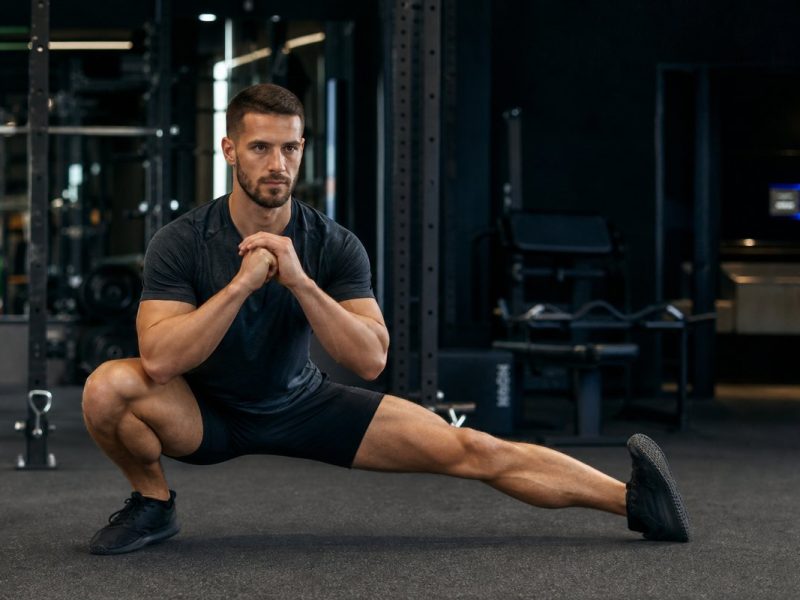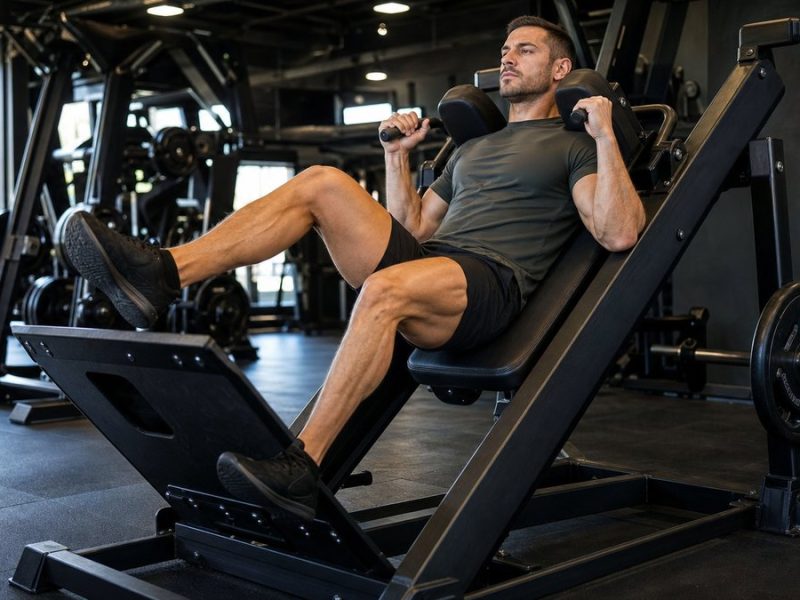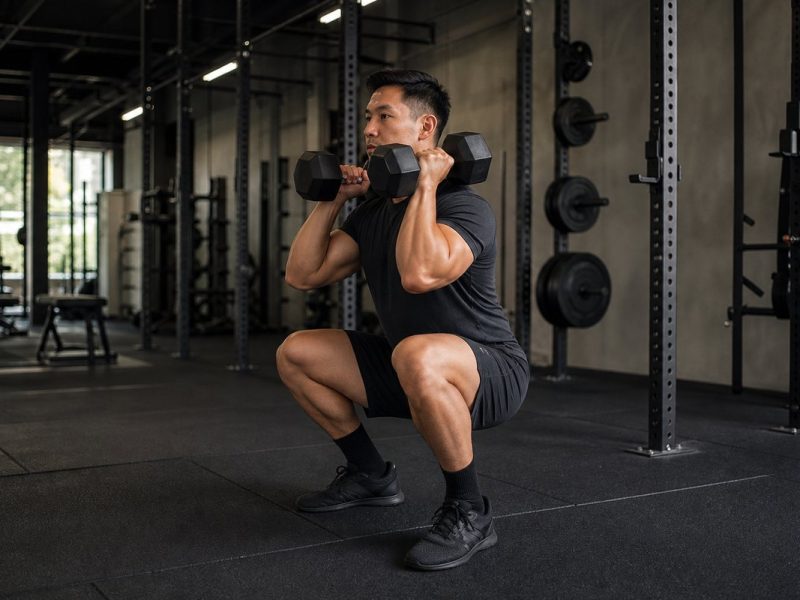

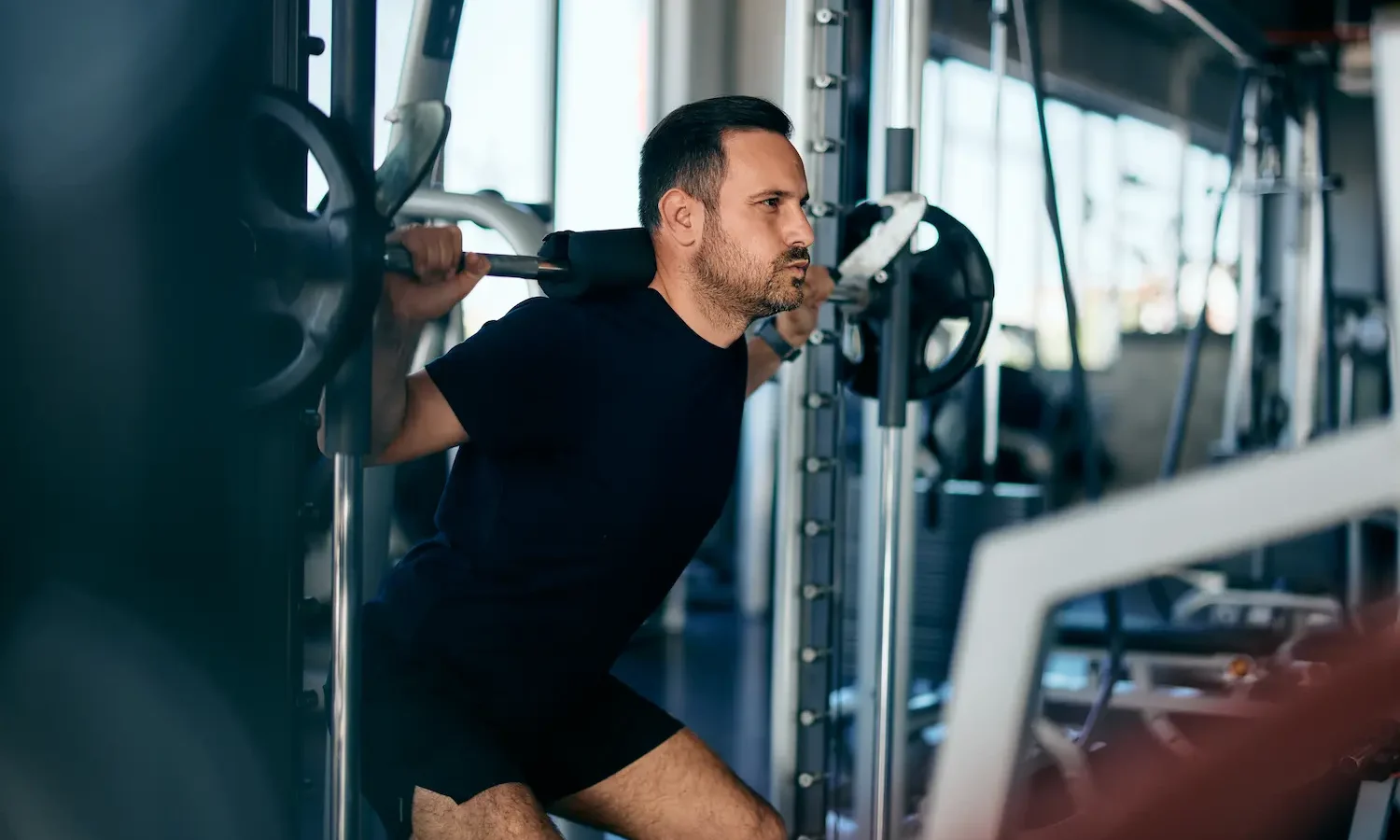
The Smith machine squat is the most divisive squat variant in lifting. Critics call it inferior to the free-weight back squat because the fixed bar path removes the stabilisation work. Fans love it for exactly that reason — fixed bar path lets you push the quads to true failure without worrying about balance, making it brilliant for hypertrophy.
Both sides have a point. The Smith machine squat isn’t a replacement for the back squat — it’s a complement. Used correctly, it’s an excellent quad-building tool.
What is the Smith machine squat?
The Smith machine squat is a squat performed on a Smith machine — a barbell fixed inside vertical (or near-vertical) guide rails. The bar travels only up and down (some Smith machines have a slight angled track). You can squat with feet directly under the bar (standard), feet slightly forward (more quad-emphasis), or feet further forward (hack-squat style).
The fixed bar path eliminates the need for the core and stabiliser muscles to balance the load — every bit of effort goes into the leg drive. This is the source of both its strength (max quad recruitment) and its limitation (no stabiliser training).
Muscles worked
| Muscle group | Role | Contribution |
|---|---|---|
| Quadriceps | Primary mover, knee extension | ~50 % |
| Glutes | Hip extension | ~25 % |
| Hamstrings | Hip extension support | ~15 % |
| Adductors, calves | Stabilisation, drive | ~10 % |
The Smith machine squat heavily targets the quads and glutes — same primary muscles as the back squat, but with no balance/stabiliser demand. For pure quad and glute hypertrophy at high load, it’s extremely effective.
How to Smith machine squat: 5 steps
-
Set up the bar
Set the Smith bar at upper-back height (just below shoulders). Step under the bar — rests on upper traps (high bar) or rear delts (low bar). Grip the bar with a moderate width. **Rotate the bar to unlock** the safety catches.
-
Set the foot position
Step away from the rack and **place feet either directly under the bar (standard) or 10-20 cm forward (quad-emphasis)**. Feet shoulder-width, toes slightly turned out. **Brace the core**.
-
Squat with control
**Squat down by bending the knees and hips simultaneously** in 2-3 seconds. **Hip crease below knee** at depth. The fixed bar path means you don't balance — focus 100 % on quad and glute engagement.
-
Pause briefly at depth
1-second pause at the bottom — chest up, knees over toes, core braced. **No bouncing** out of the bottom.
-
Drive up with the legs
**Drive through the heels (or mid-foot)** and stand up by extending the knees and hips. Lock out at the top. Reset, repeat. To finish: lower the bar to the catches at the bottom of a rep and rotate to lock.
Common mistakes to avoid
Variations
- Feet-forward Smith squat. Feet placed well in front of the bar. Quad-emphasis, less back stress.
- Narrow-stance Smith squat. Feet close together. Outer-quad and adductor focus.
- Sumo-stance Smith squat. Wide stance, toes turned out. Inner thighs and glute emphasis.
- Smith front squat. Bar in front rack. Quad-emphasis, more strict.
- Back squat. Free-weight equivalent.
- Hack squat. Machine alternative.
- Leg press. Different machine-based quad compound.
Sample workout: 4-week quad-emphasis block
Smith machine squats as the main quad exercise or secondary to free-weight squats, 1-2 times per week.
| Week | Sets × reps | Tempo |
|---|---|---|
| 1 | 4 × 10 | 3 sec down + 1 sec up |
| 2 | 4 × 8 | 3 sec down + 1 sec pause + 1 sec up |
| 3 | 5 × 6 | 2 sec down + 1 sec pause + 1 sec up |
| 4 (deload) | 3 × 8 | Smooth |
Frequently asked questions
Smith machine squat or barbell back squat?
Different tools. Back squat is the strength + skill king — develops total-body coordination and stabilisation. Smith squat is the hypertrophy king — fixed path allows maximum leg recruitment to failure. For powerlifting, back squat. For pure leg size, both have value; the Smith excels as an accessory.
Where should I place my feet?
Standard: feet directly under the bar (acts most like a back squat). Slightly forward: more quad emphasis, less back stress. Further forward (hack-style): even more quad. Experiment to find what feels strongest for your hip and ankle structure.
Is the Smith machine squat bad for the knees?
No — for healthy knees. The fixed bar path actually reduces the shearing forces some lifters worry about with free squats. People with existing knee problems should consult a physio either way; for healthy knees, the Smith squat is no more risky than a back squat.
Can I deadlift heavier from the Smith machine squat?
Most lifters Smith squat 10-20 % more than they back squat for the same reps. The fixed path removes balance demand. Don’t take that as a license to chase huge numbers without form — go deep, control tempo, push to failure with quality reps.
Why does my lower back hurt during Smith squats?
Feet placement is wrong. Feet directly under or slightly behind the bar forces the lower back to take stress. Move the feet slightly forward (10-20 cm) — this shifts the load to the quads and removes lower-back demand.
Related exercises
- Back Squat: free-weight compound
- Front Squat: quad-emphasis squat
- Hack Squat: machine quad squat
- Leg Press: machine quad compound
- Bulgarian Split Squat: unilateral squat
Published by: Jay — Writer covering quad exercises
Reviewed, corrected and approved by: Martin Wood — Editor-in-chief
Updated on September 29, 2026