
The sled push is the closest gym exercise to sprinting against resistance. You drive a weighted sled (or prowler) across the floor by pushing through the handles, leg-drive after leg-drive. There’s no eccentric phase, no joint impact, and no skill barrier — just pure leg-driven concentric work. The result: massive leg strength gains, leg-day cardio, and zero soreness compared to lifts of equivalent intensity.
For athletes who sprint or change direction, sled pushes are non-negotiable. For everyone else, they’re the best low-impact leg-conditioning compound you can program.
What is the sled push?
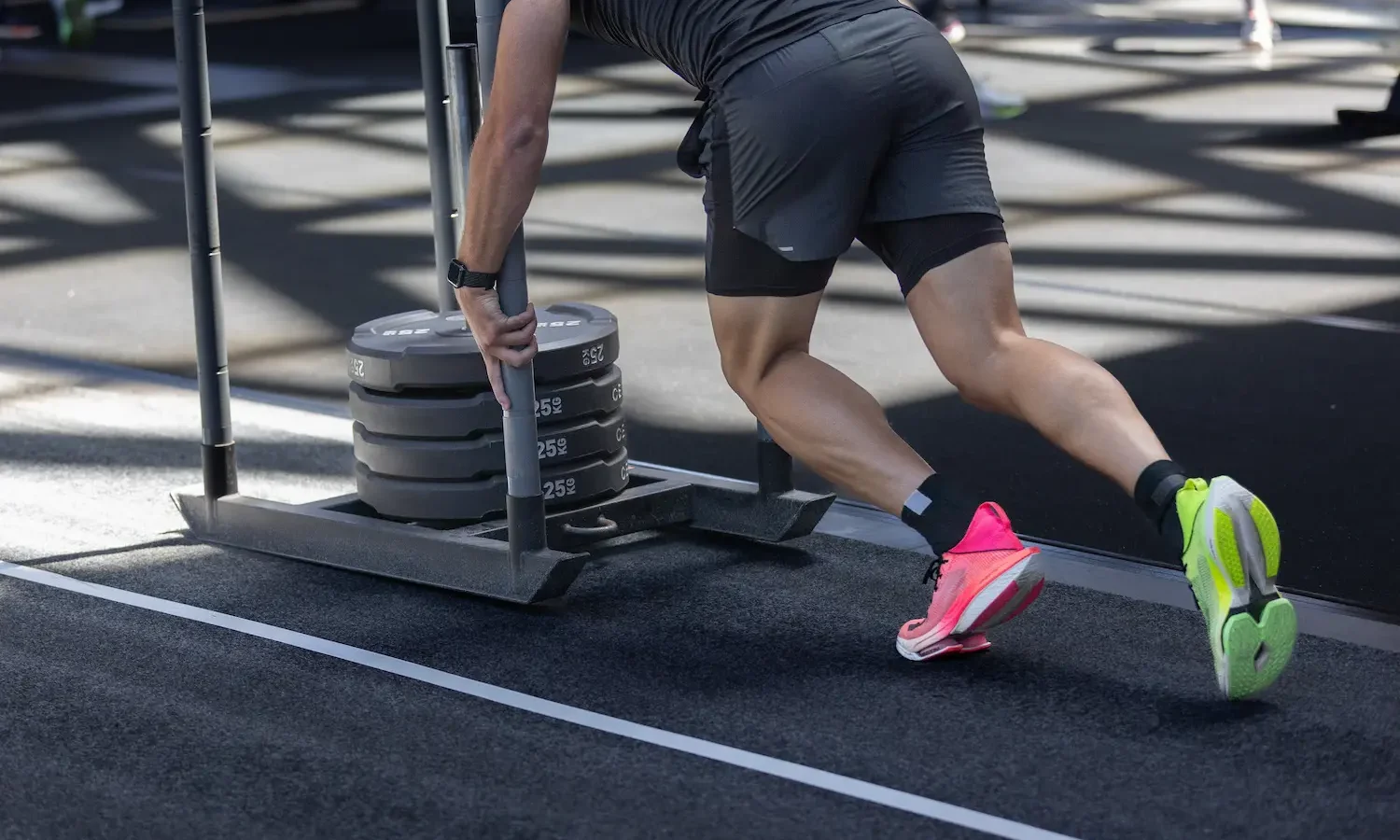
The sled push (also called prowler push) is a leg-driven exercise where you push a weighted sled across the floor by gripping handles or vertical posts and driving forward with the legs. The sled may have low handles (drive horizontally), high handles (more upright drive), or both. Distance and load vary depending on the goal: heavy short distances for strength, light long distances for conditioning.
The key feature: no eccentric component. The sled only gets pushed (concentric); it never pushes back. That eliminates the muscle damage and DOMS that come with most heavy leg work. You can train sled pushes at high frequency with minimal recovery cost.
Muscles worked
| Muscle group | Role | Contribution |
|---|---|---|
| Quadriceps | Primary mover, knee extension | ~35 % |
| Glutes | Hip extension, drive | ~25 % |
| Hamstrings, calves | Triple extension | ~20 % |
| Core, hip flexors | Stabilisation, leg cycling | ~10 % |
| Triceps, shoulders, traps | Push handles, body angle | ~10 % |
The sled push trains the quads, glutes, and calves in a sprint-mimicking pattern. For athletes, the sled-push transfers directly to acceleration speed and first-step power.
How to sled push: 5 steps
-
Set up at the sled
Stand behind the sled, grip handles or vertical posts (low for sprint-style, high for upright). Arms straight or slightly bent. Hips back, **body angled forward at about 45°** (low push) or more upright (high push).
-
Set the body position
**Brace the core**, chest tall (but body angled forward). One foot back, one foot forward in a staggered athletic stance. Weight in the front foot, ready to drive.
-
Drive forward step by step
**Drive the back leg forward** with maximum push through the floor — full triple extension at ankle, knee, hip on the drive leg. The opposite leg lifts and steps forward to repeat. **Continuous, sprint-like leg cycling.**
-
Maintain body angle and grip
**Don't stand up** during the push — maintain the forward lean. Arms stay extended, gripping the handles firmly. Pace is determined by load: heavy = grinding power steps; light = explosive sprint-cycle.
-
Stop at the target distance
Cover the prescribed distance (typically 15-30 m). Walk back to the start, rest as prescribed, repeat. **Quality over distance** — when form breaks, stop the set.
Common mistakes to avoid
Variations
- Low sled push. Grip low handles, body angled forward. Most sprint-specific position.
- High sled push. Grip high handles, more upright body. Easier on the back, more quad-emphasis.
- Heavy sled push. Loaded for slow, max-effort pushes. Strength focus.
- Sprint sled push. Light load for fast pushes — sprint mechanics overload.
- Sled pull. Backward variant — pull the sled with handles. Hamstring-emphasis.
- Farmer walk. Loaded carry alternative.
Sample workouts
Strength block
5 sets × 20 m heavy sled push. Load: as heavy as you can move steadily without stalling. Rest 2-3 minutes between sets.
Sprint block
8 sets × 15 m fast push. Light load (20-40 kg). Maximum drive speed. Rest 60-90 seconds.
Conditioning
EMOM 8 minutes: 20 m sled push at moderate load. Rest the remaining time. Sustained leg-and-cardio output.
Frequently asked questions
How heavy should I push?
Depends on the goal. For strength: heavy enough that 20 m takes 15-20 seconds. For sprint speed: light enough to move at near-sprint speed (typically 20-40 kg on the sled). For conditioning: moderate (50-80 % of strength load).
Why is the sled push so low-impact?
No eccentric loading. Eccentric muscle contractions (lowering weight against gravity) cause most of the muscle damage and soreness in lifting. Sled pushes are 100 % concentric — your muscles only contract while shortening, never while lengthening under load.
Can I sled push without a sled?
If you have a turf or smooth floor, push a loaded barbell, plate, or weight stack across it. The friction is different from a sled, but the leg-drive training effect is similar. Even pushing a heavy box works for beginners.
How often can I sled push?
3-5 times per week is sustainable for most lifters because there’s minimal eccentric load and recovery cost. Some athletes (sprint cyclists, footballers) push daily during certain training phases.
Sled push for hypertrophy?
Limited. Without eccentric loading, hypertrophy gains are modest compared to squats and leg presses. Use sled pushes for conditioning, sprint power, and accessory work — keep your main hypertrophy work on traditional lifts.
Related exercises
- Farmer Walk: loaded carry
- Squat: foundational leg strength
- Leg Press: machine leg compound
- Walking Lunge: distance leg work
- Box Jump: explosive leg power
Published by: Jay — Writer covering quad exercises
Reviewed, corrected and approved by: Martin Wood — Editor-in-chief
Updated on May 19, 2026