
The skull crusher (also called lying triceps extension or French press) is the heaviest triceps isolation exercise you can do safely. It allows much heavier loads than overhead extensions and trains all three heads of the triceps with the elbows in a fixed position. The unfortunate name comes from the fact that, if you lose control, the bar comes down toward your face — so don’t lose control.
This guide covers the standard EZ-bar skull crusher. Most lifters use an EZ bar instead of a straight bar because the angled grip reduces wrist strain. Variations with dumbbells or cables exist and are covered at the end.
What is the skull crusher?
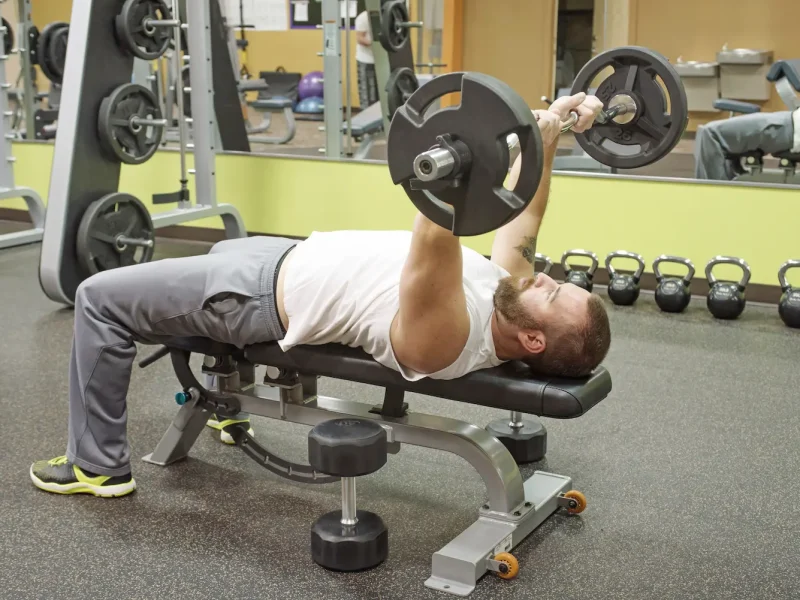
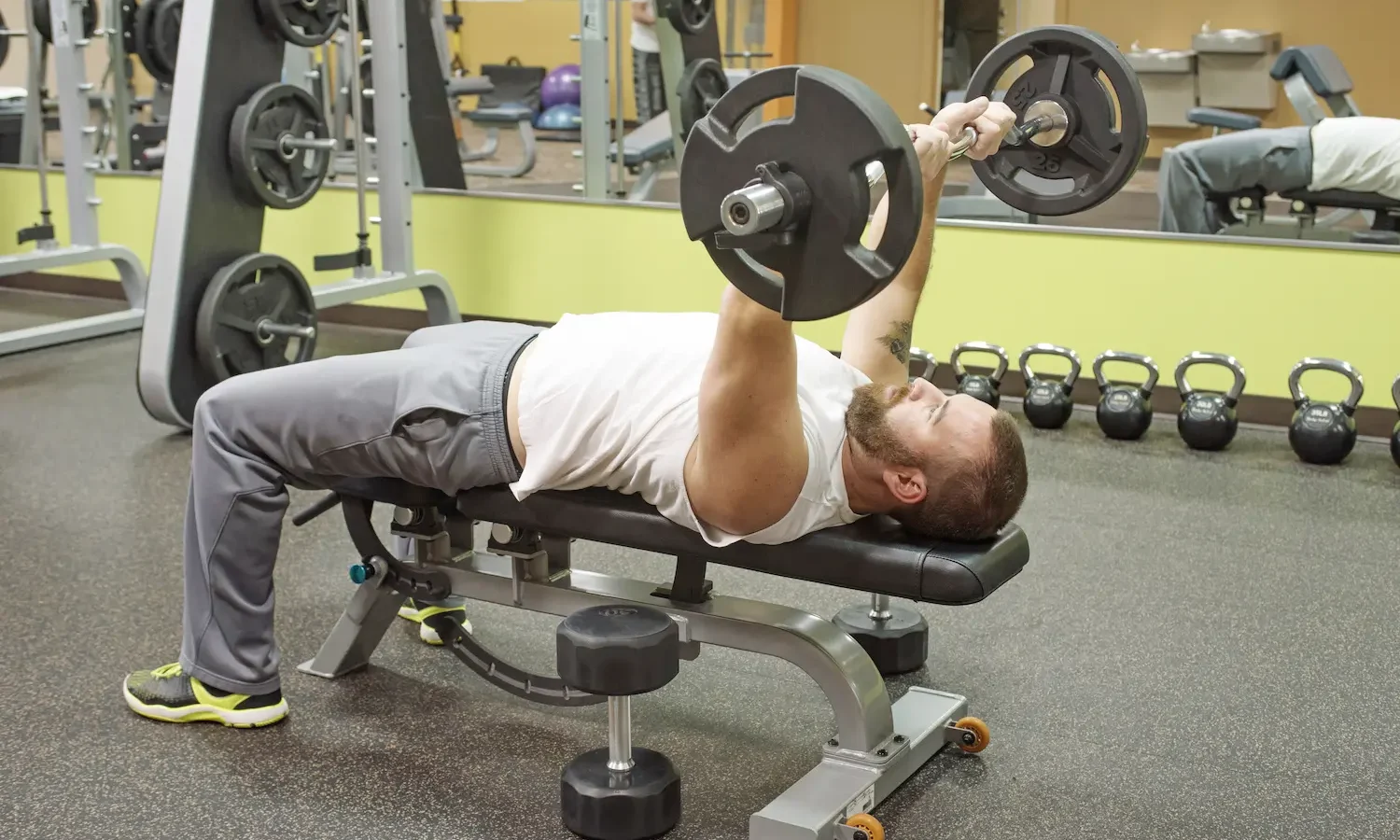
The skull crusher is a triceps isolation exercise performed lying on a flat bench, in which you hold an EZ bar (or barbell) over your chest with arms vertical, then bend the elbows to lower the bar toward your forehead, then extend back to vertical. The shoulders stay still — only the elbows move.
Compared to the overhead triceps extension, the skull crusher trains all three heads of the triceps more evenly. The overhead extension biases the long head (which is stretched in the overhead position); the skull crusher works the long head, lateral head and medial head in roughly equal proportions.
Muscles worked
| Muscle group | Role | Contribution |
|---|---|---|
| Triceps brachii (all three heads) | Primary mover, elbow extension | ~95 % |
| Forearms | Grip stabilisation | ~5 % |
The skull crusher is the most pure triceps isolation exercise — almost no other muscle contributes meaningfully. It’s also the variant that allows the heaviest loads, which is why it’s the foundational triceps mass-builder in most strength and physique programs.
How to skull crusher: 5 steps
-
Set up on the bench
Lie flat on a bench with feet planted. Hold an EZ bar with hands shoulder-width apart, palms facing forward (slightly inward angled if EZ bar). Press the bar up to arm's length over your chest.
-
Lock the elbows in position
**Upper arms remain vertical** throughout the rep — they do not move. Only the forearms rotate around the elbow joint. Brace the core, shoulder blades pulled back.
-
Lower toward the head
Bend the elbows in a 2-3 second controlled descent. Lower the bar until it's just behind your head (or to the forehead, depending on preference). **Elbows stay pointing up** — they don't flare outward.
-
Pause at the bottom
Half-second pause at the bottom, triceps fully stretched. No bouncing.
-
Extend back to the top
Drive the bar back to the start position by extending the elbows. **Soft lockout** — don't hyperextend the joint. Squeeze the triceps. Reset, repeat.
Common mistakes to avoid
Skull crusher variations
- Dumbbell skull crusher. Two dumbbells, palms facing each other. Greater range of motion, can address asymmetries.
- Incline skull crusher. On a 30-45° incline bench. Stretches the triceps further at the bottom.
- Decline skull crusher. On a decline bench. Allows heavier loads, isolates the triceps slightly better.
- JM press. Hybrid between skull crusher and close-grip bench. Allows very heavy loads. Powerlifting accessory favorite.
- Cable skull crusher. Lying with a cable from the floor. Constant tension throughout.
- Overhead triceps extension. Standing, biases the long head specifically.
Sample workout: 4-week triceps block
| Week | Sets × reps | RPE |
|---|---|---|
| 1 | 3 × 10 | 7 |
| 2 | 4 × 8 | 7-8 |
| 3 | 4 × 6 | 8 |
| 4 (deload) | 3 × 8 | 6 |
Frequently asked questions
Skull crusher or overhead extension?
Both. Skull crusher trains all three heads with heavier loads. Overhead extension specifically targets the long head with a stretch. Cycle through both for complete triceps development.
EZ bar or straight bar?
EZ bar for nearly everyone. The angled grip reduces wrist strain enormously. Straight bar is fine if your wrists handle it, but the EZ bar is just as effective for the triceps.
Where should I lower the bar — to the forehead, behind the head, or to the chin?
Slightly behind the head (toward the top of the bench) usually feels best on the elbows and gives the triceps a stronger stretch. Lowering to the forehead works but reduces the range of motion. Lowering to the chin is the most demanding but easiest on most lifters’ elbows.
Why do my elbows hurt during skull crushers?
Either you’re going too heavy, locking out hard at the top, or the bar path is putting strain on the joint. Use an EZ bar, soft lockout (don’t hyperextend), and reduce the load until the pain stops. If pain persists, switch to dumbbell or cable variations.
How heavy should I go?
For a healthy male intermediate: 25-35 kg on the EZ bar for 8-10 strict reps. For females: 12-20 kg. The right weight is one you can extend strict for the prescribed reps with no elbow flare.
Related exercises
- Overhead Triceps Extension: long head bias
- Triceps Pushdown: cable lateral head focus
- Close-Grip Bench Press: triceps-biased compound
- Dips: bodyweight triceps compound
- Diamond Push-Up: bodyweight triceps