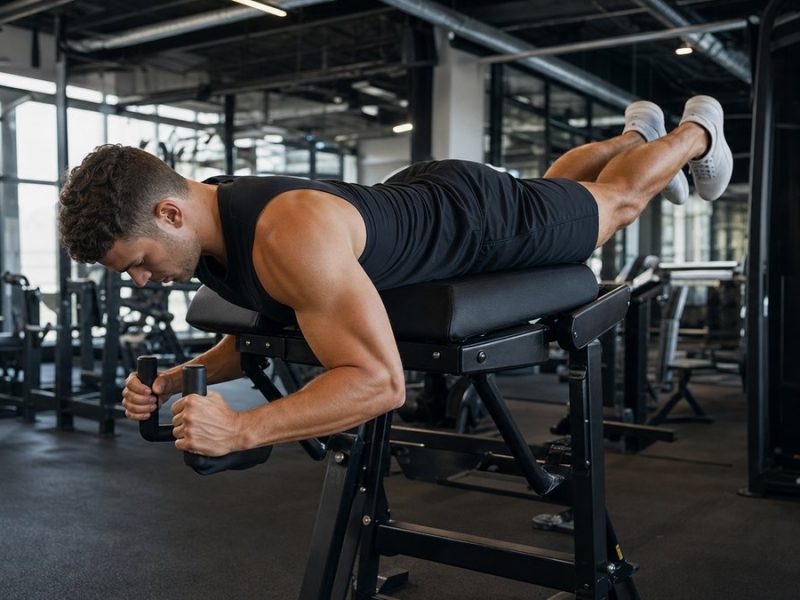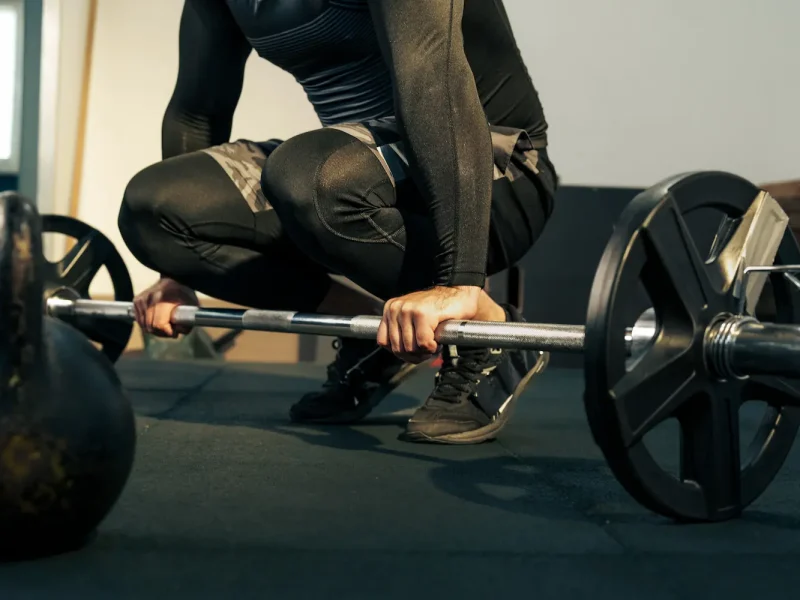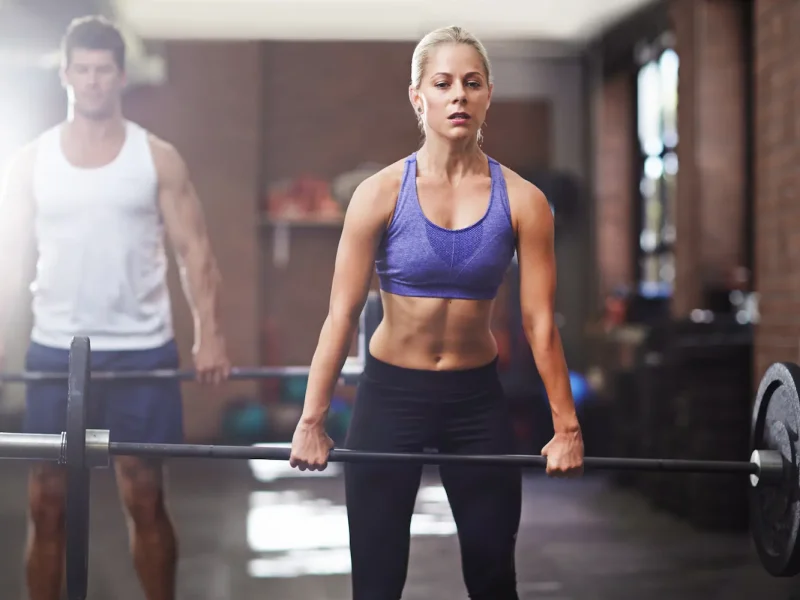

The single-leg deadlift is the unilateral hinge that exposes weaknesses your bilateral deadlifts hide. It trains the hamstrings, glutes and posterior chain on one leg at a time, while demanding balance and stability that no bilateral lift requires. The result: stronger glutes, better hip mobility, and an injury-resistant posterior chain.
This guide covers the dumbbell version (most common). Variations with kettlebells, barbells, or with a cable for assistance are covered at the end.
What is the single-leg deadlift?
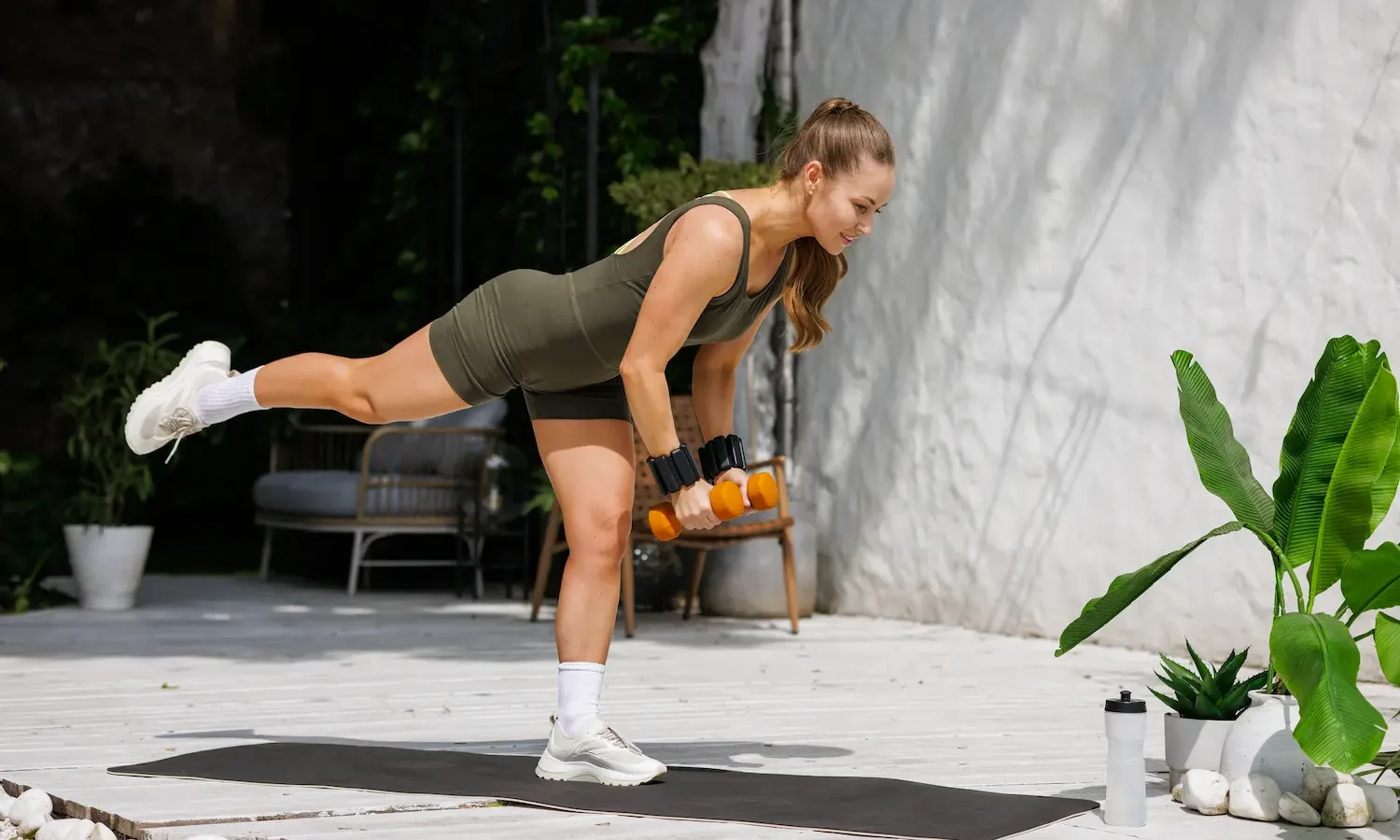
The single-leg deadlift is a unilateral hip-hinge exercise performed standing on one leg, in which you hinge forward at the hip while lifting the trailing leg behind you to maintain balance. The torso and trailing leg stay roughly parallel, forming a “T” shape at the bottom. The motion is hip extension (driven by the standing leg’s glute and hamstring), with no significant knee flexion.
Compared to the Romanian deadlift, the single-leg version trains the same posterior chain pattern but with double the demand on each leg (since one leg does all the work). It also adds a balance challenge that bilateral lifts can’t replicate.
Muscles worked
| Muscle group | Role | Contribution |
|---|---|---|
| Hamstrings (standing leg) | Primary mover, hip extension under stretch | ~40 % |
| Glutes (standing leg) | Hip extension | ~35 % |
| Erector spinae | Posture hold | ~10 % |
| Glute medius (standing leg) | Hip stabilisation, balance | ~10 % |
| Core, calves | Stabilisation | ~5 % |
The unique advantage of the single-leg deadlift is the glute medius work. The standing leg has to fight to keep the hip from collapsing inward, which fires the glute medius hard — a muscle that’s notoriously underdeveloped in most lifters and a key contributor to glute shape and athletic stability.
How to single-leg deadlift: 5 steps
-
Set the start position
Stand on one leg, slight bend in the knee. Hold a dumbbell in the opposite hand at your side. Other foot hovers just off the floor or barely touches.
-
Set the spine and engage the lats
Pull shoulder blades back and down. Brace the core. **Lower back flat — neutral spine.** Lats engaged.
-
Hinge at the hip
Push the standing-leg hip back as if reaching for a wall behind you. The trailing leg lifts behind you, staying roughly in line with the torso. Lower the dumbbell straight down toward the floor.
-
Stop at hamstring stretch
Stop when the torso is roughly parallel to the floor and you feel a strong hamstring stretch. Lower back stays neutral. Pause for half a second.
-
Drive the hip forward
Reverse the motion: drive the hip forward by squeezing the glute and hamstring. Return to standing. Soft lockout at the top. Reset, repeat. Switch legs.
Common mistakes to avoid
Variations
- Kettlebell single-leg deadlift. Single kettlebell held in opposite hand. Slightly different balance demand.
- Barbell single-leg deadlift. With a barbell. Allows heavier loads but balance is much harder.
- Cable single-leg deadlift. With a cable for resistance. Lighter loads, smoother motion.
- Elevated single-leg deadlift. Standing on a small platform. Greater range of motion.
- B-stance Romanian deadlift. Stepping stone — toe of the trailing leg lightly touches the floor. Easier balance, similar muscle target.
- Romanian deadlift. Bilateral counterpart.
Sample workout: 4-week posterior chain block
Single-leg deadlifts twice per week. Pair with bilateral Romanian deadlifts for full posterior chain coverage. Reps are per side.
| Week | Sets × reps/side | Load |
|---|---|---|
| 1 | 3 × 8 | Bodyweight or light dumbbells |
| 2 | 3 × 10 | Light dumbbells (5-10 kg) |
| 3 | 4 × 8 | Moderate dumbbells (12-18 kg) |
| 4 (deload) | 3 × 8 | Bodyweight |
Frequently asked questions
Why do I keep falling over?
Balance takes weeks to develop. Start by lightly touching a wall with one finger for support — gradually reduce to no contact. Or use the b-stance variation (toe of trailing leg on the floor) until your balance improves.
How heavy should I single-leg deadlift?
Most lifters can single-leg deadlift about 50-60 % of their bilateral RDL per side. So if you RDL 80 kg total, expect 40-50 kg per side single-leg (one dumbbell of that weight, or two split). Balance is usually the limiting factor before strength.
Single-leg deadlift or RDL?
Both. RDL trains the bilateral hinge with heavier loads. Single-leg trains the unilateral pattern with balance. Most balanced posterior chain programs include both.
Can I hold the dumbbell on the same side as the standing leg?</h3
You can, but holding it on the opposite side is the standard — it loads the glute medius more heavily and is more anti-rotation challenging. For variety, mix both grips.
Why does my standing-leg foot want to roll outward?</h3
Glute medius weakness. The standing-leg hip is collapsing slightly. Plant the whole foot — heel, ball, both sides — and consciously push the floor outward with the foot. The glute medius fires.
Related exercises
- Romanian Deadlift: bilateral hinge complement
- Conventional Deadlift: bilateral pull
- Hip Thrust: glute focus
- Single-Leg Hip Thrust: unilateral glute
- Bulgarian Split Squat: unilateral squat counterpart
Published by: Jay — Writer covering hamstring exercises
Reviewed, corrected and approved by: Martin Wood — Editor-in-chief
Updated on September 29, 2026