

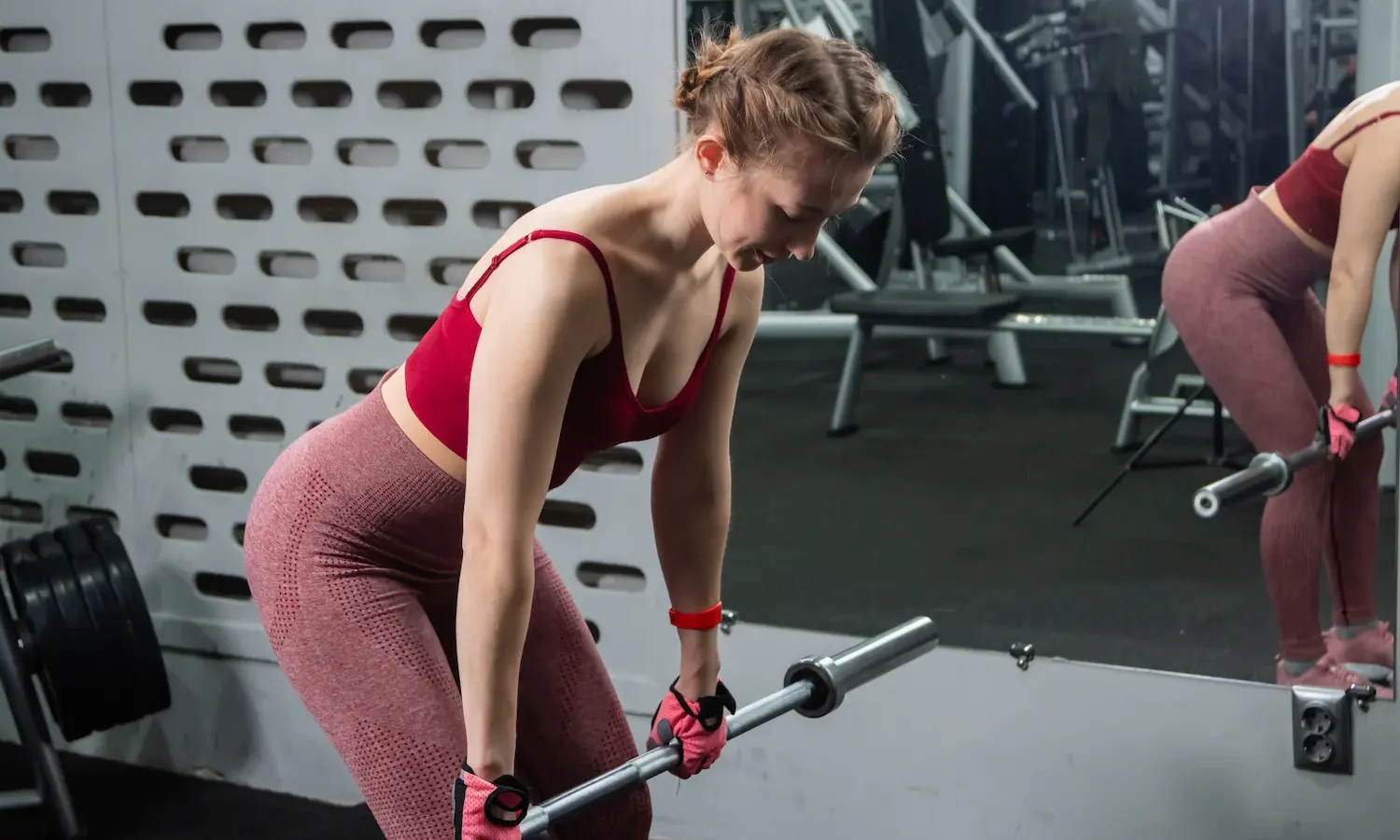
The paused deadlift adds a deliberate stop — usually just below the knee — partway up the pull. Holding the bar still in that mid-range position kills momentum and forces the back, hips, and grip to hold a hard position under load. It is one of the best fixes for a deadlift that stalls just past the floor, and it builds the kind of bracing strength that carries over to every pull.
What it is
The paused deadlift is a deadlift with a full stop of 1-3 seconds at a chosen point of the lift — most often around mid-shin or just below the knee. The lifter pulls the bar to that height, holds it dead still, then completes the rep. Removing the stretch reflex and momentum makes the lift far harder, so loads run around 70-85 % of a standard deadlift.
Muscles worked
| Muscle | Contribution |
|---|---|
| Glutes, hamstrings | ~35 % |
| Erector spinae | ~30 % |
| Quadriceps | ~20 % |
| Lats, traps, forearms | ~15 % |
How to paused deadlift: 5 steps
-
Set up the pull
Feet hip-width, bar over mid-foot, grip just outside the legs. **Chest up, lats tight, flat back.**
-
Break the floor
**Drive the bar off the ground** with the legs, keeping it against the shins.
-
Stop at the pause point
At your chosen height — usually just below the knee — **come to a full, motionless stop.** Stay braced.
-
Hold the position
Hold for **1-2 seconds with a flat back and tight lats.** Do not let the hips rise or the back round.
-
Finish and lower
**Drive the hips through to a tall lockout.** Lower under control and reset before the next rep.
How it differs from conventional deadlift
- A dead stop mid-pull. The 1-3 second pause removes momentum and any stretch reflex.
- Harder through the sticking point. Pausing where the lift is weakest builds strength exactly there.
- More bracing demand. Holding a loaded position teaches the core and back to stay rigid.
- Lighter loads. Most lifters use 70-85 % of their standard deadlift for the same reps.
Common mistakes
When to use this variation
Use paused deadlifts when your pull stalls just off the floor or you lose position mid-range. Program them as the main pull on one deadlift day, 3-4 sets of 2-4 reps at 70-85 % of standard deadlift with a 1-2 second pause. Set the pause at your sticking point. Run it for 4-6 weeks in a strength block, then drop the pause before testing a full pull.
FAQ
Where should I pause?
At your weak point. Most lifters pause just below the knee or at mid-shin. If you can identify exactly where the bar slows on a max pull, pause there.
How long should the pause be?
1-2 seconds is the standard. It should be a full, motionless stop — not a slow grind. Longer than 3 seconds becomes specialty work and forces the load down further.
Paused deadlift or deficit deadlift?
Both build off-the-floor strength. The deficit deadlift lengthens the range; the paused deadlift attacks a specific sticking point directly. Pick the one that matches your weakness.
Related exercises
- Deadlift: the standard floor pull
- Deficit Deadlift: off-the-floor range builder
- Block Pull: lockout overload pull
- Banded Deadlift: speed and lockout work