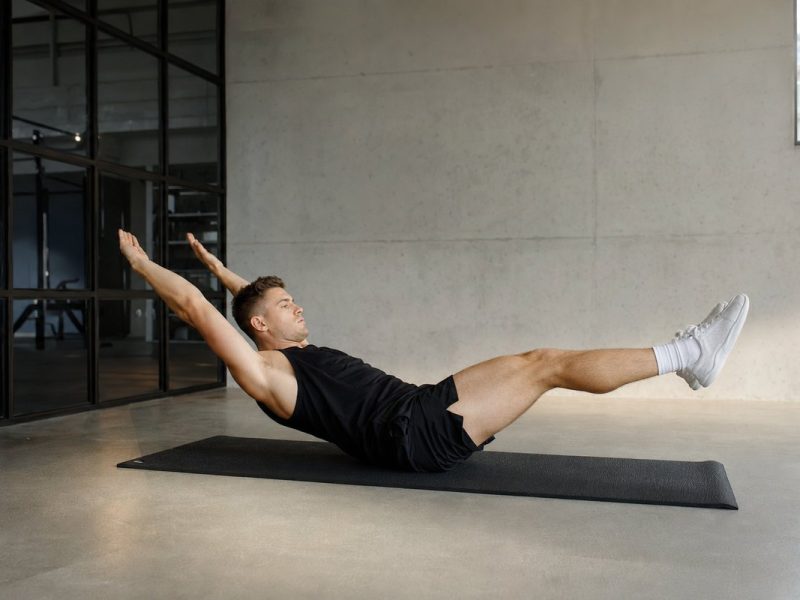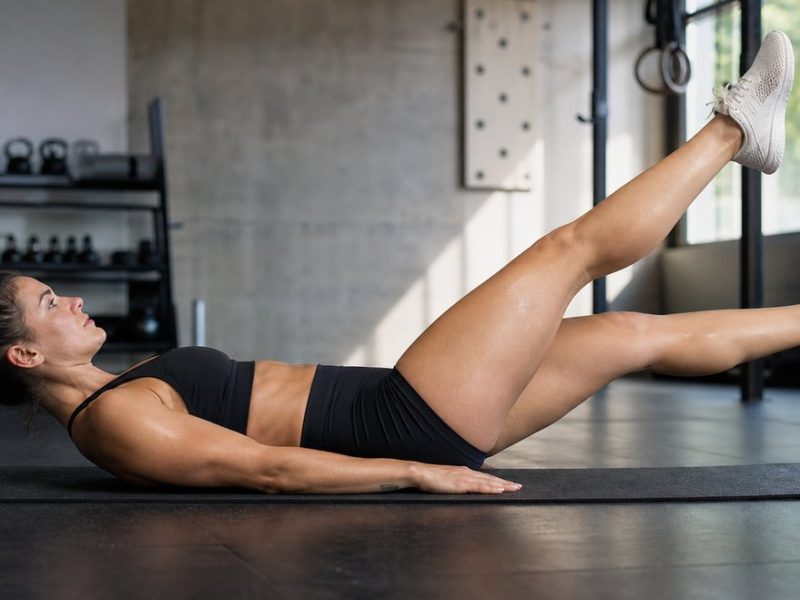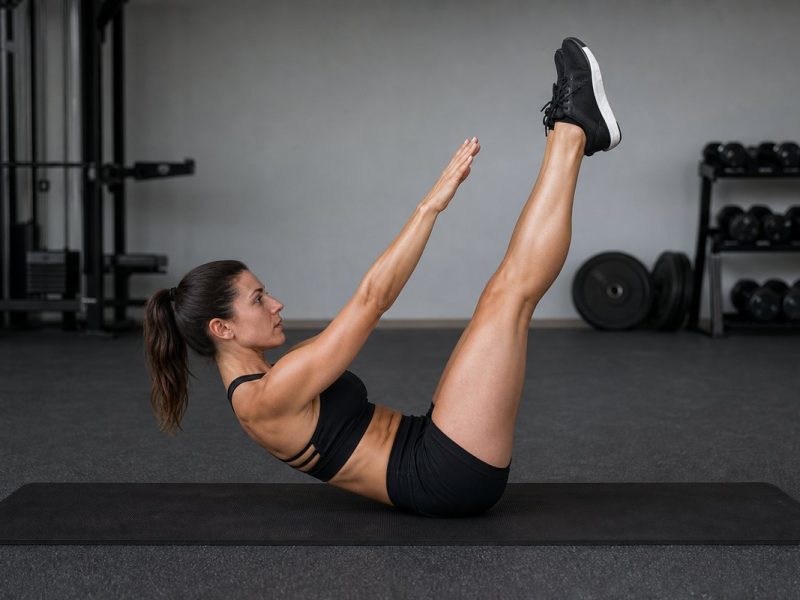

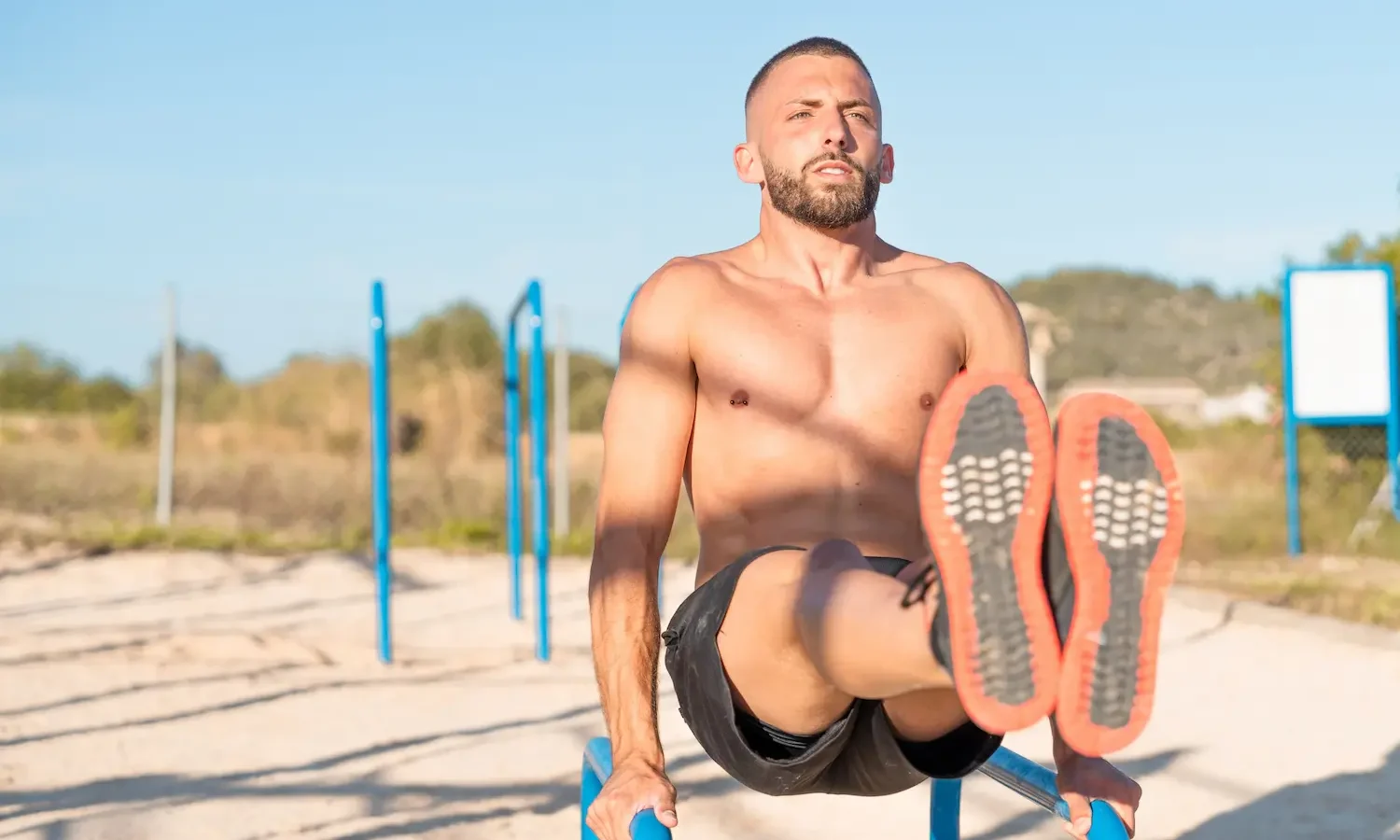
The L-sit is gymnastics’ favourite ab test. Sit on the ground (or on parallettes), hands flat beside your hips, then lift the entire body off the floor with legs extended straight in front, forming an “L” shape. Hold it. The compression of hip flexors against gravity plus the isometric ab work makes 10 seconds feel like a minute.
Beyond looking impressive, the L-sit builds compression strength — the ability to actively close the body angle — which is the foundation of advanced gymnastic moves like the V-sit, manna, and clean planche.
What is the L-sit?
The L-sit is a static bodyweight hold where you support your entire bodyweight on your hands (or parallettes), with legs extended horizontally in front and the body forming a 90° angle at the hips. Knees locked, toes pointed, head up. Hold the position for time.
Despite looking like an ab exercise, the L-sit is equally demanding on the triceps, lats, hip flexors and shoulders. The hardest part is keeping the legs straight and parallel to the floor — most beginners can’t lift the legs to parallel at first, no matter how strong their abs are. Hamstring flexibility and hip flexor strength are real limiters.
Muscles worked
| Muscle group | Role | Contribution |
|---|---|---|
| Hip flexors (psoas, rectus femoris) | Hip flexion, leg-holding | ~30 % |
| Rectus abdominis | Anti-extension, hip-flexion support | ~25 % |
| Triceps brachii | Locked elbow support | ~15 % |
| Lats, lower trapezius | Scapular depression, body support | ~15 % |
| Quads, adductors | Leg straightness, adduction | ~15 % |
The L-sit trains compression strength — the ability to close the hip angle actively. This is rare to train in normal lifting and translates well to advanced bodyweight skills and athletic movements.
How to L-sit: 5 steps
-
Set up the support
Sit on the floor (or on parallettes) with legs extended in front. Hands flat on the floor (or on parallette grips) directly beside the hips. Fingers pointing forward.
-
Press up to support
**Press down hard through the hands** — arms locked, scapulae depressed. Body rises off the floor. Hips and legs lift; only the hands touch the ground.
-
Bring legs parallel to floor
**Flex the hip flexors hard** to bring the straight legs up until they are parallel to the floor — knees fully locked, toes pointed. The body forms a clean "L" shape.
-
Hold the position
Keep arms locked, shoulders pushed down (lats engaged), abs braced. Breathe through the hold. Legs stay parallel — don't let them sag. Hold for the target time.
-
Lower with control
When the hold ends, lower the legs and body to the floor under control. Don't crash. Rest fully between sets — the L-sit is taxing.
Common mistakes to avoid
Variations & progressions
- Tuck L-sit. Knees pulled toward chest. Entry-level progression.
- One-leg L-sit. One leg extended, one tucked. Mid-progression.
- Foot-supported L-sit. Heels on a low surface to reduce load. Earliest progression for total beginners.
- Parallette L-sit. On parallettes. Easier wrist position + more clearance for legs. Standard advanced version.
- V-sit. Legs raised above 45° — much harder progression after L-sit.
- Hanging L-sit. Hanging from a bar with legs in L-position. Different stimulus, mostly abs.
- Hanging leg raise. Dynamic counterpart.
Sample workout: 12-week L-sit progression
Train 3-4 times per week. Multiple short holds beat one long failure rep.
| Weeks | Progression | Sets × time |
|---|---|---|
| 1-3 | Tuck L-sit on floor | 5 × 15s |
| 4-6 | One-leg L-sit (alternate) | 5 × 10s per leg |
| 7-9 | Full L-sit (parallettes) | 5 × 5-10s |
| 10-12 | Full L-sit (floor) | 5 × 10-20s |
Frequently asked questions
How long should I be able to hold the L-sit?
10 seconds = solid beginner. 20 seconds = intermediate. 30+ seconds = advanced. Gymnasts hold 60+ seconds. Quality over quantity — legs strictly parallel, no piking.
Why can’t I lift my legs to parallel?</h3
Two reasons. Tight hamstrings (the legs physically can’t lift higher) or weak hip flexors (you don’t have the strength to hold them there). Stretch hamstrings daily (pike fold), train hanging knee-raises, and start with tuck L-sit.
Floor or parallettes?</h3
Parallettes are easier and gentler on the wrists — recommended for learning. Floor is the benchmark version once you can hold parallette L-sits for 20+ seconds. Both are valid.
Why is my chest collapsing?</h3
Weak scapular depression. Cue “push the floor down, lift the body up, depress the shoulders”. The arms should feel like rigid pillars. Dips and straight-arm plank work build this directly.
L-sit or hanging leg raise?</h3
Different. Hanging leg raise is a dynamic ab exercise. L-sit is a static hold that emphasises compression and scapular control. Use both for complete core training.
Related exercises
- Dragon Flag: dynamic anti-flexion counterpart
- Hanging Leg Raise: hanging dynamic ab work
- Plank: foundational static core
- Dips: scapular-depression-building push
- Hanging Knee Raise: hip-flexor progression
Published by: Jay — Writer covering ab exercises
Reviewed, corrected and approved by: Martin Wood — Editor-in-chief
Updated on September 29, 2026