

The glute kickback is glute isolation in its purest form. Where the hip thrust and squat involve the quads and hamstrings as helpers, the kickback does one thing: extend the hip against load with the glutes alone. For glute hypertrophy, especially the upper portion that’s hardest to grow, the kickback is one of the most efficient exercises in the gym.
This guide covers the cable kickback (the most common version with progressive overload). Variations with bands, kettlebells, or bodyweight exist and are covered at the end.
What is the glute kickback?
The glute kickback is a unilateral hip-extension exercise performed at a low cable machine with an ankle strap, in which you stand facing the cable and extend one leg straight back behind you by squeezing the glute. The motion is pure hip extension with the knee staying nearly locked.
The kickback works the glutes through their primary function (hip extension) without involving the quads or hamstrings significantly. That’s its strength — pure isolation — and also its limitation, since you can’t load it as heavy as compound lifts.
Muscles worked
| Muscle group | Role | Contribution |
|---|---|---|
| Gluteus maximus | Primary mover, hip extension | ~70 % |
| Hamstrings | Hip extension assistance | ~15 % |
| Lower back, core | Stabilisation | ~10 % |
| Glute medius | Hip stabilisation (standing leg) | ~5 % |
The cable kickback hits the gluteus maximus at about 90 % of its maximum potential — meaning very few muscles are recruited as helpers. That makes it ideal as a finisher to a glute session, after compound work like hip thrusts and squats.
How to glute kickback: 5 steps
-
Set up at the low cable
Attach an ankle strap to one ankle, connected to a low cable. Stand facing the cable. Hold the cable post or a sturdy surface for balance with both hands. Standing leg slightly bent, working leg extended forward against the cable tension.
-
Set the body position
Stand tall, slight forward lean (10-15°). Brace the core. **Lower back stays neutral** — no arching. Working leg has a slight 5-10° bend at the knee, maintained throughout.
-
Kick the leg back
Squeeze the glute to extend the leg back and behind you. **The motion comes from the hip** — drive the heel back, not just up. Stop when the leg is fully extended behind you (about 15-20 cm past vertical).
-
Pause and squeeze
1-second pause at the top, glute fully contracted. **Don't arch the lower back** to extend the leg further — squeeze the glute, not the back.
-
Lower in 2-3 seconds
Controlled return. Bring the leg forward until you feel the glute released. Don't let it crash forward — control the cable tension. Reset, repeat. Switch legs.
Common mistakes to avoid
Variations
- Banded glute kickback. Resistance band around the ankle. Home version when no cable is available.
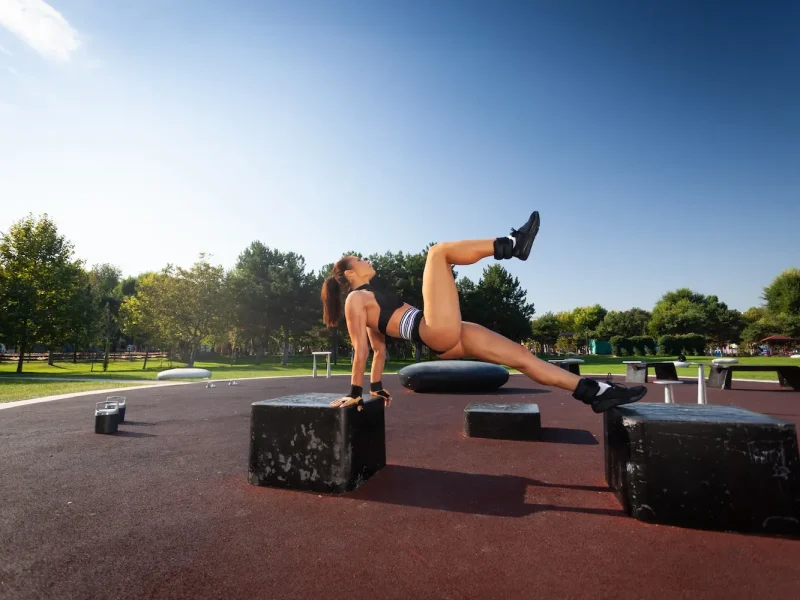
- Kneeling kickback. On hands and knees on the floor. Bodyweight version. Good for warm-up activation.
- Donkey kick. Like a kneeling kickback but with the knee bent (heel toward the ceiling). Works the glute max from a different angle.
- Standing cable kickback. Standard variation as described above.
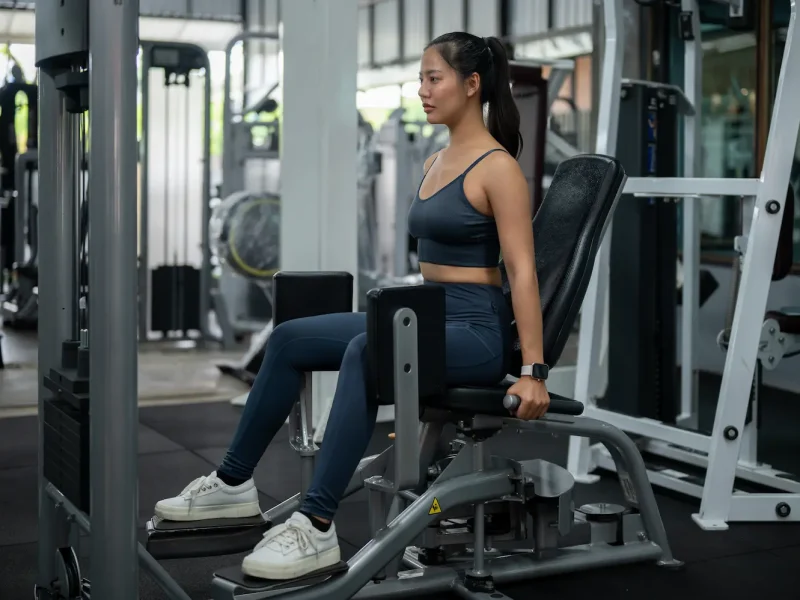
- Glute kickback machine. Dedicated machine — rests against a pad, kicks back. Easier setup than cable.
- 45-degree hip extension. On a roman chair. Bigger range of motion, more posterior chain.
Sample workout: 4-week glute block
Glute kickbacks 2-3 times per week, after compound glute work. Reps are per leg.
| Week | Sets × reps/leg | Tempo |
|---|---|---|
| 1 | 3 × 12 | 2 sec eccentric |
| 2 | 3 × 15 | 2 sec eccentric + 1 sec pause at top |
| 3 | 4 × 12 | 3 sec eccentric + 1 sec pause |
| 4 (deload) | 3 × 12 | Smooth |
Frequently asked questions
Glute kickback or hip thrust?
Different functions. Hip thrust is your heavy bilateral compound for absolute glute strength. Kickback is unilateral isolation for finishing volume and asymmetry-fixing. Most balanced glute programs include both.
Why don’t I feel my glute during kickbacks?
You’re probably arching the lower back to extend the leg further. The glute does the work in a small range — about 15-20 cm of leg extension behind the body. Past that, the lower back takes over. Reduce the range, focus on squeezing the glute hard.
How heavy should I cable kickback?
Light to moderate. 10-20 kg on the cable for 12-15 reps for most lifters. Heavier loads usually mean compensation — lower back arching, hip rotating. Strict form matters more than load.
Should I keep my leg straight or bend the knee?</h3
Slight bend (5-10°), maintained throughout. Completely straight legs put strain on the lower back; bent legs reduce ROM. Slight bend hits the glute max best.
How often should I do glute kickbacks?</h3
2-3 times per week as accessory work. Glutes recover well; high frequency is fine. Daily light banded kickbacks as activation are also a good practice.
Related exercises
- Hip Thrust: heavy bilateral glute
- Glute Bridge: foundational floor variant
- Single-Leg Hip Thrust: unilateral heavy
- Single-Leg Deadlift: hinge counterpart
- 45° Hip Extension: posterior chain compound