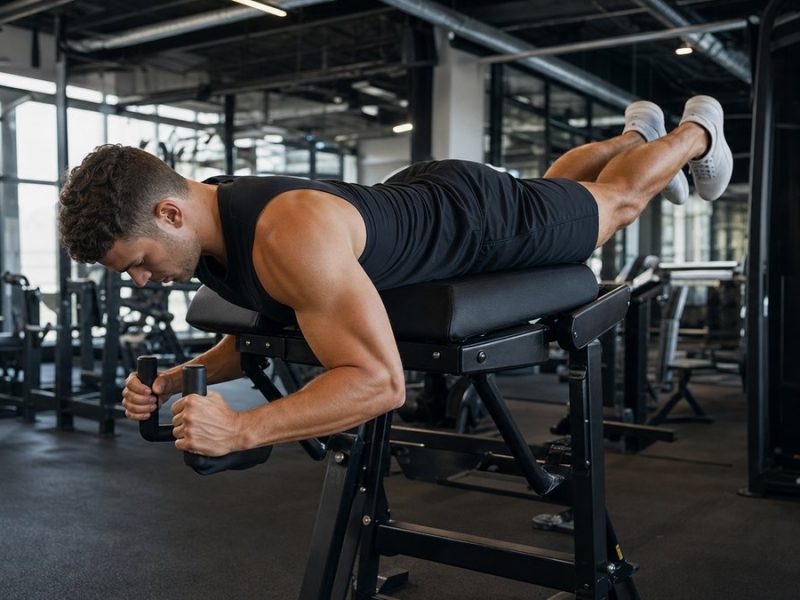

The glute ham raise (GHR) is the most demanding hamstring exercise in any well-equipped gym. It loads the hamstrings under both knee flexion and hip extension simultaneously — the only common exercise that does both. The result: hamstring strength and growth that no other isolation can match.
The GHR also looks easy and feels brutal. Most beginners can’t do a single full rep. The strict version takes weeks of regression work to build up to. This guide covers the standard glute ham raise on a GHR machine.
What is the glute ham raise?
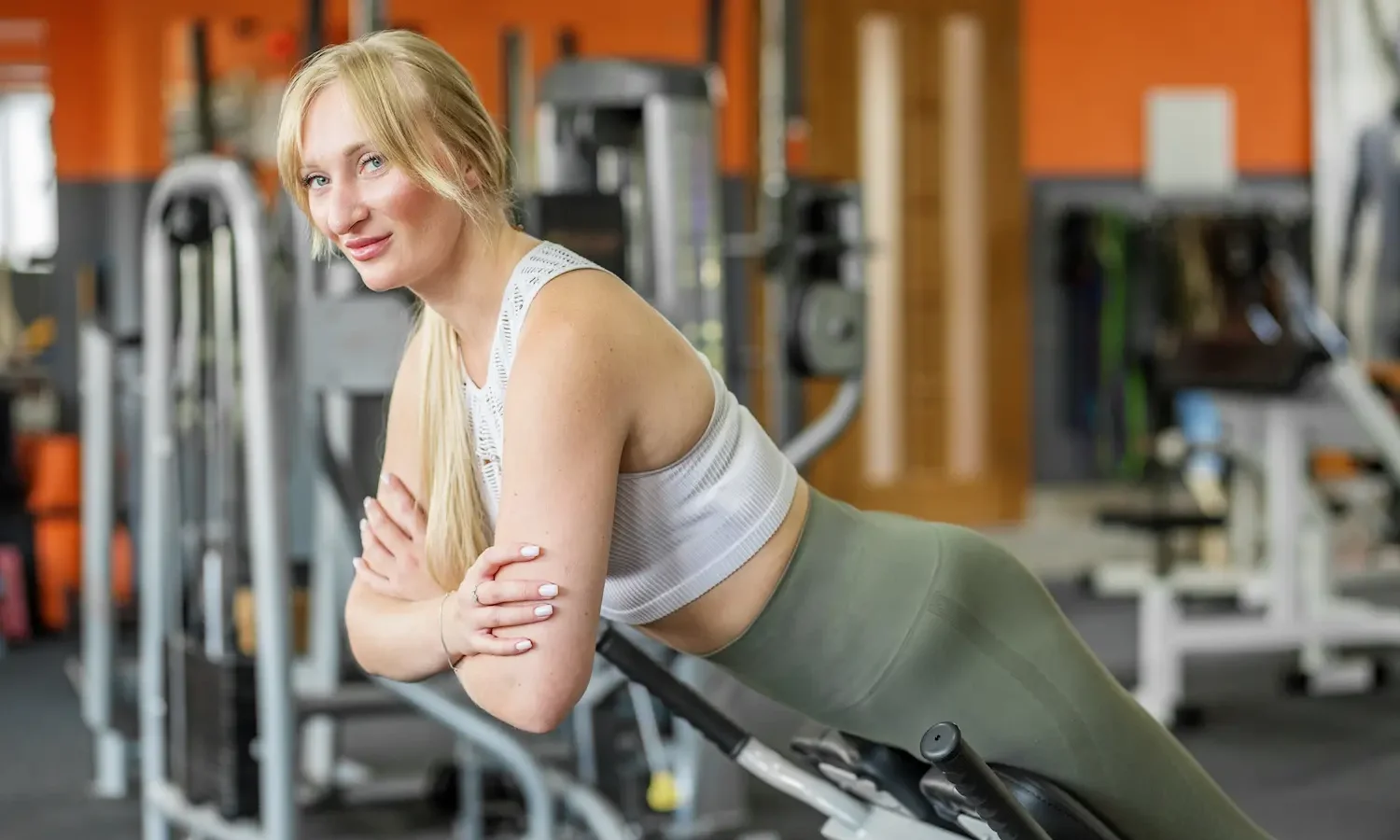
The glute ham raise is a posterior chain exercise performed on a GHR (glute ham raise) machine, in which you secure your feet between rollers, kneel on a pad, and lower your torso forward by extending the knees, then pull yourself back up by contracting the hamstrings and glutes. The motion combines hip extension and knee flexion in one smooth pattern.
Compared to other hamstring exercises, the GHR is unique because it loads both functions of the hamstrings simultaneously. The leg curl isolates knee flexion. The Romanian deadlift isolates hip extension. The GHR combines both, making it the most “complete” hamstring exercise.
Muscles worked
| Muscle group | Role | Contribution |
|---|---|---|
| Hamstrings (all heads) | Primary mover, knee flexion + hip extension | ~60 % |
| Glutes | Hip extension | ~20 % |
| Calves (gastrocnemius) | Knee flexion assistance | ~10 % |
| Lower back, core | Posture stabilisation | ~10 % |
The GHR loads the hamstrings harder per rep than nearly any other exercise. Studies have shown peak hamstring activation reaching 90 %+ of maximum during the GHR. For posterior chain hypertrophy or sports performance (sprinting, jumping), it’s a foundational lift.
How to glute ham raise: 5 steps
-
Set up on the GHR machine
Adjust the foot plate so when you kneel on the knee pad, your knees are just behind the pad and your feet press firmly against the foot plate, hooked under the rollers.
-
Set the body position
Kneel on the pad, secure feet under the rollers. Body upright. Hands across the chest or behind the head. **Body in one straight line** from knees to crown.
-
Lower under control
Slowly lower the torso forward by extending the knees. **Maintain neutral spine** throughout — don't round or arch the lower back. Lower in 3-4 seconds until the body is roughly horizontal (parallel to floor).
-
Pause briefly at the bottom
Hamstrings stretched, glutes engaged. Don't bounce. Brief pause to feel the stretch.
-
Pull back to the start
Contract hamstrings and glutes hard to pull yourself back up. **Drive the toes into the foot plate** while flexing the knees. Return to upright kneeling. Reset, repeat.
Common mistakes to avoid
Variations / progressions
- Assisted glute ham raise. Use a band attached overhead to assist the upward portion. Build to unassisted reps.
- Eccentric-only GHR. Lower under control, push back up with hands. Builds eccentric strength to enable full reps.
- Nordic curl. Bodyweight version. Kneel with feet anchored, lower forward under control. Ultimate hamstring exercise.
- Weighted GHR. Hold a plate against the chest. Once bodyweight reps are easy.
- 45° back extension. Different machine. Different angles. Hits posterior chain similarly.
- Leg curl. Isolation alternative for knee flexion only.
Sample workout: 4-week posterior chain block
Glute ham raises 1-2 times per week. Pair with Romanian deadlifts on the same day for full hamstring volume.
| Week | Sets × reps | Variation |
|---|---|---|
| 1 | 3 × 5 eccentric-only | Lower controlled, push up with hands |
| 2 | 3 × 6 assisted | Light band assistance |
| 3 | 4 × 5 | Bodyweight (or assisted as needed) |
| 4 (deload) | 3 × 5 | Bodyweight or assisted |
Frequently asked questions
I can’t do a single full GHR — what now?
Normal. Most beginners can’t. Start with eccentric-only reps: lower under control over 4-5 seconds, then push back up with your hands. Build up over 4-6 weeks to where you can perform full unassisted reps.
Glute ham raise or Nordic curl?</h3
Same muscles, different setup. Nordic curl needs no machine — just a partner or anchor for the feet. GHR needs the machine. Both are excellent. Use whichever your gym has.
Why does my back hurt during GHRs?</h3
Either you’re hyperextending the lower back at the top, or rounding it during the lift. Maintain a neutral spine throughout — body in one straight line at the top, no exaggerated arch.
How heavy can I add weight?</h3
Once you can do 8-10 strict bodyweight reps, add 5 kg held against the chest. Build up gradually. Most lifters can eventually do 15-25 kg added weight.
Does the GHR replace deadlifts and Romanian deadlifts?</h3
No. Deadlifts and RDLs are bilateral hip-hinge compounds that train hamstrings + glutes + back together. GHR isolates hamstrings + glutes specifically. Most balanced posterior chain programs include all three.
Related exercises
- Romanian Deadlift: bilateral hip-hinge
- Leg Curl: knee-flexion isolation
- Nordic Curl: bodyweight equivalent
- Single-Leg Deadlift: unilateral hinge
- 45° Back Extension: posterior chain compound
Published by: Jay — Writer covering hamstring exercises
Reviewed, corrected and approved by: Martin Wood — Editor-in-chief
Updated on May 11, 2026