
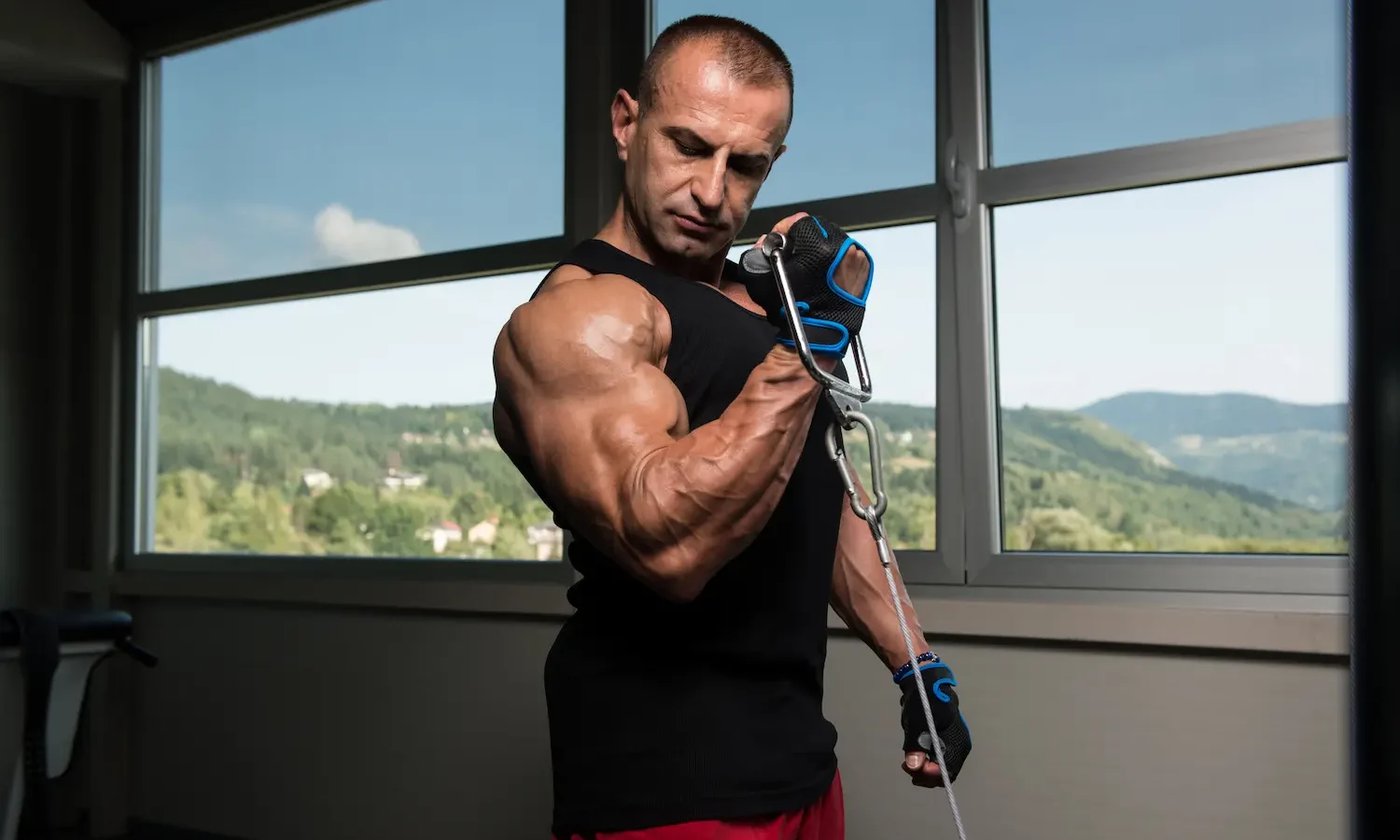
The cross-body hammer curl is a hammer curl variation where each arm curls the dumbbell across the body toward the opposite shoulder, instead of straight up. The angled path puts maximum tension on the brachialis — the muscle responsible for the thickness between biceps and forearm.
What it is
The cross-body hammer curl is a hammer curl performed by curling a dumbbell across the front of the body to the opposite shoulder. Grip stays neutral (palm facing in). The arms alternate, each one tracing a diagonal path across the chest. The cross-body angle isolates the brachialis effectively.
Muscles worked
| Muscle | Contribution |
|---|---|
| Brachialis | ~45 % |
| Brachioradialis | ~25 % |
| Biceps brachii | ~20 % |
| Forearms | ~10 % |
How to cross-body hammer curl: 5 steps
-
Stand tall
Feet hip-width, dumbbells in each hand at the sides, **neutral grip (palms facing in).**
-
Brace
**Elbow pinned to side, core tight, shoulders back.**
-
Curl across
**Curl one dumbbell across the body toward the opposite shoulder.** Wrist stays neutral.
-
Peak squeeze
**Dumbbell head reaches near the opposite collarbone.** Brief squeeze.
-
Lower and switch
**Lower over 2 seconds** to full extension. Repeat with the other arm. Alternate.
How it differs from hammer curl
- Angled curl path. Dumbbell travels across the body, not straight up.
- Maximum brachialis emphasis. The cross-body angle isolates the brachialis better than vertical hammer curls.
- Alternating arms. Standard hammer curl can be done simultaneously; cross-body is almost always alternating.
- Lighter loads. The unfamiliar angle reduces strength; expect to use 80 % of regular hammer curl weight.
Common mistakes
When to use this variation
Use cross-body hammer curls to develop the brachialis — the muscle that creates arm thickness viewed from the side. Program 3 sets of 10-15 reps per arm. Pair after standard biceps curls and hammer curls in an arms session. Most lifters notice visible arm thickness improvements after 6-8 weeks of consistent inclusion.
FAQ
Why does it hit the brachialis better?
The brachialis works in elbow flexion regardless of grip. The cross-body path keeps the upper arm slightly more abducted, which biases the brachialis over the biceps brachii.
Where exactly does the dumbbell go?
Toward the opposite shoulder. The dumbbell head should brush near (but not touch) the opposite collarbone at the top.
Cross-body or regular hammer curl?
Both work the brachialis. Cross-body emphasises it more; regular hammer curl trains it alongside the biceps and brachioradialis. Use both.
Related exercises
- Hammer Curl: vertical version
- Dumbbell Curl: supinated variant
- Cable Hammer Curl: cable version with constant tension
- Zottman Curl: rotational variant for forearms
Published by: Martin Wood — Writer covering biceps exercises
Reviewed, corrected and approved by: Martin Wood — Editor-in-chief
Updated on July 20, 2026