
The concentration curl is the strict isolation curl that exposes how badly you do regular dumbbell curls. Sat on a bench, elbow braced against the inner thigh, you can’t cheat with your back, your shoulder, or your hips. Just the biceps, doing the work.
EMG studies have repeatedly found the concentration curl to produce the highest biceps activation per rep of any standard biceps exercise. It’s slow, deliberate, and effective. This guide covers the strict version.
What is the concentration curl?
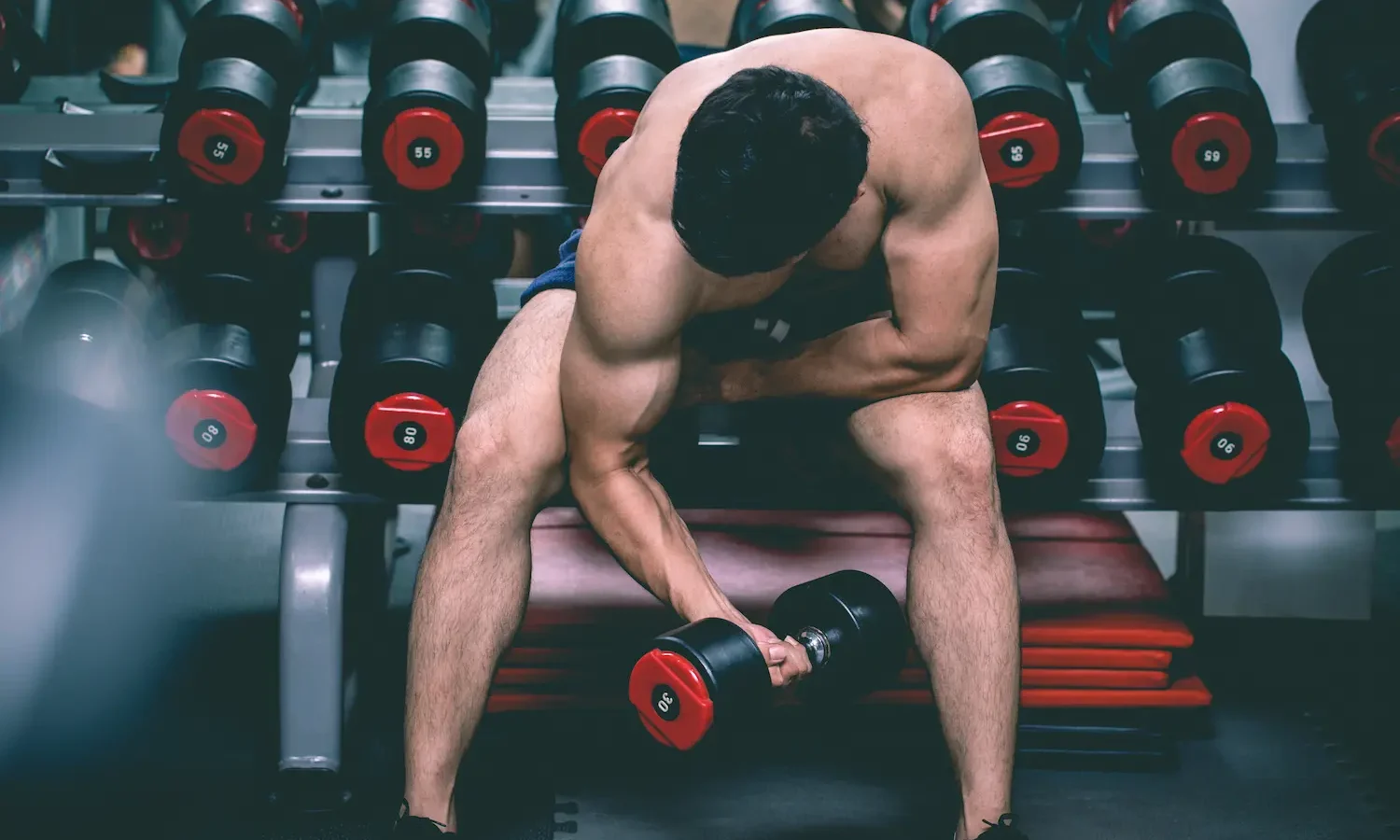
The concentration curl is an isolation exercise for the biceps performed seated, in which you hold a dumbbell in one hand and rest the elbow of that arm against the inner thigh on the same side. From this braced position, you curl the dumbbell up toward the shoulder, then lower with control.
The bracing of the elbow against the thigh eliminates virtually all body English. The biceps does all the work — there’s no swinging, no shoulder lift, no cheat. That’s the whole point. Strict, focused, and brutal at moderate loads.
Muscles worked
| Muscle group | Role | Contribution |
|---|---|---|
| Biceps brachii (especially the peak) | Primary mover, elbow flexion | ~80 % |
| Brachialis | Elbow flexion (under biceps) | ~15 % |
| Brachioradialis (forearm) | Forearm flexion | ~5 % |
The concentration curl bias the biceps brachii harder than nearly any other curl variation. The braced elbow position eliminates compensatory muscle recruitment, so the biceps does pure work.
How to concentration curl: 5 steps
-
Set up on a bench
Sit on a bench with feet wider than hip-width, knees bent at ~90°. Hold a dumbbell in one hand. Lean forward slightly, place the elbow of the working arm against the inner thigh on the same side, just above the knee.
-
Set the start position
The arm holding the dumbbell hangs straight down between your legs, elbow firmly braced against the inner thigh. The free hand rests on the opposite knee or thigh for stability. Palm facing forward (supinated).
-
Curl up with intent
Bend the elbow to lift the dumbbell up toward the shoulder. **Squeeze the biceps hard at the top.** The elbow stays braced — don't let it drift forward or back. Only the forearm moves.
-
Pause at the top
1-second pause at the top, biceps fully contracted. Don't let momentum carry the dumbbell — pause and feel the squeeze.
-
Lower in 2-3 seconds
Controlled eccentric. Fully extend the arm at the bottom — biceps stretched. Don't let the dumbbell crash. Reset, repeat. Switch arms after the set.
Common mistakes to avoid
Variations
- Standing concentration curl. Bent over instead of seated, free arm braced on the standing thigh. Same isolation, different setup.
- Dumbbell curl. Standard biceps curl, both arms. Allows heavier loads.
- Cable concentration curl. Single low cable with D-handle, same braced position. Constant tension throughout.
- Preacher curl. Arms over a sloped pad. Eliminates body English with a different brace.
- Spider curl. Lying chest-down on an incline bench. Peak biceps contraction at the top.
- Incline dumbbell curl. Lying back on a 45° incline. Stretches the biceps further.
Sample workout: 4-week biceps block
Concentration curls 1-2 times per week, after compound back work or as a biceps finisher. Reps are per arm.
| Week | Sets × reps/arm | Tempo |
|---|---|---|
| 1 | 3 × 10 | 2 sec eccentric |
| 2 | 4 × 8 | 3 sec eccentric + 1 sec pause at top |
| 3 | 4 × 8 + 1 dropset | 3 sec eccentric + 1 sec pause |
| 4 (deload) | 3 × 10 | Smooth |
Frequently asked questions
Concentration curl or dumbbell curl?
Both. Standing dumbbell curls allow heavier loads (and are usually your primary biceps lift). Concentration curls isolate better with light load. Use them as accessory or finisher to your main curl.
How heavy should I concentration curl?</h3
Lighter than your standing dumbbell curl — often 60-70 % of that load. The strict position eliminates the cheat that lets you go heavier on standing curls. For a healthy male intermediate: 10-15 kg per dumbbell for 8-10 strict reps.
Why don’t I feel my biceps despite the strict form?</h3
Probably going too heavy. Drop the load, slow down, focus on the squeeze. Mind-muscle connection improves quickly with intentional practice.
Should the elbow press hard against the thigh?</h3
Firm contact, not crushing. The thigh is a brace to prevent elbow drift, not a counterweight. If you’re pressing so hard that your hip lifts, the load is too heavy.
How often should I do concentration curls?</h3
2 times per week as accessory work. Like any biceps isolation, they recover in 48-72 hours. Pair with rowing or pull-up days.
Related exercises
- Dumbbell Curl: standing foundational
- Preacher Curl: alternative bracing
- Spider Curl: peak contraction variant
- Cable Curl: constant tension
- Hammer Curl: brachialis variant