
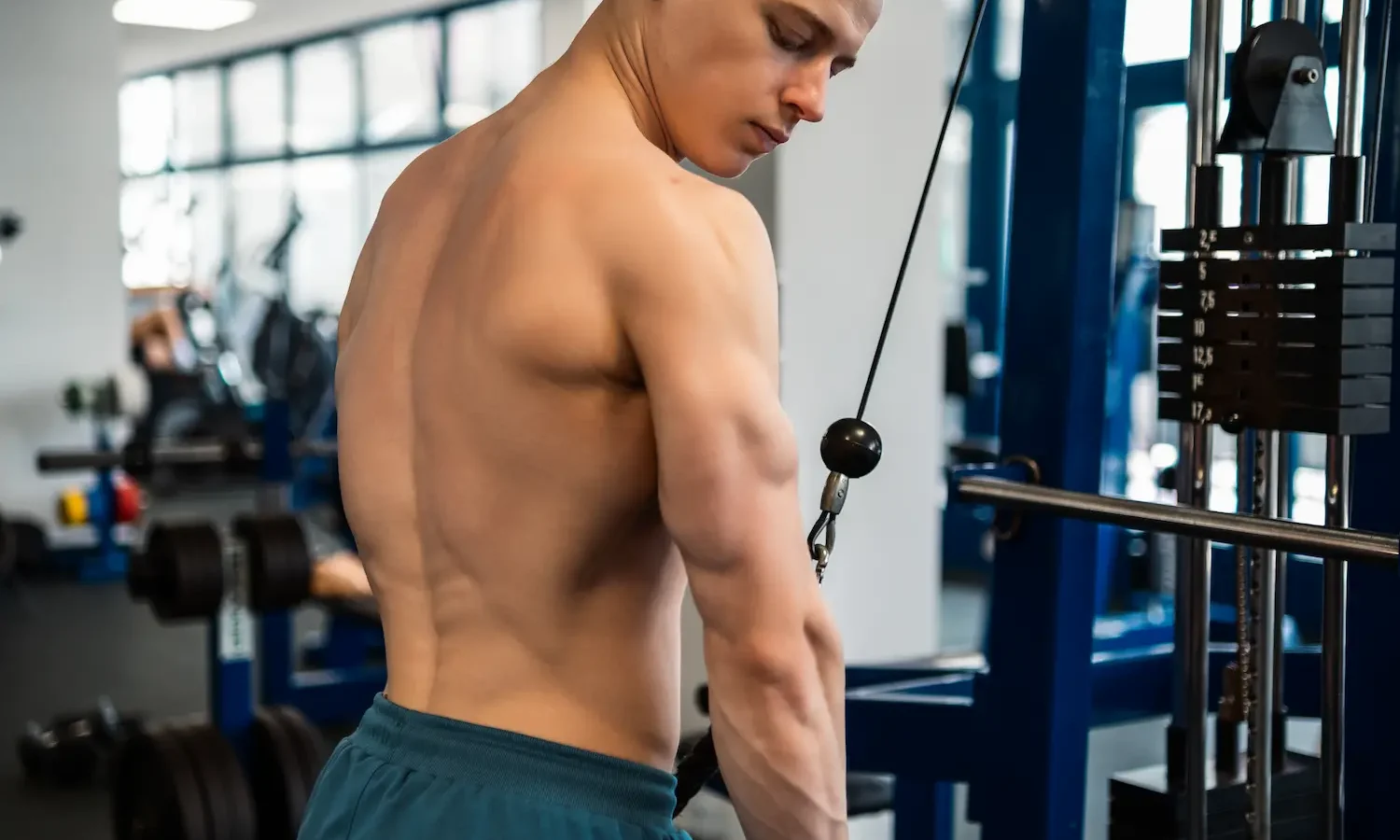
The cable triceps kickback is the cable version of the dumbbell kickback — and significantly better. Dumbbell kickbacks lose all tension at the top of the rep (the hardest part); cables keep the triceps loaded through the full range. For lifters wanting to feel the long head of the triceps work, the cable kickback delivers more reliably than any free-weight option.
This guide covers the standard single-arm cable kickback performed at a low pulley.
What is the cable triceps kickback?
The cable triceps kickback is a unilateral cable isolation for the triceps. You stand facing a low pulley, hinge forward at the hips, set the upper arm parallel to the torso, then extend the elbow backward against the cable’s resistance. The shoulder stays fixed; only the elbow moves.
It targets all three heads of the triceps with a particular emphasis on the long head (which gets stretched by the slight upper-arm angle behind the torso). It’s the go-to isolation when you want strict, controlled triceps work without joint-stressing heavy loads.
Muscles worked
| Muscle group | Role | Contribution |
|---|---|---|
| Triceps brachii (long, lateral heads) | Primary mover, elbow extension | ~85 % |
| Posterior deltoid | Shoulder stabilisation | ~10 % |
| Core, scapular stabilisers | Body stabilisation | ~5 % |
The cable kickback isolates the triceps as cleanly as it gets. Compared to the triceps pushdown (also great), the kickback puts the upper arm in a slightly stretched position, hitting the long head harder.
How to cable triceps kickback: 5 steps
-
Set up the cable
Attach a single handle to the **low pulley**. Stand facing the cable column, about 60 cm away. Grip the handle in one hand, palm facing the torso.
-
Hinge forward
**Hinge forward at the hips** until the torso is at roughly 45° to the floor. Brace the core. Free hand on the same-side knee or hip for support. Back flat, not rounded.
-
Set the upper arm
**Pin the upper arm against your torso, parallel to the floor.** Elbow bent at 90°, forearm hanging straight down. This is the starting position. The upper arm stays in this position throughout — only the forearm moves.
-
Extend the elbow back
**Drive the forearm back** until the elbow is fully locked, arm extended straight behind you. 2 seconds. **Squeeze the triceps hard** at peak contraction. Maintain the upper-arm position.
-
Return with control
Lower the forearm back to the 90° bent position in 2 seconds. Keep tension on the cable. Reset, repeat. Switch arms after the set.
Common mistakes to avoid
Variations
- Rope cable kickback. Rope attachment, wrist rotates outward at the top. Greater peak contraction.
- Bent-over cable kickback. Hinge deeper for max stretch on the long head.
- Two-arm cable kickback. Both arms simultaneously with straight bar. Time-efficient.
- Incline-bench cable kickback. Chest on a low-incline bench. Strict body position.
- Dumbbell kickback. Free-weight version, loses tension at the top.
- Triceps pushdown. Vertical cable triceps alternative.
Sample workout: 4-week triceps finisher block
Cable kickbacks as a triceps finisher 1-2 times per week, after main pressing or compound triceps work like close-grip bench or dips. Sets per arm.
| Week | Sets × reps/arm | Tempo |
|---|---|---|
| 1 | 3 × 12 | 2 sec back + 1 sec squeeze + 2 sec return |
| 2 | 3 × 15 | 2 sec back + 2 sec squeeze + 2 sec return |
| 3 | 4 × 12 + drop set | 1 sec back + 1 sec squeeze + 3 sec return |
| 4 (deload) | 3 × 10 | Smooth |
Frequently asked questions
Cable or dumbbell kickback?
Cable wins for constant tension and peak-contraction loading. Dumbbell kickbacks lose all tension at the lockout — exactly where the triceps should be working hardest. If you have access to a cable stack, kick the dumbbells.
How heavy should I cable kickback?</h3
Lighter than you think. Cable kickbacks are isolation, not strength work. Most lifters use 5-15 kg per arm for 12-15 reps with strict form. If the upper arm moves or the body swings, lower the load.
Should the upper arm be parallel to the floor or pointed back?</h3
Parallel to the floor for the standard kickback (upper arm horizontal). Pointing it slightly higher (10-15° above horizontal) stretches the long head more — useful as a variation.
Why do I feel it in my shoulder, not my triceps?</h3
The upper arm is moving when it shouldn’t. Pin the elbow to the side, fix the upper arm parallel to the torso — only the forearm should move. If shoulder fatigue keeps showing up, the load is too heavy.
Cable kickback vs triceps pushdown?</h3
Both excellent. Pushdown is heavier and more shoulder-friendly, hits the lateral head harder. Kickback is more strict and hits the long head harder. Use both in rotation.
Related exercises
- Triceps Pushdown: vertical cable triceps
- Skull Crusher: barbell triceps isolation
- Triceps Extension: overhead triceps
- Close-Grip Bench Press: compound triceps
- Dips: bodyweight triceps + chest