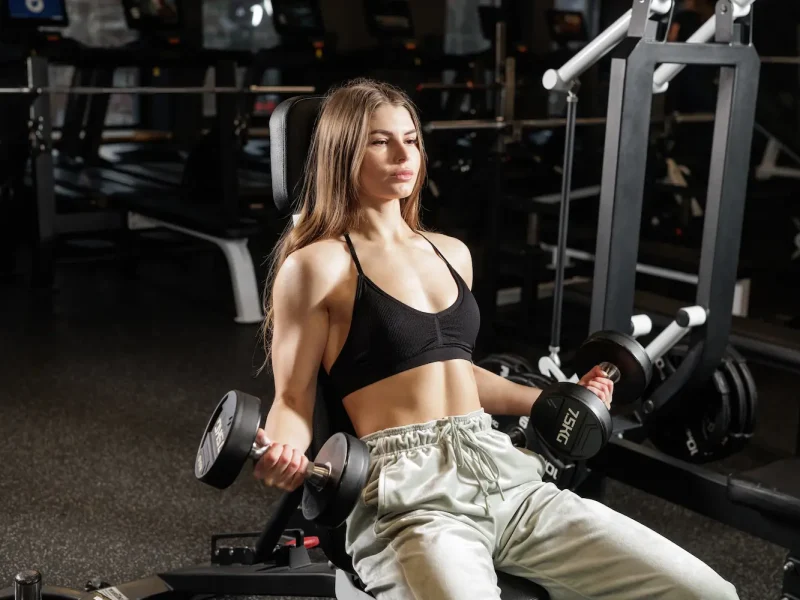

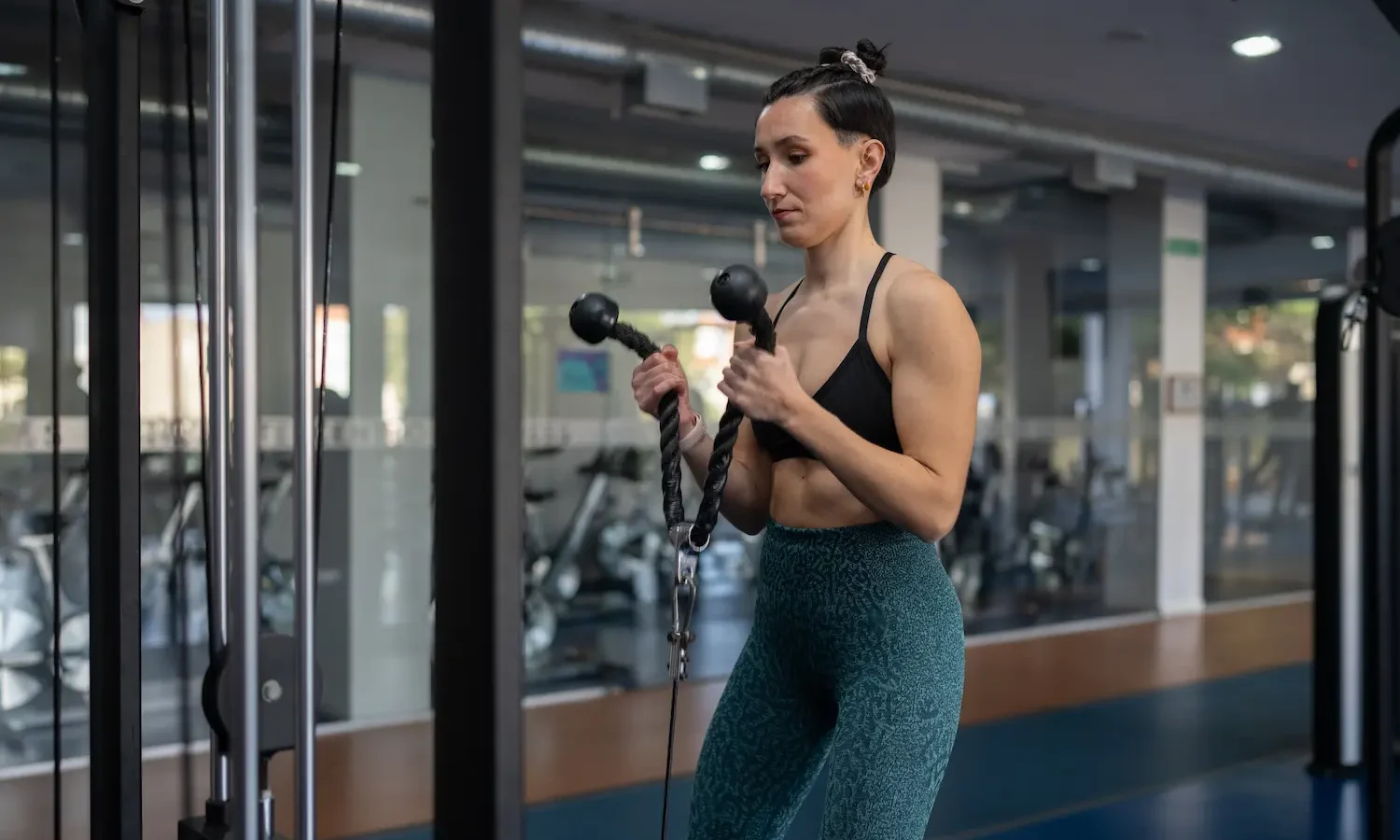
The cable rope curl uses a rope attachment on a low cable, allowing the hands to rotate freely throughout the curl. The free rotation lets you exaggerate the supination at the top — squeezing the biceps harder than any fixed bar can — and the cable provides constant tension start to finish.
What it is
The cable rope curl is a bilateral cable curl performed with a rope attachment on a low pulley. The lifter grips the rope ends, palms facing each other, and curls up while rotating the wrists outward (supinating) at the top. The combination of constant cable tension and active supination maximises biceps activation.
Muscles worked
| Muscle | Contribution |
|---|---|
| Biceps brachii | ~60 % |
| Brachialis | ~20 % |
| Brachioradialis | ~10 % |
| Forearms | ~10 % |
How to cable rope curl: 5 steps
-
Set up the cable
Attach a **rope to the low pulley.** Grip both ends, palms facing each other.
-
Stand tall
**Feet hip-width, elbows pinned to sides,** arms extended at hips.
-
Curl with supination
**Curl up while rotating the wrists outward** (supinating). At the top, palms should face the shoulders.
-
Peak squeeze
**Hold the full supination at the top** with maximal biceps contraction.
-
Controlled descent
**Lower over 2-3 seconds,** returning to neutral grip at the bottom.
How it differs from cable curl
- Rope attachment with free rotation. Hands rotate during the curl, allowing maximal supination at the top.
- Active supination. Wrists turn outward at the top — the biceps’ second action (besides flexion).
- Constant tension. Cable maintains load through the entire rep.
- Lighter loads than barbell. The dynamic grip limits load — 60-70 % of barbell curl weight.
Common mistakes
When to use this variation
Use cable rope curls for maximum biceps activation with constant tension and active supination. Program 3 sets of 12-15 reps as a finisher or a high-volume biceps drill. Pair after heavy barbell curls — the rope variation rewards the pump phase.
FAQ
Why supinate at the top?
The biceps brachii flexes the elbow AND supinates the forearm. Adding active supination at the top maximises biceps shortening — a peak contraction that fixed-bar curls can’t replicate.
Cable rope curl or standard cable curl?
The straight bar cable curl loads heavier. The rope curl maximises supination and peak contraction. Both have value; rotate between them.
Bench or standing?
Standing is the standard. Sitting (using a bench) eliminates body english and forces stricter form — both versions work.
Related exercises
- Cable Curl: straight-bar version
- Bayesian Curl: arm-behind-body cable variant
- Dumbbell Curl: standard free-weight curl
- Cable Hammer Curl: neutral-grip cable option