
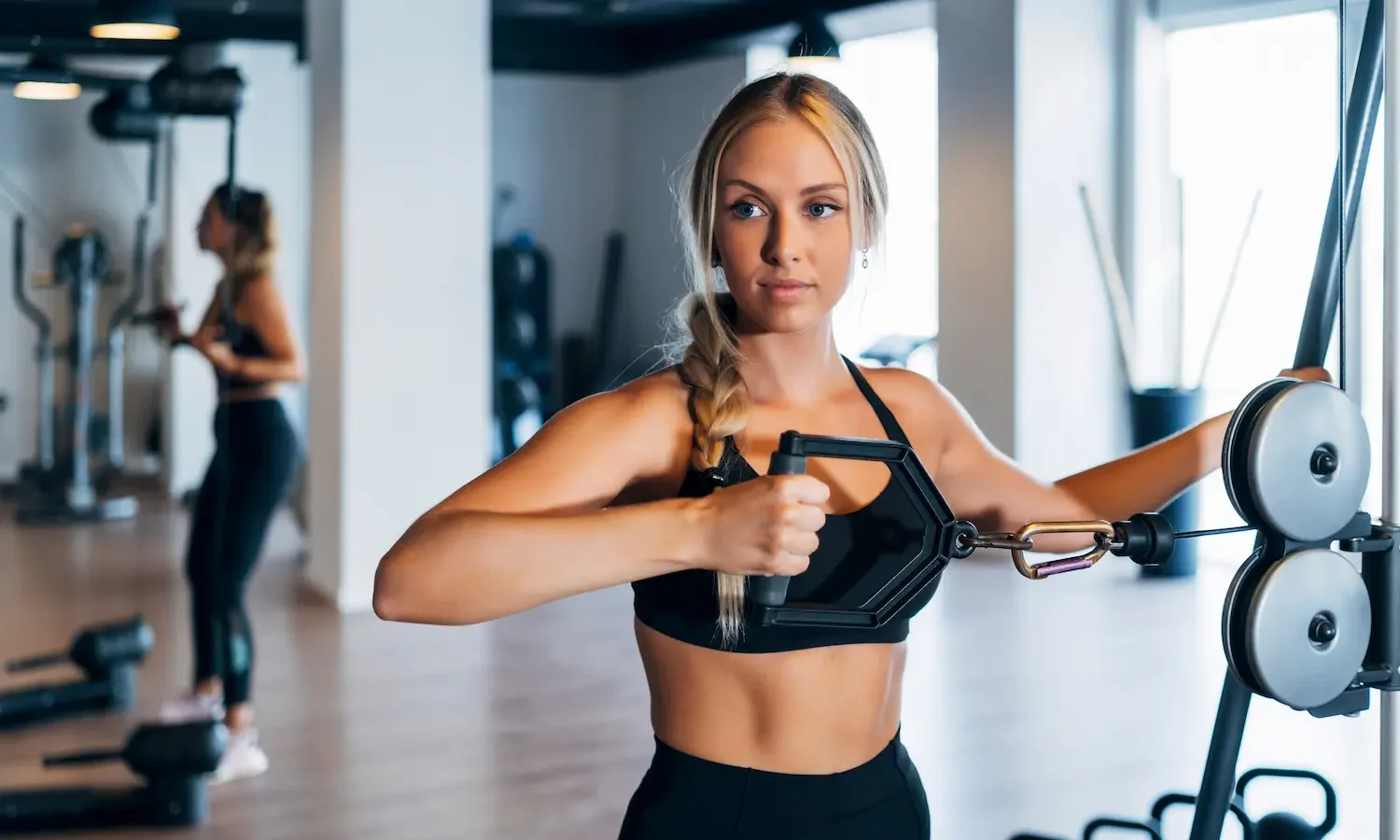
The cable reverse fly is the gold-standard rear deltoid isolation. Standing in a dual-cable station with handles set at shoulder height crossed in front of you, you pull both cables outward and back — opening the arms wide while squeezing the rear delts and mid-traps together. The crossing setup keeps the rear delts loaded through the full range.
If your rear delts lag behind your front and side delts (typical for most lifters), the cable reverse fly is the single most useful fix. It works alongside the face pull and reverse pec deck for complete rear-delt coverage.
What is the cable reverse fly?
The cable reverse fly is a cable isolation for the posterior deltoid and mid-back muscles. Standing in the centre of a dual-cable station, you grip the right-side handle in the left hand and vice versa — cables crossed in front. From this position, you pull both cables outward and back, opening the arms into a “T” shape while squeezing the shoulder blades together.
The crossed-cable setup keeps the rear delts loaded through the full ROM — including the back-end squeeze where dumbbell reverse flyes lose tension. Cable resistance also forces strict scapular control, which is half the battle for rear-delt growth.
Muscles worked
| Muscle group | Role | Contribution |
|---|---|---|
| Posterior deltoid | Primary mover, horizontal abduction | ~55 % |
| Mid trapezius, rhomboids | Scapular retraction | ~25 % |
| Teres minor, infraspinatus | External rotation | ~10 % |
| Core, lower traps | Stabilisation | ~10 % |
The cable reverse fly is one of the best rear delt exercises available. It also strongly trains the mid-back and rotator cuff externals — important for shoulder health and posture for anyone who benches a lot.
How to cable reverse fly: 5 steps
-
Set up the dual cable station
Set both cables to **shoulder height**, attach single handles. Stand in the centre. **Reach for the opposite-side handle with each hand** — left hand grips right-side cable, right hand grips left-side cable. The cables now cross in front of your chest.
-
Set the start position
Stand tall, slight knee bend, **brace the core**. Arms extended forward and slightly down in an "X" position, palms facing in. Elbows at a **fixed slight bend (~15°)** throughout.
-
Pull the cables out and back
**Pull both arms outward and back** in a wide arcing motion. **Pinkies lead the way out.** The arms travel from a forward "X" position to a wide "T" position with hands roughly in line with the ears or slightly behind. 2 seconds.
-
Squeeze at the back
1-2 second pause when the arms are fully open. **Squeeze the rear delts and shoulder blades together hard.** Don't let the elbows drop or extend.
-
Return with control
Reverse in 3 seconds back to the crossed-arm start position. **Maintain tension on the cables** throughout. Reset, repeat.
Common mistakes to avoid
Variations
- Single-arm cable reverse fly. One arm at a time. Identifies left-right asymmetries.
- Seated cable reverse fly. Seated on a bench. Removes lower-back cheating.
- Face pull. Rope-handle horizontal pull with external rotation. Same target, slightly different angle.
- Reverse pec deck. Machine-based rear fly. Easy to learn, no setup hassle.
- Bent-over dumbbell reverse fly. Free-weight version.
- Cable Y-raise. Lower traps and upward rotation focus.
Sample workout: 4-week rear-delt block
Cable reverse flyes 2-3 times per week. Rear delts recover fast — high frequency works. Pair with face pulls and reverse pec deck for max stimulus.
| Week | Sets × reps | Tempo |
|---|---|---|
| 1 | 3 × 15 | 2 sec out + 1 sec squeeze + 2 sec in |
| 2 | 3 × 12 + drop set | 2 sec out + 2 sec squeeze + 2 sec in |
| 3 | 4 × 15 | 1 sec out + 2 sec squeeze + 3 sec in |
| 4 (deload) | 3 × 12 | Smooth |
Frequently asked questions
Cable reverse fly or face pull?
Both excellent. Face pull has more external rotation (better for rotator cuff health). Cable reverse fly is more isolated rear-delt work. Most rear-delt programs include both — face pulls on one day, reverse flyes on another.
Why are rear delts so commonly underdeveloped?</h3
The front delts get hammered by every push exercise (bench, overhead press, push-ups). Side delts get direct work via lateral raises. Rear delts only fire significantly in rowing motions and direct work — which most lifters skip. Result: a front-heavy shoulder that round forward.
How heavy should I cable reverse fly?</h3
Light to moderate. Rear delts are small muscles that respond to high-rep, strict work. Most lifters work 10-25 kg per side for 12-15 reps. Heavier loads almost always cause the lats to take over.
Why do I feel it in my back instead of my rear delts?</h3
The lats are taking over (you’re rowing instead of flying). Two fixes: (1) keep the elbows wide, not tucked, and (2) think “pull out and back with the pinkies leading” — that cue activates the rear delt over the lat.
Should the cable be shoulder-height or higher?</h3
Shoulder-height is the standard — pure horizontal abduction. Slightly above shoulder height (chest-height cables) shifts emphasis toward the mid-traps. Both work; rotate between heights for variety.
Related exercises
- Face Pull: rear-delt + external rotation
- Reverse Pec Deck: machine rear fly
- Lateral Raise: side-delt isolation
- Cable Lateral Raise: cable side-delt
- Barbell Row: compound upper-back builder
Published by: Jay — Writer covering back exercises
Reviewed, corrected and approved by: Martin Wood — Editor-in-chief
Updated on May 17, 2026