
The cable deadlift is the perfect introduction to the hip hinge — and an underrated finisher for advanced lifters. With a cable instead of a barbell, the loading curve is reversed: resistance is hardest at the top (full hip extension) where conventional deadlifts are easiest. That makes it brutal on the glutes and a precise teacher of hip-hinge form.
This guide covers the standard cable deadlift with handle or rope at the low pulley.
What is the cable deadlift?
The cable deadlift is a cable hip-hinge exercise. Standing facing a low cable, you grip a rope or straight bar attachment, then hinge at the hips (squatting slightly) to lower the attachment toward the floor while the cable pulls you forward. From this hinged position, you drive the hips forward and stand back up — fully extending against the cable’s peak resistance.
Because the cable’s resistance peaks at the top of the rep (full lockout), the cable deadlift uniquely loads the glutes at lockout — exactly where conventional barbell deadlifts are easiest. It’s also lighter on the lower back, making it an excellent teaching tool and a safer alternative for people with previous back issues.
Muscles worked
| Muscle group | Role | Contribution |
|---|---|---|
| Gluteus maximus | Primary mover, hip extension | ~40 % |
| Hamstrings | Hip extension support | ~25 % |
| Erector spinae, lower back | Spinal extension | ~15 % |
| Quadriceps | Knee extension | ~10 % |
| Lats, traps, core, forearms | Stabilisation, grip | ~10 % |
The cable deadlift trains the same primary muscles as the barbell deadlift and RDL — gluteus maximus, hamstrings, erector spinae. The lighter, top-loaded resistance is gentler on the lower back, making it ideal for hip-hinge teaching, rehab, or finisher work.
How to cable deadlift: 5 steps
-
Set up the cable
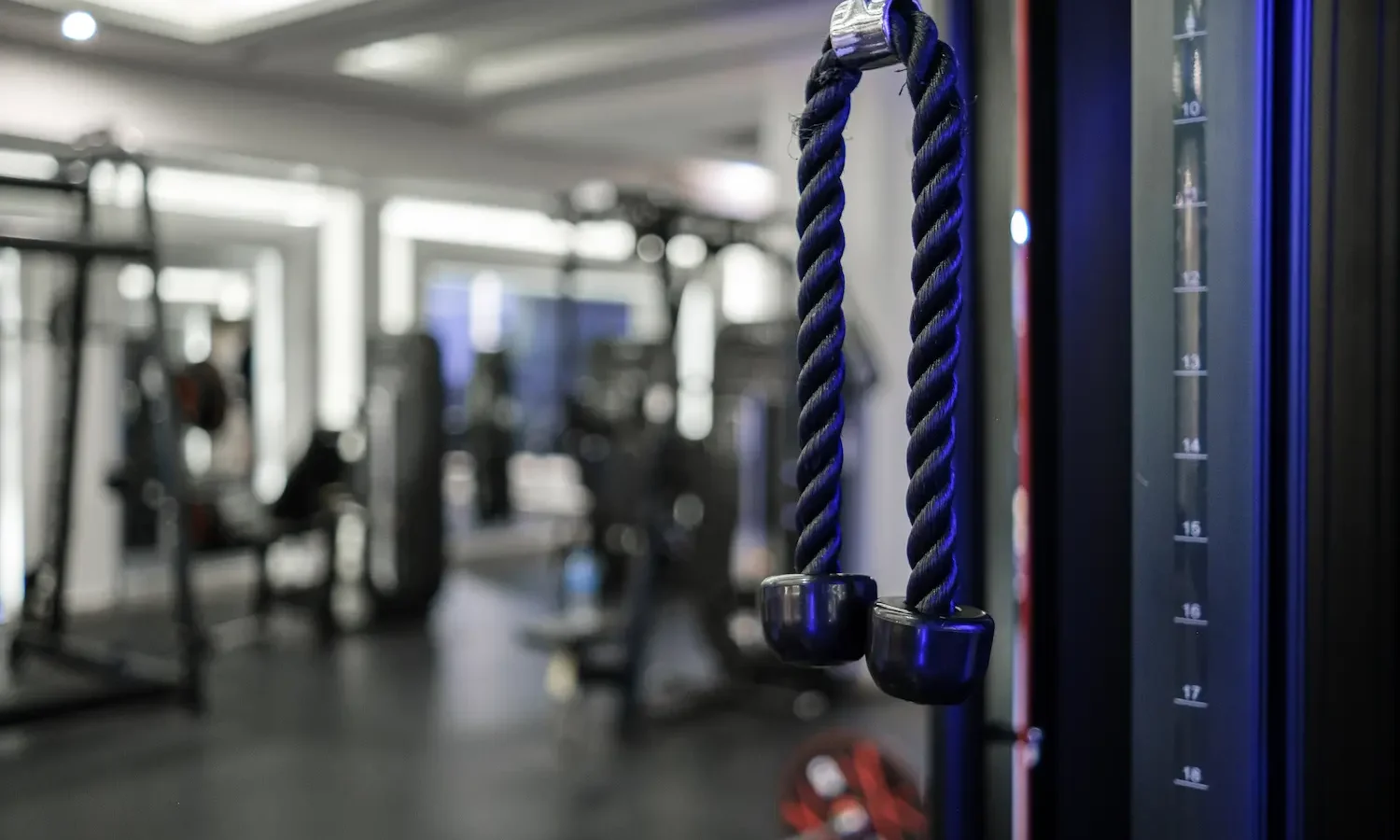
Attach a rope or straight bar to the **low pulley** (lowest setting). Stand facing the cable column, about 60 cm away. Grip the attachment with both hands, arms fully extended down. Cable taut.
-
Hinge down to start
**Push the hips back** as if closing a car door with your butt. **Hinge at the hips**, slight knee bend, **back flat (neutral spine)**. The attachment lowers along the front of your legs. Stop when the torso is at roughly 45° from upright. **Brace the core.**
-
Drive hips forward to stand up
**Drive the hips forward and up** to stand. The cable pulls you forward — fight it. **Squeeze the glutes hard** as you reach full hip extension. Arms stay straight throughout — they're just hooks.
-
Lock out at the top
Stand fully upright at the top — hips fully extended, glutes squeezed at peak contraction. **Don't lean back or arch the lower back** — neutral spine, glutes do the work.
-
Hinge back down with control
Lower in 3 seconds back to the hinged start position. **Maintain the hip hinge — hips go back, not down.** Cable tension stays constant. Reset, repeat.
Common mistakes to avoid
Variations
- Cable Romanian deadlift. Stiffer-leg version, hamstring-emphasis. Minimal knee bend.
- Single-leg cable deadlift. One-leg version. Unilateral glute work, big balance demand.
- Cable pull-through. Cable between the legs from behind, pull-through pattern. Glute-emphasis.
- Sumo cable deadlift. Wide-stance version. More adductor work.
- Barbell deadlift. The heavy compound version.
- Romanian deadlift. Barbell hamstring-focus hinge.
Sample workout: 4-week hinge-teaching block
Cable deadlifts 1-2 times per week — either as a teaching/warm-up tool before heavy barbell work, or as a glute-focused finisher.
| Week | Sets × reps | Tempo |
|---|---|---|
| 1 | 3 × 10 | 2 sec down + 1 sec pause + 1 sec up + 1 sec squeeze |
| 2 | 4 × 10 | 3 sec down + 1 sec pause + 1 sec up + 2 sec squeeze |
| 3 | 3 × 12 | 3 sec down + 2 sec pause + 1 sec up + 2 sec squeeze |
| 4 (deload) | 3 × 10 | Smooth |
Frequently asked questions
Cable or barbell deadlift?
Different roles. Barbell deadlift is the king of total-body strength — heavier loads, more compound stimulus. Cable deadlift is a teaching tool + glute finisher with reversed loading (heaviest at lockout). Use both for complete development.
Why is the cable deadlift good for beginners?</h3
Three reasons. (1) Lighter loads mean less injury risk while learning the hinge. (2) The constant cable tension forces awareness of the hip hinge throughout the rep. (3) The peak load at lockout teaches proper glute drive — a movement pattern many beginners struggle with.
How heavy should the cable deadlift be?</h3
30-60 % of your barbell deadlift 1RM for 10-12 reps. The cable’s top-loaded resistance feels heavier than barbells of equivalent weight at the lockout — respect the difference.
Cable deadlift or cable pull-through?</h3
Similar movements with different setups. Cable pull-through has the cable between the legs from behind — more glute-specific. Cable deadlift has the cable in front — more total-body, more like a traditional deadlift pattern. Both are excellent.
Is the cable deadlift safer for the lower back?</h3
Generally yes — lower loads, more controlled hinge teaching, peak resistance at lockout (where the spine is already neutral). For lifters recovering from a lower-back injury, cable deadlifts are often a stepping stone back to barbell work.
Related exercises
- Deadlift: barbell compound
- Romanian Deadlift: hamstring-focus hinge
- Cable Pull-Through: between-legs glute hinge
- Hip Thrust: glute-isolation hip extension
- Glute Bridge: floor-based glute work