
The cable pull-through is the hip-hinge teaching exercise of the gym. It looks weird (you stand facing away from a cable, pulling rope between your legs and standing up), but it loads the glutes and hamstrings in a hinge pattern with constant tension and minimal lower-back demand.
The pull-through is the perfect bridge between learning the hip hinge with bodyweight and loading it heavy with the Romanian deadlift. It’s also an excellent finisher for posterior chain volume after deadlifts.
What is the cable pull-through?
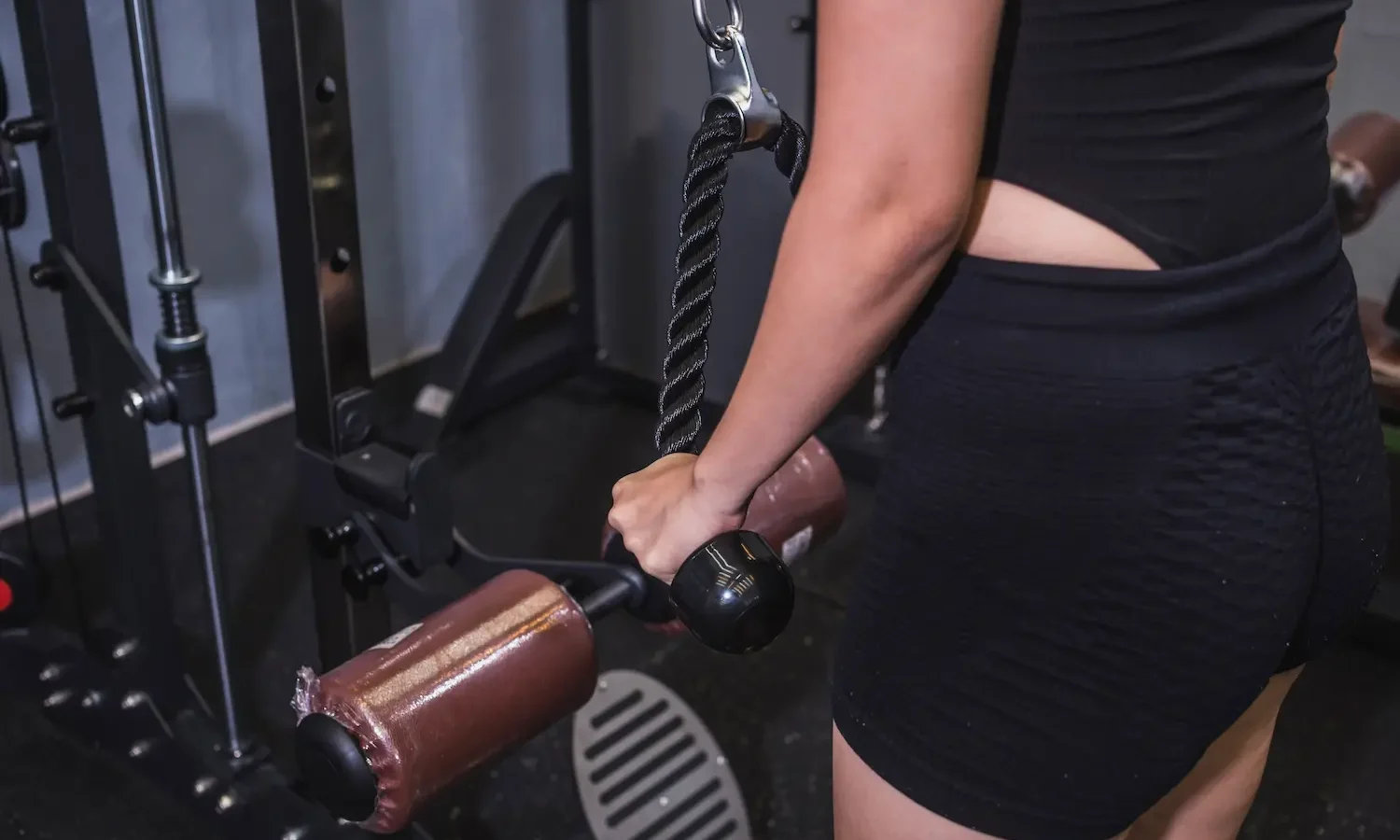
The cable pull-through is a hip-hinge exercise performed at a low cable, in which you stand facing away from the cable, grip a rope handle between your legs, hinge forward at the hips, then drive the hips forward to bring the cable rope through your legs to a fully standing position. The movement is identical to the Romanian deadlift in pattern but loaded from behind by a cable instead of in front by a barbell.
The cable angle (pulling slightly downward and back) creates constant tension on the glutes throughout the rep, which is the pull-through’s main advantage over barbell hinges. It also removes the need for grip strength as a limiting factor.
Muscles worked
| Muscle group | Role | Contribution |
|---|---|---|
| Glutes (gluteus maximus) | Primary mover, hip extension | ~50 % |
| Hamstrings | Hip extension support | ~25 % |
| Erector spinae (lower back) | Posture stabilisation | ~15 % |
| Core, forearms | Stabilisation | ~10 % |
The pull-through hits the glutes and hamstrings with less spinal load than the deadlift or RDL. That makes it ideal for finishing volume after heavy hinges, or as a primary hinge for lifters with lower-back issues.
How to cable pull-through: 5 steps
-
Set up at the low cable
Attach a rope handle to a low cable. Stand facing away from the cable, straddle it with feet shoulder-width apart. Step forward 1-2 metres so the cable is taut. Reach down between your legs and grip the rope.
-
Set the start position
Stand tall, slight bend in the knees. Pull the rope between your legs, then take 1-2 small steps forward to set the cable tension. Brace the core. Hinge at the hips slightly.
-
Hinge forward
Push the hips back as if reaching for a wall behind you. The cable pulls the rope back between your legs. Spine stays neutral, knees soft. Stop when you feel a strong stretch in the hamstrings.
-
Drive the hips forward
**Squeeze the glutes hard** to drive the hips forward and bring the rope through. Stand fully upright. **Glute contraction at the top** is the goal — pause and squeeze.
-
Lower with control
Reverse the motion in 2-3 seconds. Hinge back into the stretched position. Don't fully relax — maintain tension. Reset, repeat.
Common mistakes to avoid
Variations
- Single-leg cable pull-through. One leg at a time. Adds balance demand and unilateral hip work.
- Banded pull-through. Resistance band anchored low instead of cable. Home version.
- Kettlebell swing. Similar pattern, ballistic version. The next step up in posterior chain training.
- Romanian deadlift. Heavier loaded hinge with barbell.
- Hip thrust. Different position but similar primary muscles.
- Good morning. Bar across the back, hinge variant. Demanding lower back.
Sample workout: 4-week glute block
Cable pull-throughs 2-3 times per week, after compound work or as a glute finisher.
| Week | Sets × reps | Tempo |
|---|---|---|
| 1 | 3 × 12 | 2 sec eccentric + 1 sec squeeze at top |
| 2 | 4 × 10 | 2 sec eccentric + 2 sec squeeze |
| 3 | 4 × 10 + 1 dropset | 3 sec eccentric + 2 sec squeeze |
| 4 (deload) | 3 × 10 | Smooth |
Frequently asked questions
Cable pull-through or Romanian deadlift?
Different functions. RDL is heavier and trains posterior chain with maximum load. Pull-through is lighter, constant tension, kinder on the back, and excellent as a teaching exercise or finisher. Most balanced programs use the RDL as primary, pull-through as accessory.
How heavy should I cable pull-through?</h3
Moderate. The cable angle creates a powerful glute squeeze at the top — too much weight ruins that. For most lifters: 30-50 kg on the cable for 10-15 reps with strict form.
Why does my back round during pull-throughs?</h3
Either the load is too heavy or you’re not hinging at the hips. Push the hips back, not down. Knees soft. Spine stays neutral throughout — same as RDL.
Can I do pull-throughs at home with a band?</h3
Yes. Anchor a resistance band to a low sturdy point (door anchor at floor level, heavy furniture). Same exercise. Slightly different feel because band tension increases as you stand up, but very effective.
Is the cable pull-through a glute or a hamstring exercise?</h3
Primarily glute, with hamstrings as secondary. The cable angle creates a strong glute contraction at the top of the rep — that’s the unique value of the pull-through.
Related exercises
- Romanian Deadlift: heavy bilateral hinge
- Hip Thrust: heavy bilateral glute
- Glute Bridge: floor-based glute
- Kettlebell Swing: ballistic hinge
- Glute Ham Raise: combined hip + knee posterior chain
Published by: Jay — Writer covering hamstring exercises
Reviewed, corrected and approved by: Martin Wood — Editor-in-chief
Updated on May 11, 2026