
The beltless deadlift is simply the conventional deadlift performed without a lifting belt. Stripping away the belt forces the core to do all the bracing on its own. Lifters program it to build raw trunk strength, expose bracing weaknesses, and make sure their belted numbers are built on a solid foundation rather than borrowed support.
What it is
The beltless deadlift is a deadlift done with no belt, relying entirely on the lifter’s own bracing. A belt gives the abdominal wall something to push against, raising intra-abdominal pressure and trunk stiffness. Without it, the core, obliques, and erectors must generate that stiffness alone, so working loads usually sit around 85-90 % of a belted deadlift.
Muscles worked
| Muscle | Contribution |
|---|---|
| Glutes, hamstrings | ~35 % |
| Erector spinae | ~25 % |
| Core, obliques | ~25 % |
| Quadriceps, traps, forearms | ~15 % |
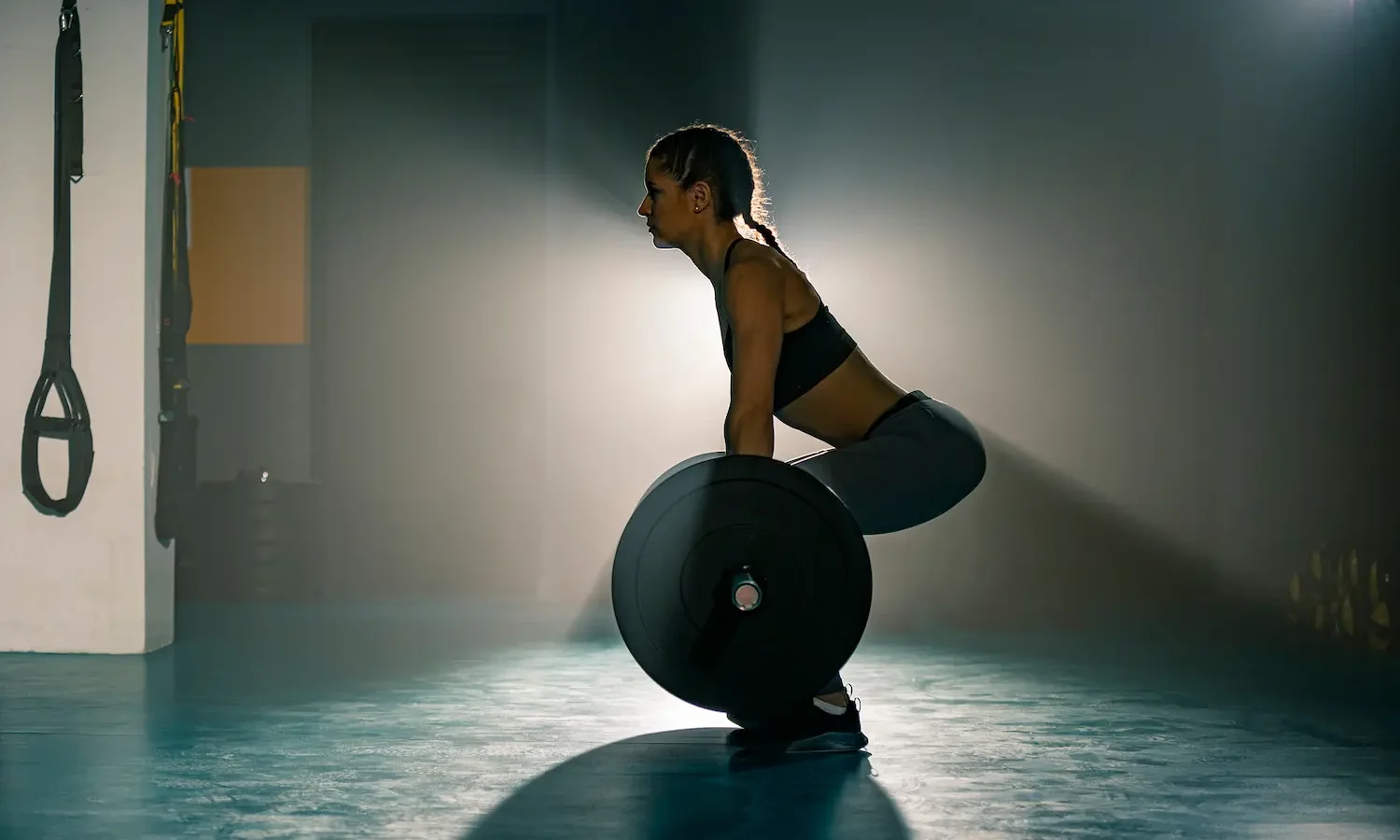
How to beltless deadlift: 5 steps
-
Set up the pull
Feet hip-width, bar over mid-foot, grip just outside the legs. **No belt — this is all you.**
-
Take a big breath
**Breathe deep into the belly and brace the whole trunk 360 degrees** as if expecting a punch.
-
Set the back
**Chest up, lats tight, flat back.** Pull the slack out of the bar while holding the brace.
-
Pull with a locked trunk
**Drive off the floor and keep the brace solid.** The core must hold rigid the entire rep.
-
Lock out and reset
Finish tall, then **lower under control.** Reset your breath and brace fully before the next rep.
How it differs from conventional deadlift
- No belt support. The core must create all the trunk stiffness on its own.
- More core development. The abs, obliques, and erectors get a bigger training stimulus every rep.
- Lighter loads. Most lifters pull around 85-90 % of their belted deadlift.
- Better bracing skill. It forces you to learn a proper breath-and-brace rather than leaning on the belt.
Common mistakes
When to use this variation
Use beltless deadlifts to build core strength and reinforce bracing during off-season or hypertrophy blocks. Many lifters do their lighter warm-up and back-off sets beltless, then belt up only for top sets. As dedicated work, 3-4 sets of 4-8 reps at 85-90 % of your belted deadlift fits well. Save the belt for genuine maximal efforts where you want every kilo.
FAQ
Is deadlifting beltless safer?
Neither is inherently safer. A belt does not protect the back by itself — good technique does. Beltless work just builds more independent core strength, which supports the back over time.
How much weight will I lose without a belt?
Most lifters lose roughly 5-15 % off their belted deadlift. The exact gap depends on how well you brace and how accustomed you are to lifting beltless.
Should beginners use a belt at all?
Learn to brace beltless first. Once you can deadlift with a confident, well-braced trunk, a belt becomes a useful tool for heavy work rather than a crutch.
Related exercises
- Deadlift: the standard pull
- Paused Deadlift: another bracing builder
- Plank: isometric core strength
- Suitcase Carry: anti-lateral-flexion core work