
The behind-the-neck press is the old-school shoulder builder that fell out of fashion — sometimes for good reason, often unfairly. Pressing the bar from behind the head allows a more vertical bar path and targets the middle deltoid harder than the standard overhead press. The catch: it demands excellent shoulder mobility, and it’s unsafe for anyone who lacks it.
For lifters with healthy shoulders and full overhead mobility, the behind-the-neck press is a legitimate shoulder developer. For everyone else, it’s an injury waiting to happen. Honest assessment of your mobility comes first.
What is the behind-the-neck press?
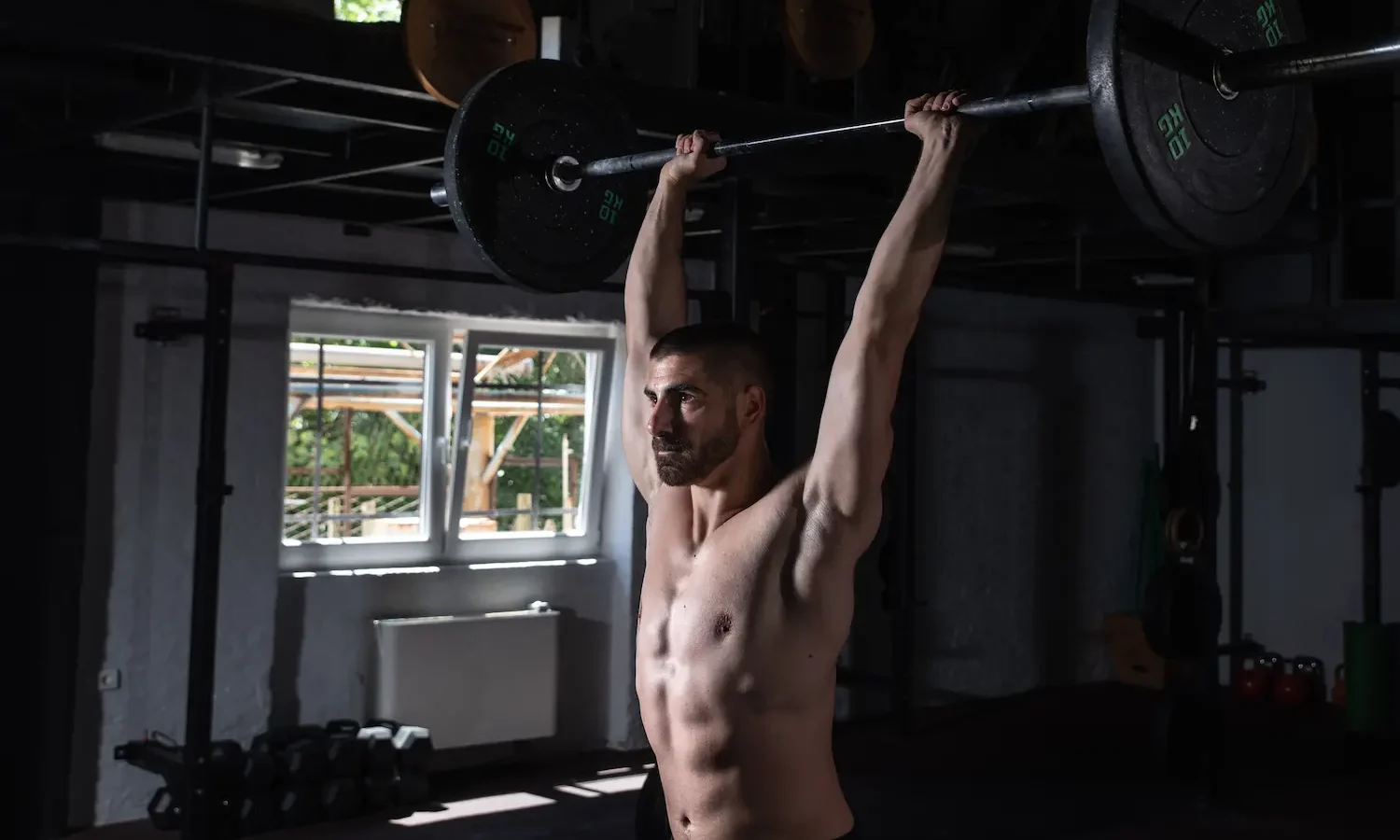
The behind-the-neck press is a barbell shoulder press performed seated (most commonly) with the bar starting and finishing behind the neck instead of in front of the face. The bar travels in a more vertical path than the front-press version, and the elbows track straight out to the sides instead of slightly forward.
It places more emphasis on the middle deltoid (vs the front delt in standard presses) and engages the upper back and rear shoulders for stabilisation. The position requires significant external rotation and overhead mobility — without those, it’s genuinely high-risk for the shoulder.
Muscles worked
| Muscle group | Role | Contribution |
|---|---|---|
| Middle deltoid | Primary mover, abduction press | ~40 % |
| Anterior + posterior deltoid | Press assist + stabilisation | ~25 % |
| Triceps brachii | Elbow extension | ~15 % |
| Trapezius, upper back | Scapular control, stability | ~15 % |
| Rotator cuff | Shoulder rotation control | ~5 % |
The behind-the-neck press hits the middle deltoid harder than any other compound shoulder press. It also works the upper back significantly — useful for posture and balance against the heavy bench-press work most lifters do.
How to behind-the-neck press: 5 steps
-
Verify mobility before loading
**Test first**: arms overhead with elbows pointing up and slightly back, no lower-back arch. If you fail this test, skip this exercise. Use the overhead press instead.
-
Set up seated
Seated on a bench with back support. Bar set in a rack at shoulder height. Grip the bar slightly wider than shoulder-width. **Brace the core**, chest up.
-
Unrack with the bar behind the neck
Duck under the bar so it rests on the upper traps (behind the head). Take 1-2 steps back from the rack (if standing) or settle into position (if seated). Elbows pointing straight down, bar resting just below the base of the skull.
-
Press straight up
**Press the bar directly up overhead** in a vertical path. Lock out at the top — arms straight, bar over the centre of the head. **No forward lean during the press.**
-
Lower with control
Lower the bar in 2-3 seconds back to the starting position behind the neck. **Stop when the bar lightly touches the upper traps** — no further. Reset, repeat.
Common mistakes to avoid
Variations
- Smith machine behind-the-neck press. Fixed bar path. Easier balance, often safer for beginners.
- Half-range behind-the-neck press. Only lower to ear level. Safer for those with limited mobility.
- Standing behind-the-neck press. Standing version. More core demand, but less stability.
- Snatch-grip behind-the-neck press. Wider grip. Used by Olympic weightlifters for catch-position mobility.
- Overhead press: front-press standard variant.
- Handstand push-up: bodyweight overhead alternative.
Sample workout: 4-week shoulder block
Behind-the-neck press 1 time per week max. Test mobility every session — if your shoulders or upper back feel restricted that day, swap for a regular overhead press.
| Week | Sets × reps | Load (% of overhead press 1RM) |
|---|---|---|
| 1 | 3 × 8 | 60 % |
| 2 | 3 × 8 | 65 % |
| 3 | 4 × 6 | 70 % |
| 4 (deload) | 3 × 8 | 55 % |
Frequently asked questions
Is the behind-the-neck press dangerous?
Only for those without the required mobility. If you can’t hold a bar with arms vertical and elbows under the bar without strain, the position is dangerous for your shoulder. With proper mobility and moderate loads, it’s safe — the same way any technical lift is safe under proper conditions.
How do I know if I have enough mobility?
Test: with arms overhead, can you bring the elbows pointing straight up and slightly back without the lower back arching? If yes, you have the mobility. If the elbows can only point forward, the behind-the-neck press is contraindicated for now.
Behind-the-neck or overhead press?
The overhead press is the default — safer for more lifters, more transferable to athletic movements. Behind-the-neck adds variety and middle-delt emphasis when mobility allows it. Use overhead press as the staple, behind-the-neck as the occasional accessory.
How heavy should I behind-the-neck press?
About 70-85 % of your overhead press 1RM for the same reps. Most lifters can’t handle as heavy a load behind-the-neck as in front because the position is less stable. Respect that gap; don’t chase parity.
How low should the bar go?
Just below the base of the skull, touching the upper traps. Lower than that increases impingement risk significantly. If the bar can’t reach this point comfortably, stop at ear level (half-range version).
Related exercises
- Overhead Press: standard front-press variant
- Push Press: dip-drive overhead
- Handstand Push-Up: bodyweight vertical press
- Lateral Raise: middle-delt isolation
- Face Pull: rear-delt + posture work