
The B-stance deadlift is a clever halfway point between a two-leg and a single-leg hinge. One foot does almost all the work while the other stays back as a light kickstand for balance. The result is a near-unilateral exercise that hits one glute and hamstring hard — without the wobble and balance demand of a true single-leg deadlift.
What it is
The B-stance deadlift is a Romanian-style hinge with a staggered stance. The working leg is flat on the floor and carries roughly 80-90 % of the load; the rear leg is set a foot back, toes down, acting only as a kickstand. It delivers most of the single-leg training effect of the single-leg deadlift with far more stability, so you can load it heavier and focus on the target side.
Muscles worked
| Muscle | Contribution |
|---|---|
| Glutes (working side) | ~40 % |
| Hamstrings (working side) | ~35 % |
| Erector spinae | ~15 % |
| Core, forearms | ~10 % |
How to B-stance deadlift: 5 steps
-
Set the staggered stance
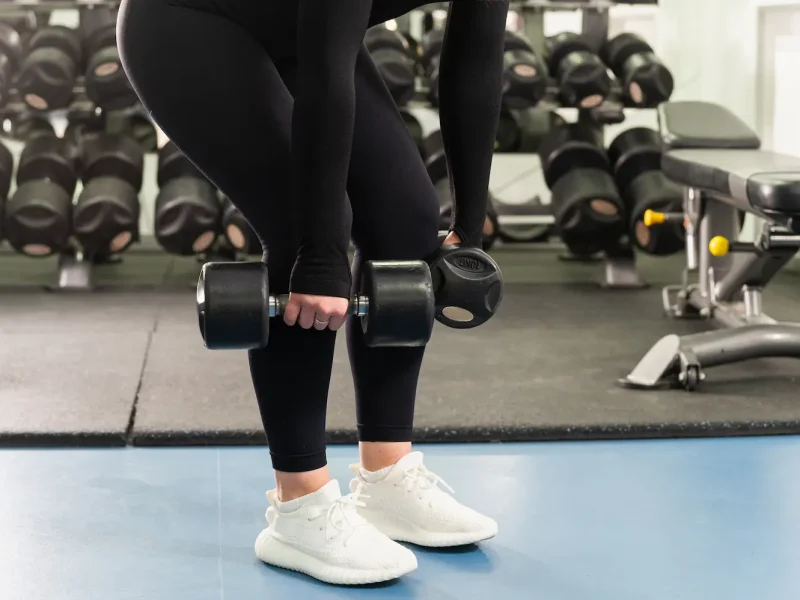
Plant the working foot flat. **Set the other foot about a foot behind, only the toes touching down** as a kickstand.
-
Load the working leg
Hold a dumbbell in each hand. **Shift 80-90 % of your weight onto the front, working leg.**
-
Brace and set the back
**Chest up, flat back, core braced.** Keep a soft bend in the working knee.
-
Hinge over the working leg
**Push the working-side hip back and lower the dumbbells down the leg** until you feel a strong hamstring stretch.
-
Drive the hip through
**Squeeze the working glute and push the hip forward** to stand tall. Complete all reps, then switch sides.
How it differs from Romanian deadlift
- Staggered stance. One leg does the work; the other is a light kickstand a foot behind.
- Near-unilateral loading. It trains one glute and hamstring at a time, fixing side-to-side imbalances.
- More stable than single-leg. The kickstand foot removes the balance challenge of a true single-leg deadlift.
- Lighter loads. Working one side at a time means each rep uses well below a two-leg RDL.
Common mistakes
When to use this variation
Use the B-stance deadlift to fix a glute or hamstring imbalance, add single-leg work without the balance demand, or build the posterior chain when heavy bilateral pulling is not an option. Program 3-4 sets of 8-12 reps per leg as accessory work. It is an excellent stepping stone toward the full single-leg deadlift, and a great way to bring up a lagging side.
FAQ
How much weight should the back leg take?
Very little — just enough for balance. Keep only the toes of the rear foot lightly touching down so the working leg carries 80-90 % of the load.
B-stance deadlift or single-leg deadlift?
The single-leg deadlift adds a big balance challenge; the B-stance version removes it so you can load heavier and focus purely on the muscle. Use B-stance to build strength, single-leg to also train balance.
Can I use dumbbells or a barbell?
Both work. Dumbbells are easier to balance and most common; a barbell allows heavier loading once you are confident with the staggered stance.
Related exercises
- Romanian Deadlift: the two-leg version
- Single-Leg Deadlift: full unilateral hinge
- Dumbbell Romanian Deadlift: two-leg dumbbell hinge
- Bulgarian Split Squat: another single-side leg builder