
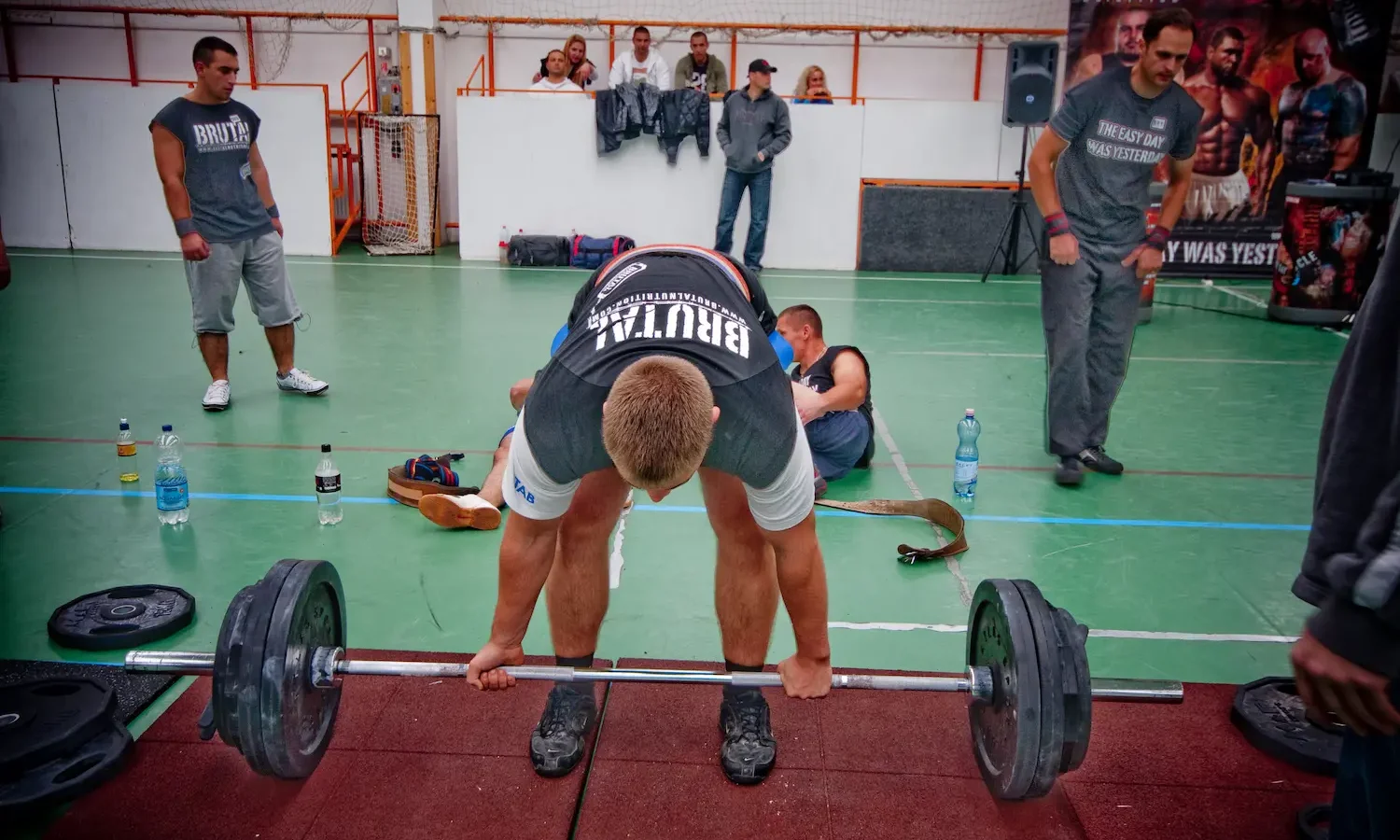
The stiff-leg deadlift is a hip-hinge pull done with the knees held almost straight throughout the lift. By taking the knees out of the equation, it forces the hamstrings to do nearly all the work of lowering and raising the bar. Bodybuilders love it for hamstring thickness, and lifters use it to expose — and fix — a hamstring weakness that conventional deadlifts can hide.
What it is
The stiff-leg deadlift is a close cousin of the Romanian deadlift. Both are hip hinges, but the stiff-leg version keeps the knees nearly locked and usually lets the bar touch the floor each rep, often from a slight deficit. The result is a maximal stretch on the hamstrings and a longer range of motion than the RDL, which keeps a soft knee bend and stops short of the floor.
Muscles worked
| Muscle | Contribution |
|---|---|
| Hamstrings | ~55 % |
| Glutes | ~25 % |
| Erector spinae | ~15 % |
| Forearms, core | ~5 % |
How to stiff-leg deadlift: 5 steps
-
Set up tall
Stand with the bar at hip height, feet hip-width. Grip just outside the legs, **knees almost straight with only a tiny soft bend.**
-
Brace the back
**Chest up, lats engaged, flat back.** Pull the shoulder blades down before you move.
-
Hinge at the hips
**Push the hips back and lower the bar down the legs.** Keep the knees fixed — let the hamstrings stretch.
-
Reach the stretch
Lower until you feel a strong hamstring stretch with a **flat back**. Touch the floor only if your spine stays neutral.
-
Drive the hips through
**Squeeze the glutes and push the hips forward** to stand tall. Do not hyperextend at the top.
How it differs from Romanian deadlift
- Knees nearly straight. The RDL keeps a soft 15-20 degree bend; the stiff-leg version locks the knees out almost fully.
- Longer range of motion. The bar usually reaches the floor, often from a deficit, for a deeper hamstring stretch.
- More hamstring-dominant. Removing the knee bend shifts even more load onto the hamstrings.
- Lighter loads. The bigger stretch and straighter legs mean working weights drop below your RDL.
Common mistakes
When to use this variation
Use the stiff-leg deadlift as a hamstring hypertrophy and flexibility builder, or as accessory work to strengthen a hamstring weakness. Program 3-4 sets of 8-12 reps with moderate weight, after your main pull or on a separate hamstring day. Keep the load light enough that your lower back stays flat through the deepest stretch — chasing weight here is how lifters get hurt.
FAQ
Stiff-leg deadlift or Romanian deadlift?
The RDL is the safer everyday choice with its soft knee bend. The stiff-leg version gives a deeper stretch and more hamstring isolation but demands good flexibility and control.
Should the bar touch the floor?
Only as far as you can go with a flat back. Many lifters stand on a small platform so the bar reaches the floor at full hamstring stretch without rounding the spine.
Why does my lower back fatigue first?
Usually the load is too heavy or the back is rounding. Drop the weight, keep the spine flat, and feel the work in the hamstrings — not the lumbar erectors.
Related exercises
- Romanian Deadlift: soft-knee hip hinge
- Deadlift: the full conventional pull
- Leg Curl: isolated hamstring flexion
- Glute Ham Raise: bodyweight hamstring builder