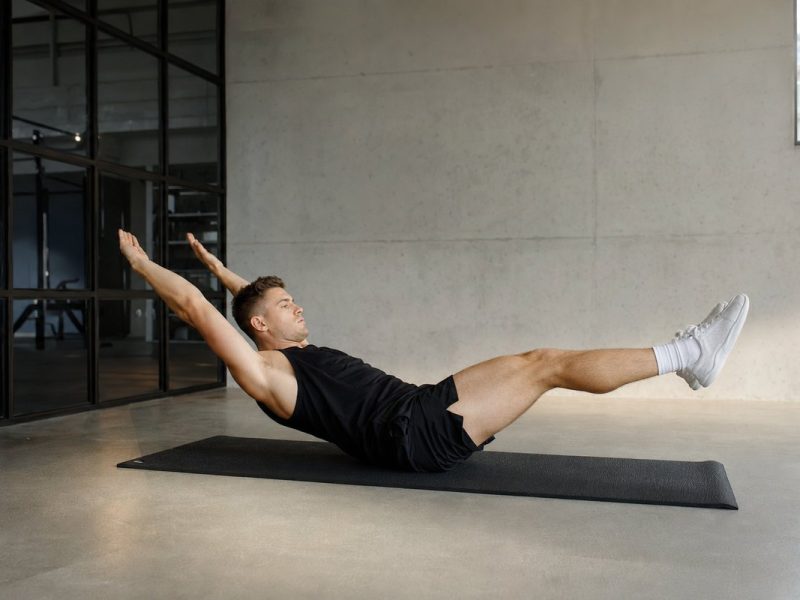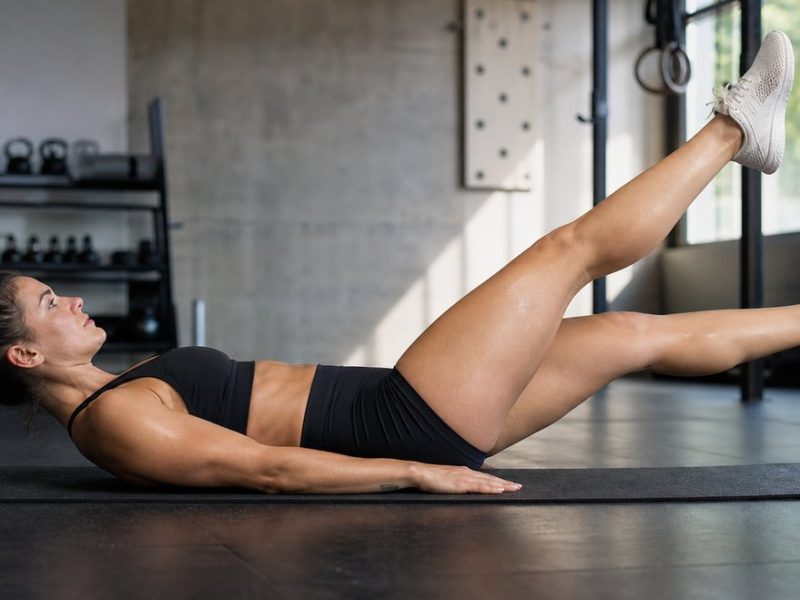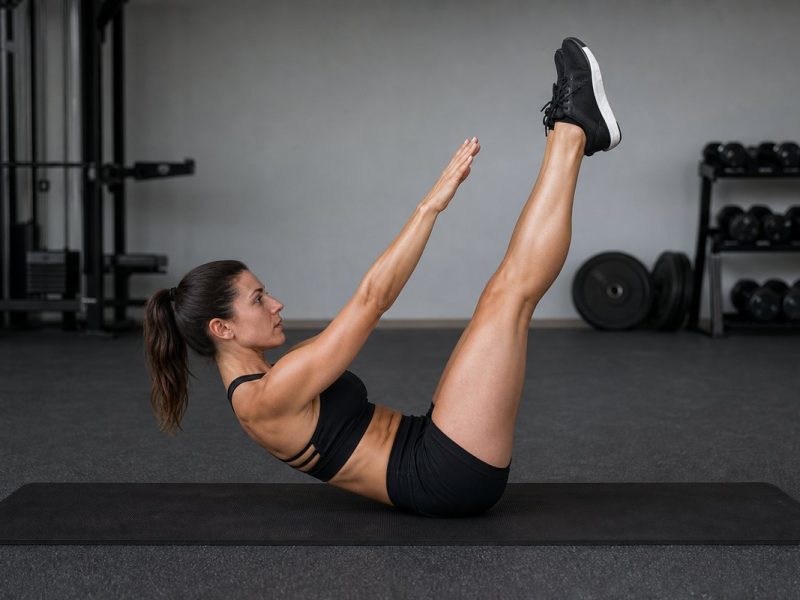

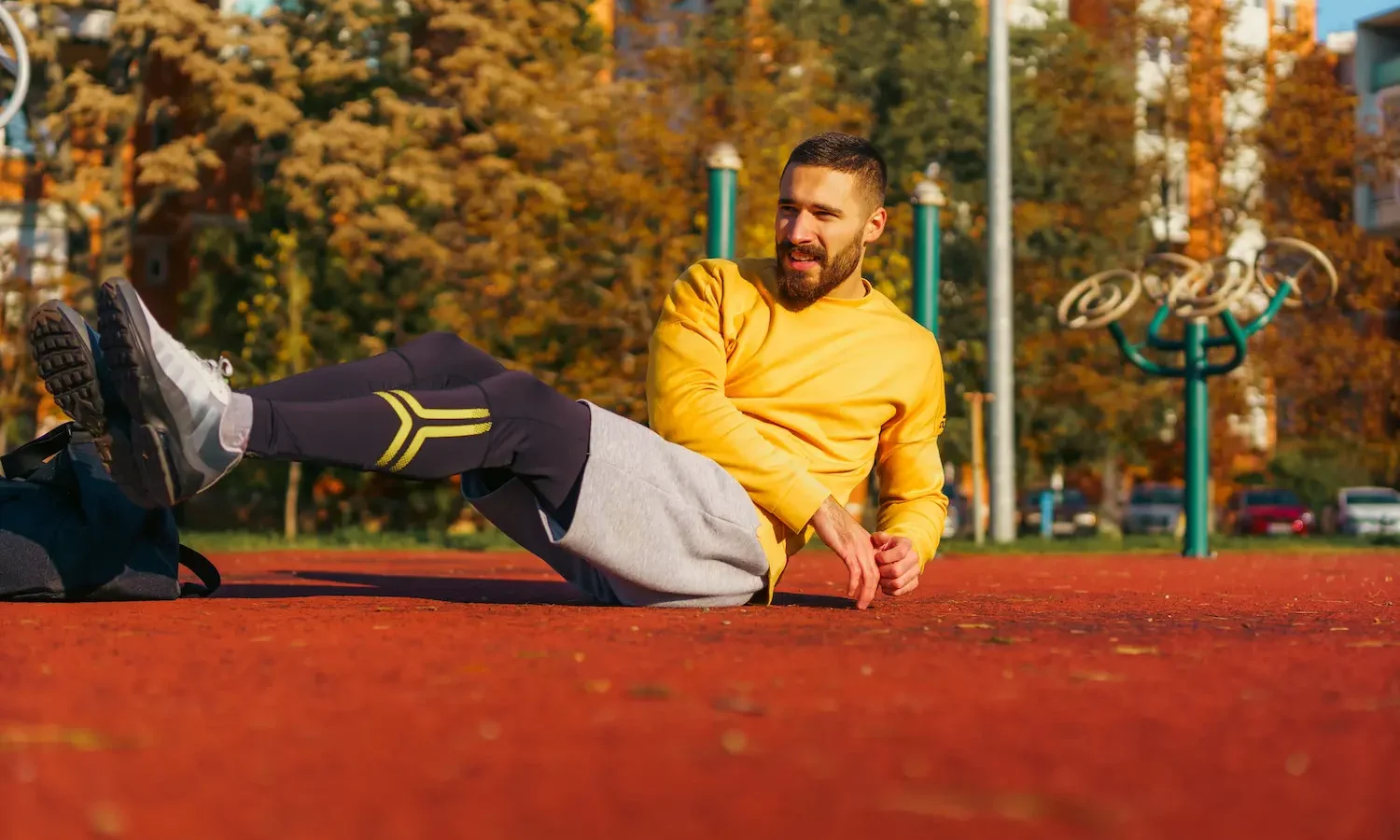
The Russian twist is the most popular oblique exercise on the internet, and the most badly executed. Done with sloppy form (which is most of the time), it’s just thrashing the spine side-to-side under load. Done strict, it’s an effective rotational core exercise that builds the obliques and serratus anterior.
This guide covers the strict version — slow, controlled, with the abs doing the work and the spine staying braced. Skip the bouncing-around-with-a-medicine-ball version you saw on social media.
What is the Russian twist?
The Russian twist is a rotational core exercise performed seated on the floor with knees bent and feet hovering or planted. You lean back to engage the abs, hold a weight (dumbbell, plate, medicine ball, or just your hands clasped together), then rotate the torso side to side, touching the weight to the floor on each side.
The motion trains the obliques (the side abs) under both flexion and rotation. Compared to side planks (which train anti-lateral-flexion isometrically), Russian twists train the obliques dynamically. Both have value — the side plank for stabilisation, the Russian twist for rotation.
Muscles worked
| Muscle group | Role | Contribution |
|---|---|---|
| Obliques (internal & external) | Primary mover, spinal rotation | ~50 % |
| Rectus abdominis | Anti-extension, posture hold | ~25 % |
| Hip flexors | Holding the leaning-back position | ~15 % |
| Serratus anterior · Lats | Stabilisation | ~10 % |
The Russian twist is one of the few common exercises that loads the obliques rotationally. Most ab work trains flexion (crunches, sit-ups) or anti-extension (planks). The twist adds the third pattern: rotation under load.
How to Russian twist: 5 steps
-
Set the start position
Sit on the floor with knees bent at ~90°, heels touching the ground (or off the ground for advanced version). Lean back to engage the abs — about 45° from vertical. Hold a weight or clasp hands together at chest level.
-
Set the spine
Sit tall, chest proud. **Spine in a straight line** — don't round the lower back. Brace the core hard.
-
Rotate to one side
Slowly rotate the torso to one side. The hands/weight travel to the side, not just the arms — the rotation comes from the core. Touch the weight (or hand) lightly to the floor next to your hip.
-
Pause briefly
Half-second pause at the side, obliques fully contracted.
-
Reverse to the other side
Rotate back through center to the opposite side. The motion stays slow and controlled — the abs do the work, not momentum. Keep the weight close to the body throughout.
Common mistakes to avoid
Variations
- Weighted Russian twist. Holding a dumbbell, plate, or medicine ball. Adds load. The standard once bodyweight feels easy.
- Feet-elevated Russian twist. Feet off the floor throughout. Increases core demand significantly.
- Decline Russian twist. On a decline bench. Greater core load through angle.
- Cable Russian twist. Standing or kneeling at a cable machine. Constant tension, rotational power work.
- Medicine ball Russian twist. With a medicine ball, optionally throwing to a partner or wall. Conditioning + power.
- V-up. Different exercise but similar starting position. Add for variety.
Sample workout: 4-week oblique block
Russian twists 2-3 times per week, after main lifts. Pair with side planks for full oblique coverage.
| Week | Sets × reps (each side) | Tempo |
|---|---|---|
| 1 | 3 × 10/side bodyweight | 2 sec/rep |
| 2 | 3 × 12/side bodyweight | 2 sec/rep |
| 3 | 3 × 10/side weighted (5-10 kg) | 2 sec/rep + 1 sec pause |
| 4 (deload) | 3 × 10/side bodyweight | Smooth |
Frequently asked questions
How many Russian twists should I do?
10-15 reps per side with strict form. Doing 100 fast reps doesn’t build obliques — it just gets your heart rate up. Quality matters far more than quantity.
Why does my lower back hurt during Russian twists?
You’re probably leaning back too far and rounding the lower spine. Sit up taller, brace the core hard, and only lean back enough to feel the abs engage (about 45° from vertical). Spine should stay neutral throughout.
Russian twist or side plank — which is better?
Different functions. Side plank trains the obliques to resist lateral flexion isometrically (anti-rotation). Russian twist trains them to produce rotation. For complete oblique training, do both.
How heavy should I twist?
Light to moderate. 5-10 kg dumbbell or plate is typical for most lifters. The Russian twist is a hypertrophy and core control exercise, not a strength lift. Heavier and form breaks.
Should my feet be on the floor or off?
Feet off the floor is harder and more demanding on the core. Beginners can keep feet planted lightly; intermediate and advanced lifters lift the feet for greater challenge. Choose based on your level.
Related exercises
- Side Plank: anti-lateral-flexion oblique work
- Cable Russian Twist: standing variation
- Wood Chop: standing rotational work
- Bicycle Crunch: rotational ab work
- Plank: foundational anti-extension
Published by: Jay — Writer covering ab exercises
Reviewed, corrected and approved by: Martin Wood — Editor-in-chief
Updated on September 29, 2026