
The reverse curl is the forearm builder hiding in plain sight in the curl family. Same setup as a standard dumbbell curl or cable curl, but with a pronated grip — palms facing down instead of up. That single change shifts the work from the biceps to the brachioradialis and the forearm extensors, the most under-trained arm muscles in any lifter’s program.
For lifters chasing thicker forearms, stronger grip, or rehab from elbow tendinopathy (the classic “tennis elbow”), the reverse curl is the answer.
What is the reverse curl?
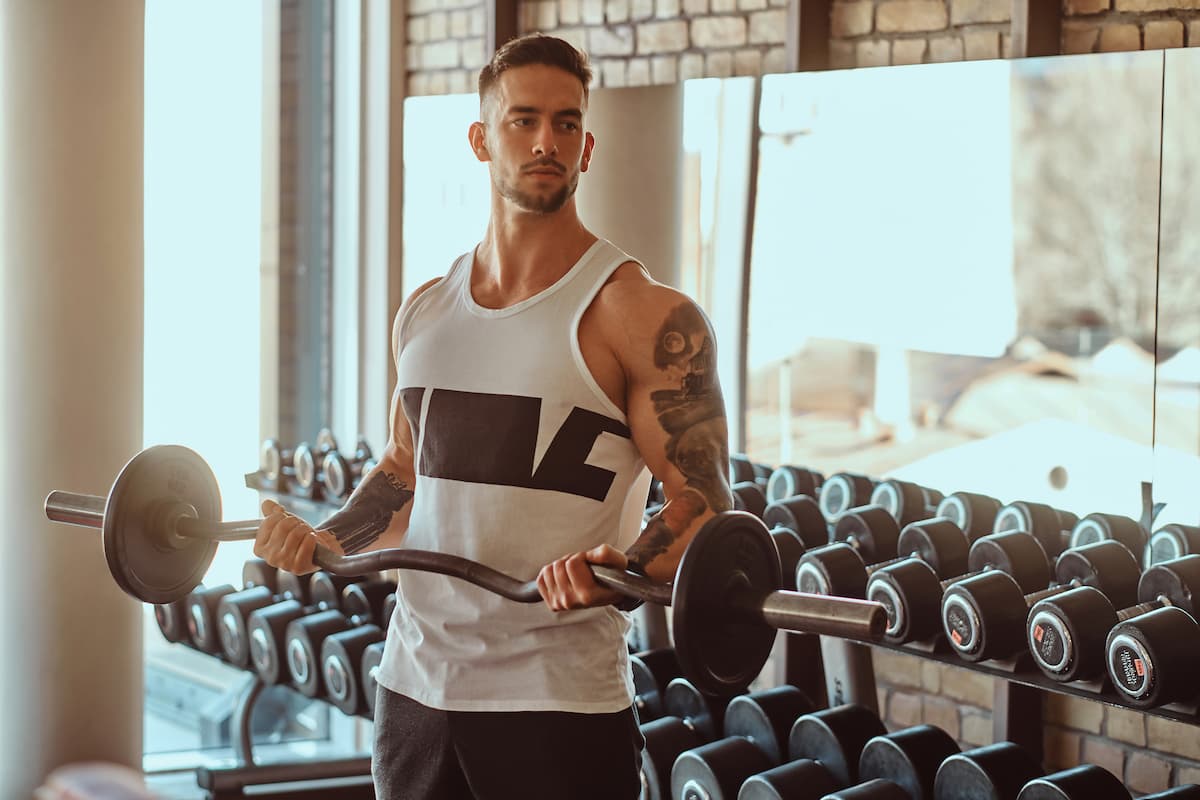
The reverse curl is an isolation exercise performed with a barbell, EZ-bar, dumbbells, or cable attachment, using a pronated grip (palms facing down) throughout. You curl the weight from extended-elbow at the hips up to shoulder height by bending the elbows — but with the pronated grip that shifts the work onto the brachioradialis and forearm extensors instead of the biceps.
The brachioradialis (the large muscle on the thumb side of the forearm) and the forearm extensors (on top of the forearm) get heavily loaded — both rarely trained directly outside of reverse curls and Zottman work.
Muscles worked
| Muscle group | Role | Contribution |
|---|---|---|
| Brachioradialis | Primary mover, forearm flexion | ~40 % |
| Forearm extensors | Wrist stabilisation under load | ~30 % |
| Brachialis | Elbow flexion | ~20 % |
| Biceps brachii | Minor elbow flexion assist | ~10 % |
The reverse curl is the most direct forearm-extensor builder available. Combined with regular curls and hammer curls, it gives complete arm development.
How to reverse curl: 5 steps
-
Set up with a pronated grip
Stand tall with a barbell (or EZ-bar/dumbbells) in front. **Grip the bar with palms facing down — pronated grip, shoulder-width apart.** Arms fully extended down. Feet shoulder-width, **brace the core**, elbows tucked at the hips.
-
Set the body position
Stand tall — chest up, shoulders pulled back. **Elbows locked at the hips, upper arms vertical.** No body lean, no shoulder shrug.
-
Curl up with control
**Curl the bar up** by bending the elbows in 2 seconds. **Maintain the pronated grip** — palms stay facing the floor throughout. **Upper arms stay still** — only forearms move.
-
Pause and squeeze at the top
1-second pause at the top with the bar at chest level. **Squeeze the brachioradialis** at peak contraction. Wrists stay neutral — don't let them flex up or hyperextend.
-
Lower with control
Lower in 3 seconds back to full elbow extension. **Maintain pronated grip and tight wrists throughout the descent.** Eccentric loading is where the forearm extensors grow. Reset, repeat.
Common mistakes to avoid
Variations
- Barbell reverse curl. Standard straight bar. Heaviest loading possible.
- EZ-bar reverse curl. EZ-bar grip is more wrist-friendly than a straight bar.
- Dumbbell reverse curl. Allows independent left-right work and natural wrist position.
- Cable reverse curl. Constant tension throughout — best for hypertrophy.
- Preacher reverse curl. On a preacher bench. Strict elbow, peak contraction.
- Zottman curl. Supinated up + pronated down — hybrid biceps + forearm work.
- Hammer curl. Neutral grip — middle ground between standard and reverse curl.
Sample workout: 4-week forearm block
Reverse curls 2 times per week, after main biceps work. Pair with hammer curls for total forearm coverage.
| Week | Sets × reps | Tempo |
|---|---|---|
| 1 | 3 × 12 | 2 sec up + 1 sec squeeze + 3 sec down |
| 2 | 4 × 10 | 2 sec up + 2 sec squeeze + 3 sec down |
| 3 | 3 × 12 + drop set | 1 sec up + 2 sec squeeze + 4 sec down |
| 4 (deload) | 3 × 10 | Smooth |
Frequently asked questions
How heavy should I reverse curl?
About 50-60 % of your regular curl weight. The pronated grip puts you at a major mechanical disadvantage. Most lifters use 15-25 kg on the barbell or 5-10 kg per dumbbell. Heavier loads almost always force wrist breakdown.
Reverse curl or Zottman curl for forearms?
Both are excellent. Zottman combines biceps + forearm work in one exercise. Reverse curl is pure forearm-extensor work, allowing more strict reps and heavier eccentric loading. For time-efficiency, Zottman. For pure forearm focus, reverse curl.
Why does my wrist hurt during reverse curls?
Straight bar in a pronated grip stresses the wrists. Switch to EZ-bar (angled grips), dumbbells (natural wrist position), or cable rope (most wrist-friendly). Most wrist pain disappears with grip changes.
Can reverse curls help with tennis elbow?
Yes — the eccentric phase loads the forearm extensors, which are the muscles affected by tennis elbow (lateral epicondylitis). Used as part of a rehab program (with a physio), reverse curls are highly effective. Start very light, slow eccentric, gradually load.
Will reverse curls grow my biceps?
Minimally. The biceps work only as a secondary mover. For biceps size, stick with supinated curls (dumbbell, preacher). For forearm and arm thickness from the side view, reverse curls are excellent.
Related exercises
- Zottman Curl: biceps + forearm hybrid
- Hammer Curl: neutral grip curl
- Dumbbell Curl: standard supinated curl
- Cable Curl: constant-tension curl
- Farmer Walk: grip + forearm endurance
Published by: Jay — Writer covering biceps exercises
Reviewed, corrected and approved by: Martin Wood — Editor-in-chief
Updated on September 29, 2026