
The push jerk is the bridge between the push press and the split jerk. Like the push press, you dip and drive the bar up using leg power. Unlike the push press, you then drop into a quarter-squat to receive the bar overhead with arms locked — eliminating the need to press the bar through the lockout. This lets you handle 15-25 % more weight than a push press.
It’s the most common jerk variation in CrossFit, the standard for beginners learning the jerk, and a powerful shoulder-and-leg-power builder for any athlete.
What is the push jerk?
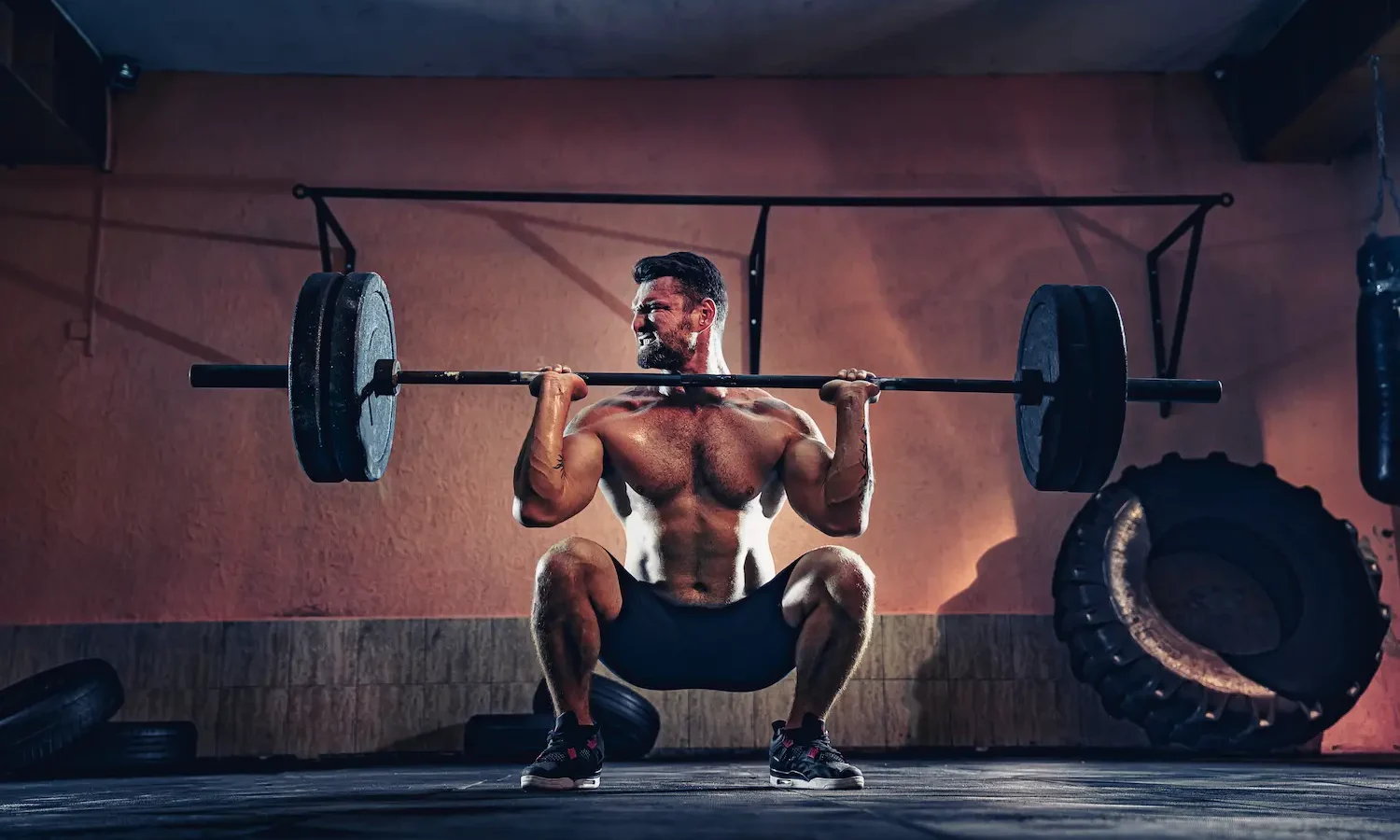
The push jerk is a barbell overhead lift in which you start with the bar in the front rack (resting on the shoulders), dip-drive the bar up using leg power, then drop into a quarter-squat to catch the bar overhead with arms already locked. Recover by standing up. Unlike the split jerk, the feet stay in roughly the same position throughout (with a small rebound jump for re-positioning).
The dip-drive-drop sequence allows much heavier loads than a strict overhead press because the legs do the bulk of the work and the catch is at a position that arrives already locked out — no slow press through the sticking point.
Muscles worked
| Muscle group | Role | Contribution |
|---|---|---|
| Quadriceps, glutes | Primary mover, dip-drive | ~40 % |
| Anterior + middle deltoid | Bar overhead, catch position | ~25 % |
| Triceps brachii | Elbow extension at catch | ~15 % |
| Traps, upper back | Bar path control | ~10 % |
| Core, calves | Stabilisation, drive | ~10 % |
The push jerk is a legs-first overhead lift. The legs do most of the work, the shoulders catch and stabilise. It’s a power exercise, not a strict pressing exercise.
How to push jerk: 5 steps
-
Set up in the front rack
Bar in the front rack — resting on shoulders, elbows high, hands shoulder-width or slightly wider. Feet hip-width, **brace the core**, weight in mid-foot.
-
Quick controlled dip
**Dip straight down** about 15-20 cm by bending the knees. **Torso stays vertical** — no forward lean. Elbows slightly down. Quick but controlled — about 0.5 seconds.
-
Explosive drive
**Reverse the dip violently** — drive through the heels, extend the legs powerfully. The bar accelerates upward off the shoulders.
-
Drop into a quarter-squat under the bar
As the bar travels up past the head, **drop into a quarter-squat (knees bent ~30°)** while **punching the arms up** to lock out under the bar. Bar is received with arms already extended, weight in mid-foot. Feet may rebound out slightly.
-
Stand up and recover
Stand up by extending the knees, **bar locked out overhead**. Head pushed through the arm "window". Reset feet under hips. Lower or drop the bar.
Common mistakes to avoid
Variations
- Push press. Dip-drive press, no quarter-squat catch. Lighter loads, more shoulder-strict.
- Split jerk. Feet split forward-and-back at the catch. Standard competition variant — heaviest loads.
- Squat jerk. Full overhead squat catch. The rarest and most technical variant.
- Jerk balance. Bar overhead in starting position, practice the catch dip. Builds receiving position.
- Dumbbell push jerk. Dumbbells instead of barbell — more accessible, unilateral option.
- Clean and jerk. The full Olympic lift including the clean.
Sample workout: 4-week push jerk block
Push jerks 1-2 times per week. As a standalone power lift or as preparation for split jerk training.
| Week | Sets × reps | Load (% of 1RM) |
|---|---|---|
| 1 | 5 × 3 | 70 % |
| 2 | 5 × 2 | 80 % |
| 3 | 6 × 1 | 87.5 % |
| 4 (deload) | 4 × 3 | 65 % |
Frequently asked questions
Push press, push jerk, or split jerk?
Progression. Push press = dip-drive press (lightest). Push jerk = dip-drive + quarter-squat catch (middle). Split jerk = dip-drive + split-foot catch (heaviest). Most lifters learn in that order and use each for different training goals.
How much heavier is the push jerk than the push press?
Typically 15-25 % heavier. Most lifters who push press 80 kg can push jerk 95-100 kg. The quarter-squat catch lets you receive heavier loads with arms already locked.
Why does my bar drift forward on the catch?
Forward lean on the dip. The dip must be straight down — knees over toes, torso vertical. Cue “weight in the heels, chest up, dip straight”. Forward lean tilts the drive path forward.
Should I press out at the top?
No — the catch should be **received already locked out**. If you have to press the bar through the last few inches, you didn’t drop fast enough. The drop creates the lockout, not a press.
Push jerk for non-Olympic lifters?
Yes — it’s an outstanding power developer. Athletes in any sport (rugby, MMA, basketball) benefit from the dip-drive-catch pattern. Loaded carries + push jerks + sprints = a brutal but effective athletic training day.
Related exercises
- Push Press: lighter dip-drive press
- Overhead Press: strict press
- Clean and Jerk: full Olympic lift
- Front Squat: front-rack mobility builder
- Handstand Push-Up: bodyweight vertical press