
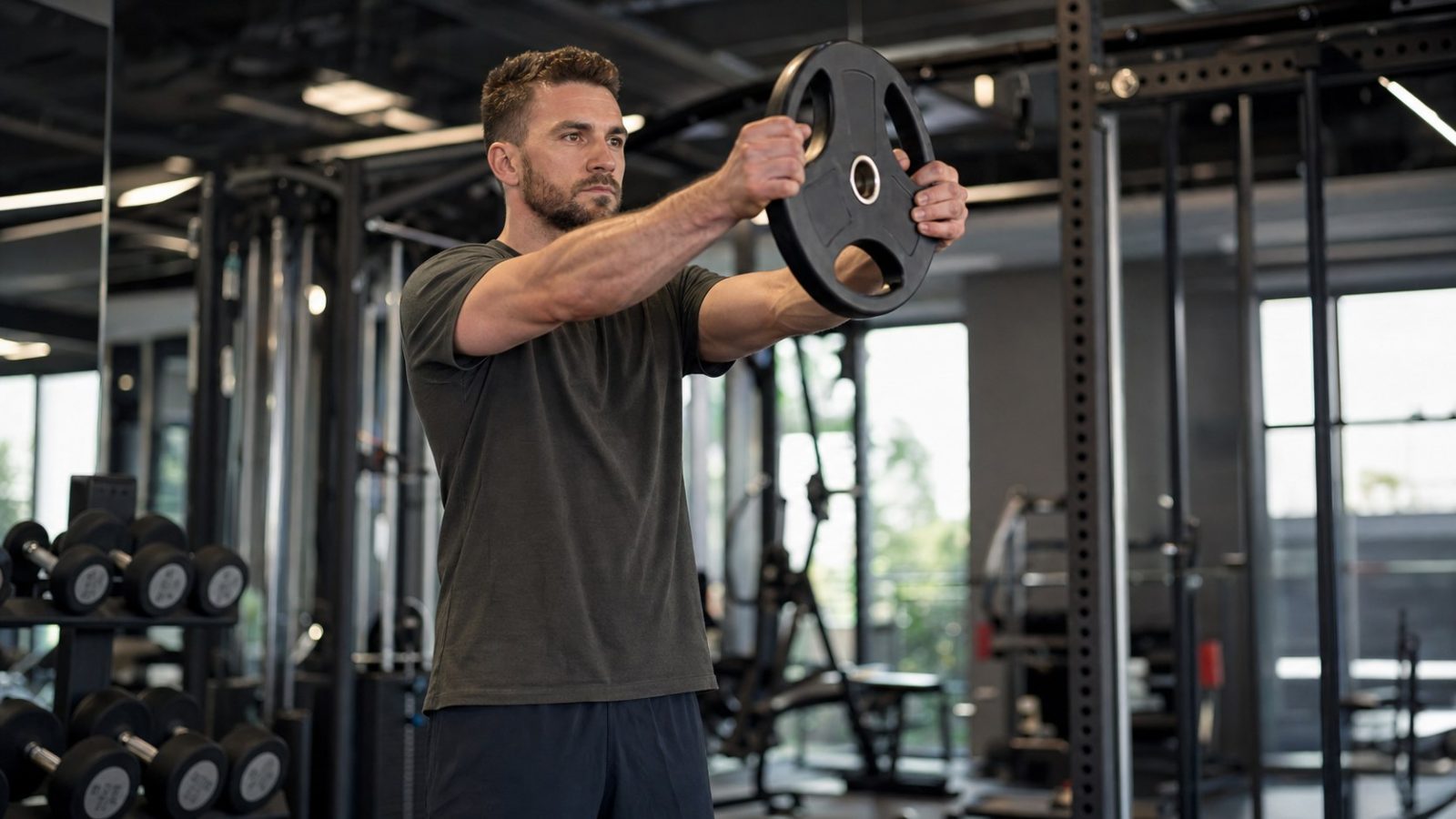
The plate front raise uses a single weight plate held vertically with both hands to perform a front raise. The two-handed grip forces both delts to work equally, and the plate itself is a versatile piece of gym gear — no cables or dumbbells required.
What it is
The plate front raise is a shoulder isolation exercise using a single weight plate (10-25 kg) held vertically with both hands. Starting at hip height, the lifter raises the plate straight forward to eye or shoulder height, keeping arms straight, then lowers back to start.
Muscles worked
| Muscle | Contribution |
|---|---|
| Anterior deltoid | ~70 % |
| Upper pecs, lateral delt | ~20 % |
| Core, forearms | ~10 % |
How to plate front raise: 5 steps
-
Grip the plate
**Grip a plate vertically with both hands at 3 and 9 o'clock positions.**
-
Stand tall
Feet hip-width, **plate at hips, arms straight but not locked.**
-
Raise
**Raise the plate straight up to eye or shoulder height.**
-
Peak position
**Brief pause at the top with delts contracted.**
-
Controlled descent
Lower over 2 seconds to starting position.
How it differs from dumbbell front raise
- Both hands on one plate. Locked grip prevents side-to-side compensation.
- Forces bilateral coordination. Weaker side must contribute equally.
- Plate is accessible. No dumbbells needed — any plate works.
- Limited load. Two-hand grip caps at 20-25 kg for most lifters.
Common mistakes
When to use this variation
Use plate front raises as a front delt isolation exercise or as a shoulder warm-up. Program 3 sets of 10-15 reps. Pair after main pressing work.
FAQ
What plate size?
10 kg for a warm-up, 15-20 kg for working sets, 25 kg for advanced. Standard steel or bumper plate.
How high to raise?
Eye height is standard. Slightly above adds top-range work. Don’t go past overhead — that stops being a front raise.
Plate or dumbbells?
Both work. Plate forces bilateral coordination; dumbbells allow independent arm loading. Choose by preference and equipment.
Related exercises
- Cable Front Raise: cable version
- Lateral Raise: side delt version
- Y Raise: raised at 45° for lateral emphasis
- Overhead Press: compound alternative