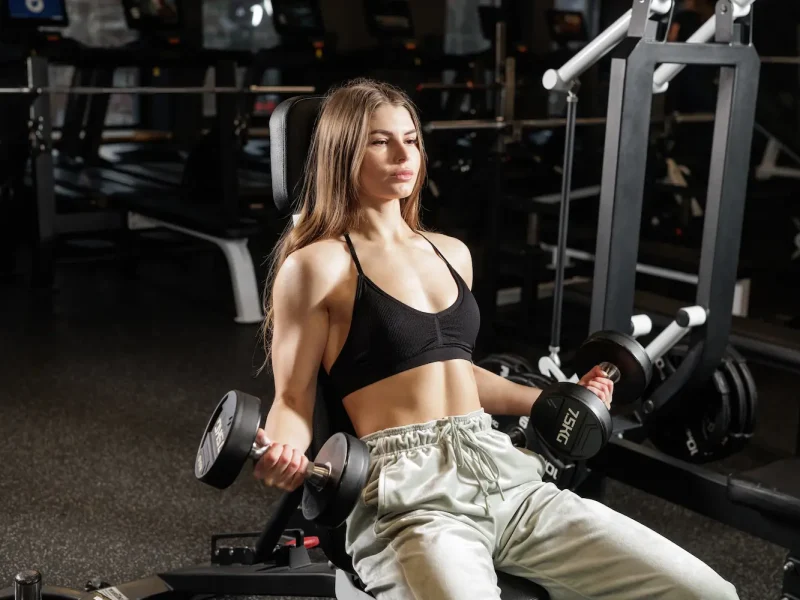

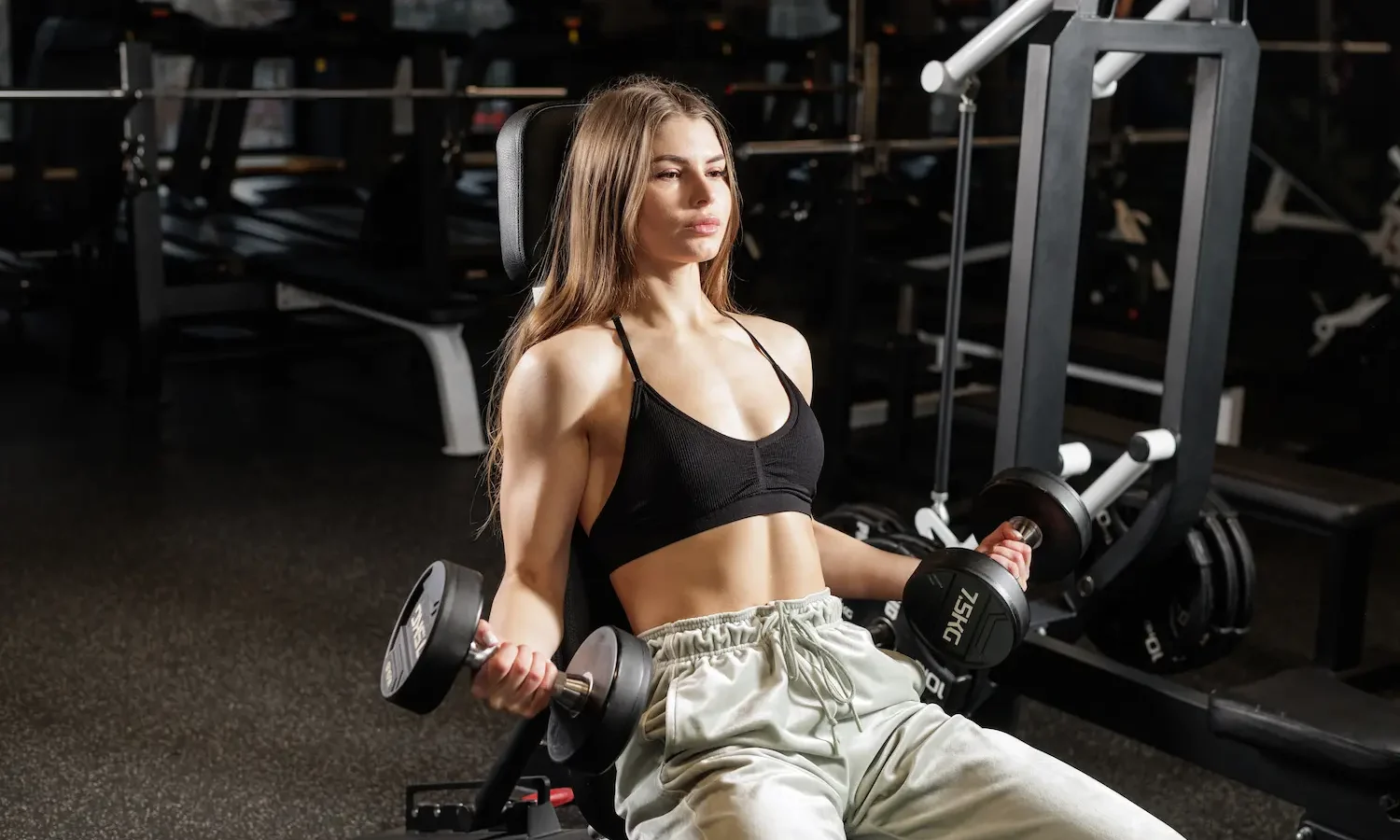
The incline dumbbell curl is performed seated on an incline bench with the arms hanging straight down behind the body. The position pre-stretches the biceps’ long head and creates a deeper range of motion than standing curls — making it one of the best builders of biceps peak and length.
What it is
The incline dumbbell curl is a dumbbell curl performed while seated on an incline bench set to 45-60°. The lifter lets both arms hang straight down behind the line of the body, then curls supinated. The bench angle puts the biceps’ long head in a stretched position, increasing time under tension across a longer range.
Muscles worked
| Muscle | Contribution |
|---|---|
| Biceps brachii (long head) | ~50 % |
| Biceps brachii (short head) | ~25 % |
| Brachialis | ~15 % |
| Brachioradialis, forearms | ~10 % |
How to incline dumbbell curl: 5 steps
-
Set incline bench
Set the bench to **45-60°**. Sit back fully, head against the bench.
-
Hang the arms
**Let both arms hang straight down behind the body line.** Supinated grip.
-
Curl up
**Curl the dumbbells up, elbows pinned to the sides.** Upper arms still throughout.
-
Peak squeeze
**Hold the contraction briefly** at the top.
-
Controlled descent
**Lower over 3 seconds** to the stretched starting position.
How it differs from standing curl
- Arms hang behind the body. Standing curls have arms at the sides — incline curls pre-stretch the long head.
- Deeper range of motion. The stretched start position adds 10-15 cm of pulling per rep.
- Long-head emphasis. The biceps’ long head (outer biceps, peak builder) gets significantly more work.
- Lighter loads. The stretched position is mechanically disadvantageous; expect to use 70-80 % of standing curl weight.
Common mistakes
When to use this variation
Use incline dumbbell curls to develop the biceps’ long head and biceps peak. Program 3-4 sets of 10-15 reps. Pair after heavy barbell or EZ-bar curls as a stretch-focused finisher. Excellent for adding peak and length to the biceps that standing curls can miss.
FAQ
What bench angle?
45-60° is the standard range. Lower angles (45°) maximise the stretch; steeper (60°) is slightly easier on the shoulder.
Why does the long head get more work?
The biceps’ long head crosses the shoulder joint. When the arm is hanging behind the body, the long head is stretched, so it generates more force during the curl.
Alternating or simultaneous?
Both work. Simultaneous reduces total set time; alternating allows slightly heavier loads with better focus on each arm.
Related exercises
- Dumbbell Curl: standing standard
- Bayesian Curl: cable equivalent with arm behind body
- Hammer Curl: neutral-grip variant
- Concentration Curl: another stretch-focused option