
The hip thrust is the single best exercise on earth for building bigger, stronger glutes. Not the squat. Not the deadlift. The hip thrust. It’s the only common compound that loads the glutes through their full range while they’re already at their strongest position — at hip extension, where most other exercises taper off.
The hip thrust was popularised by strength coach Bret Contreras in the 2010s, and the science backs it up: glute EMG activation peaks during the hip thrust at levels other exercises don’t approach. Whether your goal is athletic performance (sprinters, jumpers, fighters) or pure aesthetics, the hip thrust earns a place in the program.
What is the hip thrust?
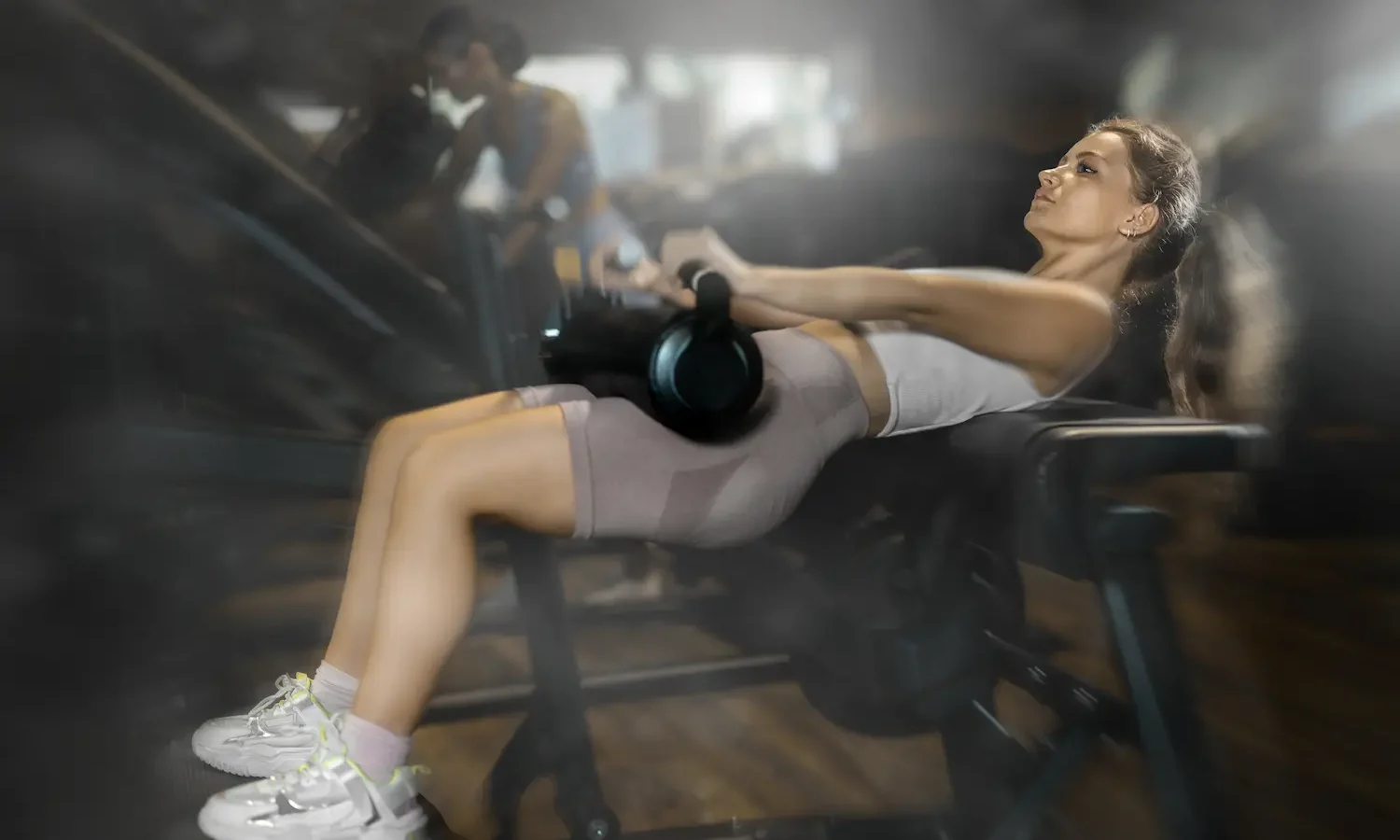
The hip thrust is a hip-extension exercise performed with the upper back resting on a bench, feet planted on the floor, and a loaded barbell across the hips. You drive the hips up by squeezing the glutes until your body forms a straight line from knees to shoulders, pause, then lower under control.
It looks awkward, you’ll feel self-conscious doing it the first time, and that’s fine — the results justify the awkwardness. It’s also one of the safer heavy lifts: the back is supported throughout, the bar can’t fall on you, and there’s no spinal compression in the bottom position.
Muscles worked
| Muscle group | Role | Contribution |
|---|---|---|
| Gluteus maximus | Primary mover, hip extension | ~60 % |
| Hamstrings | Hip extension, stabilisation | ~20 % |
| Quadriceps | Knee extension, stabilisation | ~10 % |
| Core (abs, lower back) | Posture, anti-extension | ~10 % |
The glutes are the largest and most powerful muscle in your body — when trained, they are the engine of every athletic movement (sprint, jump, change of direction). The hip thrust is one of the rare exercises that loads them as the primary mover, not as a secondary like in squats or deadlifts.
How to hip thrust: 5 steps
-
Set up at the bench
Sit on the floor with the bench behind you, upper back (just below the shoulder blades) against the bench edge. Roll the loaded barbell over your hips. Use a barbell pad — bare metal on bare hips at heavy loads will bruise.
-
Plant the feet
Feet flat, hip-width to slightly wider, knees pointing in the same direction as the toes. Heels positioned so that at lockout, your shins will be vertical.
-
Brace and tuck the chin
Take a breath into the belly, brace the core. **Tuck the chin slightly** — eyes look at the ceiling above your knees, not behind you. Squeeze the glutes hard to initiate the lift.
-
Drive the hips up
Push the floor away with your heels, drive the hips toward the ceiling. **Squeeze the glutes** as if pinching a coin between them. Lock out at full hip extension — body forms a straight line from knees to shoulders.
-
Pause and lower
Pause for a 1-3 second squeeze at the top. Lower in 2 seconds with control. Bar lowers nearly to the floor between reps. Reset breath, repeat.
Common mistakes to avoid
Hip thrust variations
- Glute bridge. Floor-based, no bench. Easier teaching variant. Use to learn the pattern before adding a barbell.
- Single-leg hip thrust. One leg at a time. Brutal unilateral version. Addresses asymmetries.
- Banded hip thrust. Band over the hips for added resistance at lockout. Excellent for warm-ups and high-rep finishers.
- Dumbbell hip thrust. One heavy dumbbell on the hips. Better when no barbell is available.
- Feet-elevated hip thrust. Heels on a bench. Greater range of motion, more hamstring involvement.
- B-stance hip thrust. One foot ahead of the other. A bridge between two-leg and single-leg work.
Sample workout: 4-week glute block
| Week | Sets × reps | Tempo | RPE |
|---|---|---|---|
| 1 | 3 × 10 | 1 sec pause at top | 7 |
| 2 | 4 × 8 | 2 sec pause at top | 7-8 |
| 3 | 5 × 6 | 3 sec pause at top | 8 |
| 4 (deload) | 3 × 8 | 1 sec pause | 6 |
Pair with Romanian deadlifts on a separate day. Add glute bridges for high-rep finishers (3 × 20 with bodyweight or light load).
Frequently asked questions
How heavy should I hip thrust?
Hip thrusts allow much heavier loads than squats or deadlifts because the back isn’t doing the stabilisation work. Many lifters can hip thrust 1.5-2 × their squat for 8 reps. Bodyweight × 1 for 8 reps is a beginner target; bodyweight × 1.5 for 8 reps is solid.
Hip thrust vs glute bridge — what’s the difference?
The glute bridge is performed lying on the floor with shoulders down. The hip thrust uses a bench under the upper back, increasing the range of motion. The hip thrust loads the glutes more, the bridge is easier to learn.
Why does the bar hurt my hips?
Bare bar on bare hips at heavy loads is brutal. Use a barbell pad (commercial gyms usually have one) or wrap a folded towel around the bar. Within a few sessions your hips toughen up.
Should I feel hip thrusts in my lower back?
No. If you do, you’re hyperextending at the top — coming up too far and arching the lower back instead of stopping at neutral hip extension. Keep your ribs down at lockout. Body forms a straight line from knees to shoulders, no further.
How often should I do hip thrusts?
Twice per week is the sweet spot for most lifters. Glutes recover well; high frequency is fine. Once a week works for maintenance.
Related exercises
- Glute Bridge: floor-based, easier teaching variant
- Single-Leg Hip Thrust: unilateral, asymmetry-fixing
- Romanian Deadlift: hip-hinge complement
- Squat: foundational compound
- Bulgarian Split Squat: unilateral leg + glute work
Published by: Jay — Writer covering glute exercises
Reviewed, corrected and approved by: Martin Wood — Editor-in-chief
Updated on May 8, 2026