

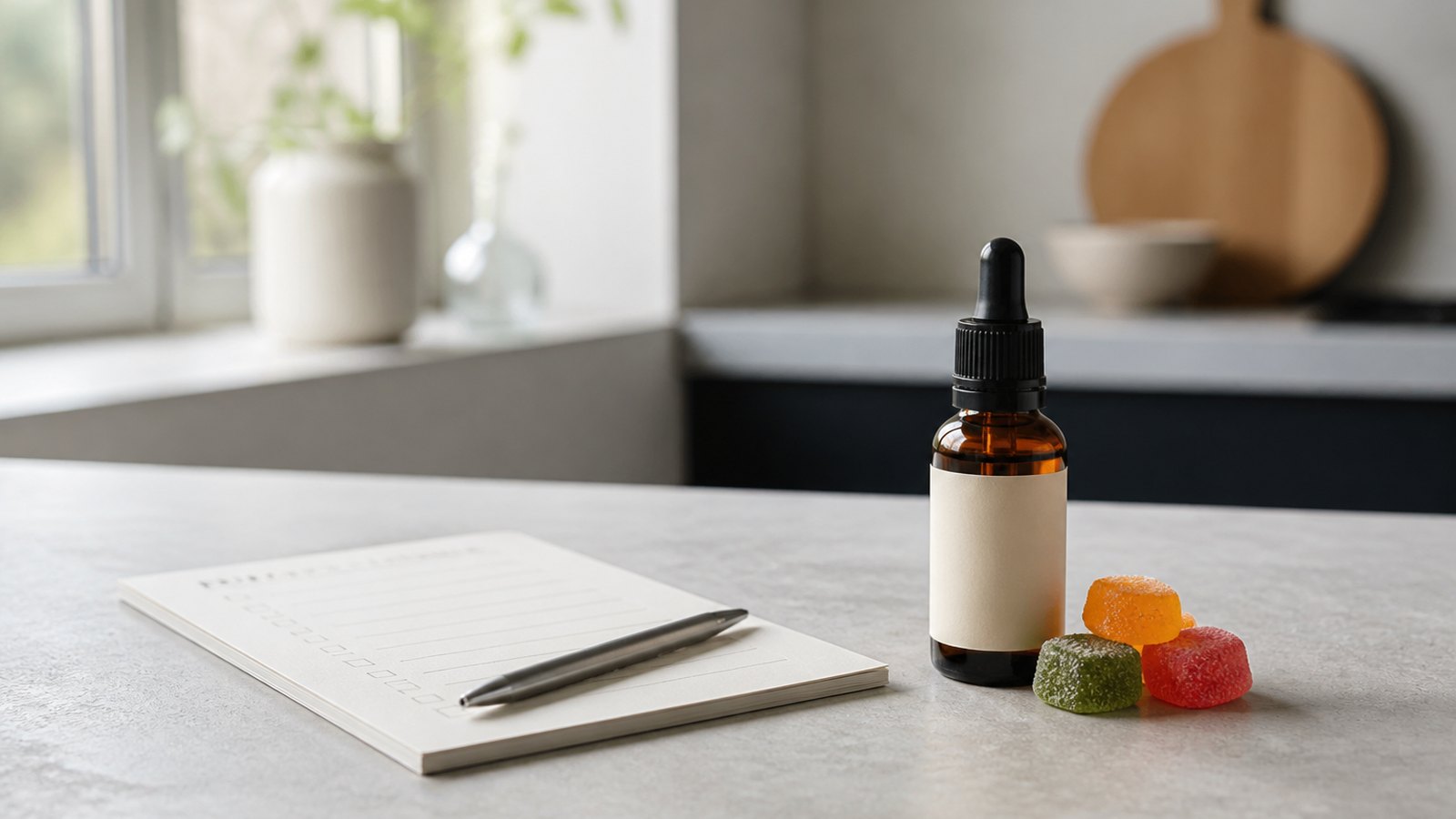
CBD gummies and CBD oil are both sold in the UK as food supplements, not as prescribed medical cannabis. The useful difference is practical: gummies come in pre-made servings, while oils usually require closer reading of strength, bottle size and drop information. For people comparing formats around everyday aches, exercise routines or recovery habits, the safe starting point is label clarity, official guidance and personal suitability, not a promise about effects.
Practical format differences
CBD gummies are edible sweets or soft chews with a stated amount of CBD per gummy. CBD oil is usually supplied in a dropper bottle, and the label may describe CBD in the whole bottle, in each millilitre or in a suggested number of drops.
The largest number on a pack is not always the serving amount. Gummies may be easier to count because each piece is a set serving. Oils may allow smaller changes between servings, depending on the dropper and label. Both can contain sweeteners, flavourings or carrier oils, and both need caution around medicines, health conditions and age restrictions.
If the aim is to support an active lifestyle, the format should sit behind basics such as gradual loading, good technique, rest and appropriate movement. Ampainsoc’s guides to strength training and injury prevention and low-impact cardio for beginners are more useful foundations.
Why aches and recovery marketing needs caution
CBD products are often marketed near words such as aches, recovery, calm or sleep. That language can make the category feel more medical than it is. In the UK, CBD food supplements are not the same as cannabis-based medicines prescribed by a specialist doctor.
The NHS page on medical cannabis says evidence for long-term pain is not yet strong enough to recommend cannabis-based products for pain relief. It also warns that products bought online may have unknown quality or content, and that legally sold CBD or hemp food supplements carry no guarantee of quality or health benefit.
So the practical takeaway is simple: do not treat a gummy or oil as a way to treat, cure, relieve or prevent pain, inflammation, anxiety, sleep problems or injury. Effects, if any are noticed, vary between people, and the evidence base for many common marketing claims remains limited.
If someone has persistent pain, a new symptom, an injury that is not improving or a condition that affects training, professional advice and safe activity planning matter more than supplement claims. The Ampainsoc pain resources page is a better place to start for broader support.
Use, route and timing are variable
CBD gummies are swallowed and digested. CBD oil is often placed in the mouth or swallowed, depending on the product instructions. It is tempting to turn that into a fixed rule about one format working faster or lasting longer, but that would be too certain for a general article.
Timing can vary because food, metabolism, product composition and individual response all play a part. A gummy eaten after a meal may be experienced differently from the same product taken at another time. An oil may also vary depending on how it is used and what the label says to do.
For safety, readers should avoid stacking several CBD products in one day simply because the formats look different. A gummy, an oil and a drink may all contribute CBD from food sources, even if they are sold in different parts of a shop.
People who exercise regularly should not confuse supplement routines with recovery management. Sleep, nutrition, hydration, rest days and sensible progression remain the core habits. For beginners, safe strength training for beginners is more concrete than assumptions about a CBD format.
How to read per-gummy, per-drop and per-bottle labels
The most common mistake is reading the biggest number on the pack and assuming it is the amount in one serving. With oils, a front label may refer to the whole bottle. With gummies, a pack may display the total CBD across all pieces. The serving amount can be smaller, and sometimes it is hidden in the supplement facts or directions.
Retail categories can show why this matters. For example, browsing CBD gummy product ranges shows how products may be grouped by format, flavour, pack size or strength, so the per-serving figure still needs to be checked before comparing one item with another.
| Label point | Gummies | Oils | Why it matters |
|---|---|---|---|
| CBD amount | Check CBD per gummy, not only per pack | Check CBD per bottle, per ml or per drop | The largest number may not be the serving amount |
| Serving directions | Look for the suggested number of gummies | Look for drop or ml instructions | Directions affect total daily intake |
| Other ingredients | Check sugar, sweeteners and gelatine | Check carrier oil and flavourings | Suitability can depend on diet or allergies |
| Batch information | Look for batch or product details | Look for batch or product details | Traceability helps if a product is queried |
| Regulatory status | Check whether the product links to a novel-food application | Check whether the product links to a novel-food application | The FSA list is not medical approval |
If a label is hard to understand, pause. A clear product should make it easy to identify the serving amount, ingredients and warnings.
FSA advice and who should avoid CBD
The Food Standards Agency’s CBD guidance on GOV.UK, published on 13 February 2020 and current when checked on 2 September 2026, says the FSA updated its precautionary consumer advice in October 2023. The advice recommends that healthy adults limit CBD from food to 10 mg per day.
That figure is precautionary consumer guidance for food sources of CBD. It is not a personalised dose, and it is not advice to start taking CBD. It also does not mean higher or lower amounts are appropriate for a particular person, especially where medicines or health conditions are involved.
The FSA also maintains a public list of CBD food products linked to novel-food applications. This list can help consumers check whether a product is associated with an application, but it is not medical approval, not a guarantee that a product works and not a promise that a supplement will suit an individual.
CBD is not suitable for everyone. People under 18 should not use CBD food supplements. Anyone who is pregnant, breastfeeding or trying to conceive should seek professional advice and, in line with FSA precautionary guidance, avoid CBD unless medically directed.
The same caution applies to people taking medication or managing a health condition. CBD can be discussed with a pharmacist, GP or relevant clinician, particularly where medicines are involved. Readers should not stop, reduce or change prescribed medication because of something they read about CBD online.
This matters for people who arrive at CBD pages after searching for pain, recovery or sleep support. Those searches may reflect a real health concern, even if the product being considered is only a food supplement. When symptoms are persistent, severe, unexplained or worsening, professional advice is the safer route.
A cautious choice checklist
A sensible choice between gummies and oil is less about chasing stronger claims and more about reducing confusion. Before buying, ask:
- Is the product clearly labelled with CBD per serving?
- Can the total daily CBD from all food sources be understood easily?
- Is the product linked to the FSA public list of CBD products with novel-food applications?
- Are the ingredients suitable for allergies, diet and personal restrictions?
- Is the seller avoiding medical claims about pain, sleep, anxiety, inflammation or injury?
- Is professional advice needed because of age, pregnancy, breastfeeding, conception plans, medication or a health condition?
Gummies may suit someone who wants a simple, counted serving and is comfortable with the other ingredients. Oil may suit someone who prefers a liquid format and can read the drop or ml information accurately. Neither should be framed as a treatment or recovery shortcut. If the reason for looking at CBD is everyday aches around exercise, review training load, technique and low-impact activity first.
Medical disclaimer
This article is for general information only and is not medical advice. CBD food supplements are not prescribed medical cannabis and should not be used to treat, cure, relieve or prevent pain, inflammation, anxiety, sleep problems, injury or any medical condition. Evidence is limited and effects vary. People under 18, anyone who is pregnant, breastfeeding or trying to conceive, and anyone taking medication or managing a health condition should seek professional advice and, in line with FSA precautionary guidance, avoid CBD unless medically directed. Do not start, stop or change medication without advice from a qualified healthcare professional.
Published by: Martin Wood — Writer covering health
Reviewed, corrected and approved by: Martin Wood — Editor-in-chief
Updated on September 2, 2026