
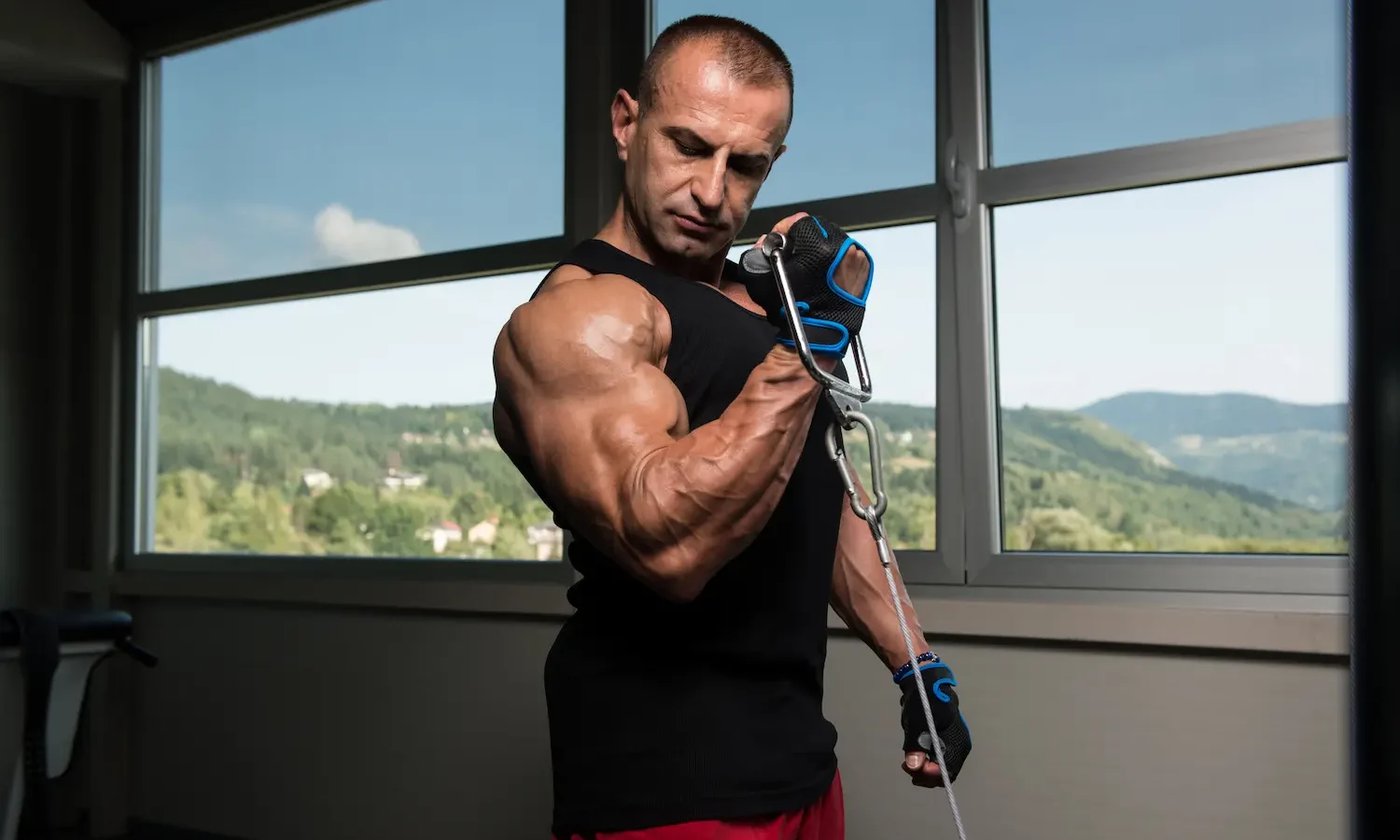
The cable hammer curl is the cable version of the dumbbell hammer curl, performed at a low cable with a rope attachment. The neutral grip (palms facing each other) shifts emphasis from the biceps brachii to the brachialis and brachioradialis — the deeper arm-flexor muscles that pump up the lower biceps and the forearm.
Where dumbbell hammer curls lose tension at the top, the cable version keeps the load constant through the whole rep. For lifters chasing thick forearms and a fuller-looking biceps, the cable hammer curl is the most effective version.
What is the cable hammer curl?
The cable hammer curl is a cable biceps isolation performed with a rope attachment at the low pulley. You stand facing the cable, grip both ends of the rope with a neutral (palms-facing-each-other) grip, then curl the rope up toward the shoulders by bending the elbows — keeping the wrists in the same neutral position throughout.
The neutral grip targets the brachialis (which sits under the biceps and pushes it up when developed) and the brachioradialis (the long muscle on the forearm side near the elbow). Both contribute to arm thickness in ways the standard supinated curl doesn’t fully reach.
Muscles worked
| Muscle group | Role | Contribution |
|---|---|---|
| Brachialis | Primary mover (deep arm flexor) | ~40 % |
| Brachioradialis | Primary mover (forearm flexor) | ~30 % |
| Biceps brachii (both heads) | Elbow flexion assist | ~25 % |
| Forearm grip muscles | Grip strength | ~5 % |
The cable hammer curl is the best single exercise for the brachialis and brachioradialis. The biceps still work, but the neutral grip de-emphasises them in favour of these deeper arm flexors. Pair with the supinated curl for full biceps development.
How to cable hammer curl: 5 steps
-
Set up the cable
Attach a rope to the **low pulley**. Stand facing the cable, about 50 cm away. Grip both rope ends with a **neutral grip — palms facing each other**, thumbs pointing up.
-
Set the body position
Feet shoulder-width, slight knee bend, **brace the core**. Stand tall — no leaning forward or backward. Arms extended down at the sides, elbows tucked at the hips. Cable taut.
-
Curl up with control
**Bend the elbows** to curl the rope up toward the shoulders in 2 seconds. **Keep the upper arm motionless** — pinned at the sides. Palms stay facing each other throughout (don't supinate).
-
Squeeze at the top
1-second pause when the rope is at shoulder height. **Squeeze the brachialis** at peak contraction. Don't let the elbows drift forward (front delts cheating).
-
Lower with control
Lower in 3 seconds back to full elbow extension. **Maintain cable tension** — stop just before the cable slacks. Reset, repeat.
Common mistakes to avoid
Variations
- Single-arm cable hammer curl. One arm at a time. Identifies asymmetries, allows greater mind-muscle focus.
- Cross-body cable hammer curl. Curl across the body toward the opposite shoulder. Greater brachialis emphasis.
- High-cable hammer curl. Cable from a high pulley, palms facing each other. Different angle of resistance.
- Dumbbell hammer curl. Free-weight version.
- Dumbbell curl. Supinated grip — biceps emphasis.
- Preacher curl. Strict elbow position, peak-contraction emphasis.
Sample workout: 4-week brachialis block
Cable hammer curls 2 times per week. Pair with supinated curls for full arm coverage.
| Week | Sets × reps | Tempo |
|---|---|---|
| 1 | 3 × 12 | 2 sec up + 1 sec squeeze + 2 sec down |
| 2 | 4 × 10 | 2 sec up + 2 sec squeeze + 3 sec down |
| 3 | 3 × 12 + drop set | 1 sec up + 1 sec squeeze + 3 sec down |
| 4 (deload) | 3 × 10 | Smooth |
Frequently asked questions
Cable or dumbbell hammer curl?
Cable wins for constant tension. Dumbbells lose tension at the top of the curl (the arm position becomes vertical against gravity). Cables stay loaded through the full ROM. For pure brachialis hypertrophy, cable hammer curls are superior.
How does this differ from a regular cable curl?</h3
Regular cable curl uses a supinated grip (palms up) — biceps emphasis. Cable hammer curl uses a neutral grip (palms facing each other) — brachialis and brachioradialis emphasis. Different targets, both useful.
Should I curl one rope end or split the rope?</h3
Grip both ends of the rope (one in each hand or interlaced) to keep the neutral grip. The rope flexes outward at the top, allowing a deeper contraction than a straight bar would.
Why are hammer curls good for forearm thickness?</h3
The brachioradialis (the large muscle on the thumb-side of the forearm) is heavily recruited in neutral-grip curls. Develop it and the forearms look noticeably bigger from the side — independent of grip-strength forearm muscles.
How heavy should I cable hammer curl?</h3
Most lifters use 20-40 kg for 10-12 reps on a cable hammer curl. Heavier loads almost always force form to break (body swing, elbow flare). Strict form > heavy load on isolation lifts.
Related exercises
- Hammer Curl: dumbbell version
- Dumbbell Curl: supinated curl
- Cable Curl: supinated cable curl
- Preacher Curl: strict elbow biceps
- Concentration Curl: peak-contraction biceps