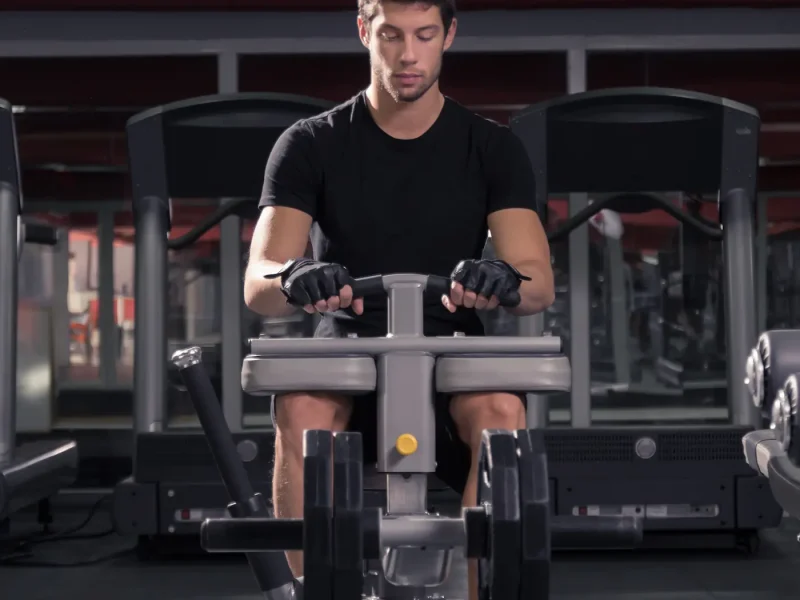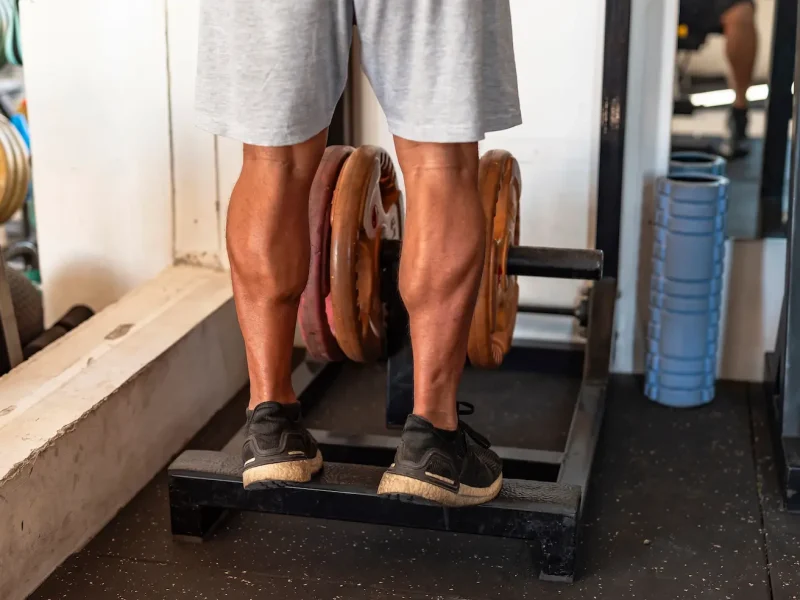

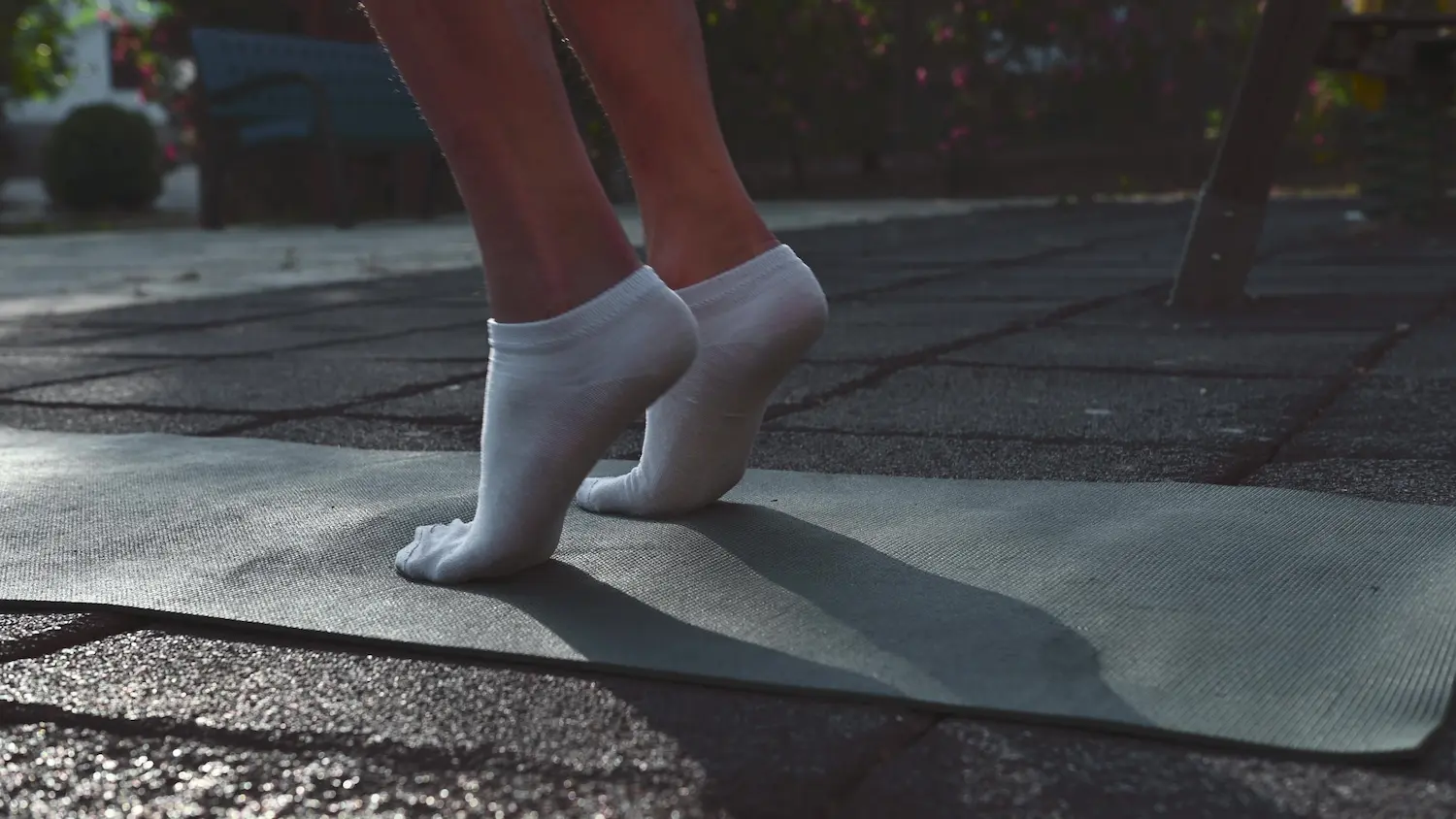
The standing calf raise is the classic, foundational calf exercise — and the most direct way to build the gastrocnemius, the large outer calf muscle that creates the “diamond” calf shape from behind. Done loaded on a calf raise machine, smith machine, or with dumbbells, it’s the calf builder every leg day deserves.
For lifters whose calves “won’t grow”, the issue is usually one of three things: not enough load, not enough volume, or not enough range. This guide covers all three.
What is the standing calf raise?
The standing calf raise is an isolation exercise for the calf muscles, performed standing with the body upright and legs straight. You rise up onto the balls of the feet by extending the ankles (plantar flexion), pause at the top with the calves fully contracted, then lower back down through full range with the heels dropping below the toe platform.
The straight-leg position is what makes it a gastrocnemius emphasis — the gastrocnemius crosses both the knee and the ankle, so it’s in its full active length only when the knee is straight. Bent-knee versions like the seated calf raise shift emphasis to the soleus instead.
Muscles worked
| Muscle group | Role | Contribution |
|---|---|---|
| Gastrocnemius (medial + lateral heads) | Primary mover, plantar flexion (knee straight) | ~65 % |
| Soleus | Plantar flexion assist | ~25 % |
| Tibialis posterior, peroneals | Stabilisation | ~10 % |
The standing calf raise specifically targets the gastrocnemius — the large outer calf muscle. For complete calf development, pair it with the seated calf raise (soleus emphasis).
How to standing calf raise: 5 steps
-
Set up at the machine or with dumbbells
On a standing calf raise machine: position shoulders under the pads, balls of the feet on the platform, heels hanging off. With dumbbells: stand on a small block or platform, dumbbells at the sides, balls of feet on the block, heels off.
-
Set the start position
Stand tall, **legs straight (knees fully locked)**. **Heels drop below the toe platform** in a deep stretch position. Brace the core, chest up. **Maintain straight knees throughout** — this is the gastrocnemius emphasis.
-
Push up to maximum height
**Drive the balls of the feet down** to rise up — push the body up onto the toes. **Reach full plantar flexion** — calves fully contracted, body as high as possible. 1 second.
-
Pause and squeeze at the top
**1-2 second pause at the top** with the calves fully contracted. **Squeeze the calves maximally** at peak. Don't bounce — pause is critical for growth.
-
Lower to full stretch
Lower in 2-3 seconds back to the deep bottom stretch — **heels drop below the platform**, calves fully stretched. **1-second pause at the bottom stretch.** Reset, repeat.
Common mistakes to avoid
Variations
- Machine standing calf raise. Dedicated machine with shoulder pads. Allows heavy loading.
- Smith machine standing calf raise. Bar on the upper back, feet on a small block. Heavy and accessible.
- Dumbbell standing calf raise. Dumbbells in each hand. Most accessible variant.
- Single-leg standing calf raise. One leg at a time. Identifies asymmetries, double the load per leg.
- Donkey calf raise. Hinged forward with the load on the hips. Old-school favourite of Arnold.
- Bodyweight calf raise. Lightest version, beginner-friendly.
- Seated calf raise. Bent-knee version — soleus emphasis.
Sample workout: 4-week calf hypertrophy block
Standing calf raises 2-3 times per week. Calves recover fast and respond to high frequency + volume.
| Week | Sets × reps | Tempo |
|---|---|---|
| 1 | 4 × 12 | 1 sec up + 2 sec squeeze + 2 sec down + 1 sec stretch |
| 2 | 4 × 15 | 1 sec up + 2 sec squeeze + 3 sec down + 1 sec stretch |
| 3 | 5 × 12 + drop sets | 1 sec up + 2 sec squeeze + 3 sec down + 1 sec stretch |
| 4 (deload) | 3 × 12 | Smooth |
Frequently asked questions
Why won’t my calves grow?
Usually one of three reasons. (1) Not enough load — calves walk all day with bodyweight, so they need heavy loads to grow (often heavier than people use). (2) Not enough volume — calves respond to high-rep, high-frequency work. (3) Not enough range — many people skip the bottom stretch and the top squeeze. Fix all three and most lifters see results within 8-12 weeks.
Standing or seated calf raise — which is more important?
Different muscles. Standing = gastrocnemius (the visible outer calf). Seated = soleus (the deeper calf muscle that’s mostly under the gastrocnemius). For complete calf development, both matter. If pressed for time, prioritise standing — the gastrocnemius is what makes calves visually big.
How heavy should I standing calf raise?
Heavier than you think. The calves carry your bodyweight all day. To stimulate growth, you typically need 1-1.5x bodyweight on the machine for 12-15 reps. Most lifters under-load their calves significantly.
How often should I train calves?
2-3 times per week minimum, 4-5x per week is also fine. Calves recover fast and tolerate high frequency. Daily light work + 2-3 heavy sessions per week is a solid approach for lagging calves.
Should I bounce or pause at the top?
Pause. Bouncing uses the stretch reflex to do the work — the calf muscles don’t work as hard. Pause 1-2 seconds at the top with full squeeze, then lower under control with a 1-second bottom stretch. Slow and controlled = calf growth.
Related exercises
- Calf Raise: bodyweight version
- Seated Calf Raise: soleus-emphasis variant
- Donkey Calf Raise: bent-forward variant
- Box Jump: explosive calf + leg power
- Kettlebell Swing: hip-power conditioning