
The calf raise is the only exercise that meaningfully trains the calves. The squat hits them as a stabiliser, the deadlift loads them isometrically, but neither produces the loaded plantarflexion that grows the calf muscles. If you want bigger calves, you raise on your toes — under load, with intent, in volume.
Calves are notoriously stubborn. Some lifters get massive calves from walking; others train them three times a week for years and see modest gains. Genetics matter more here than with any other muscle group. The good news: with consistent training, full range of motion, and a slow eccentric, almost everyone can add visible calf size.
What is the calf raise?
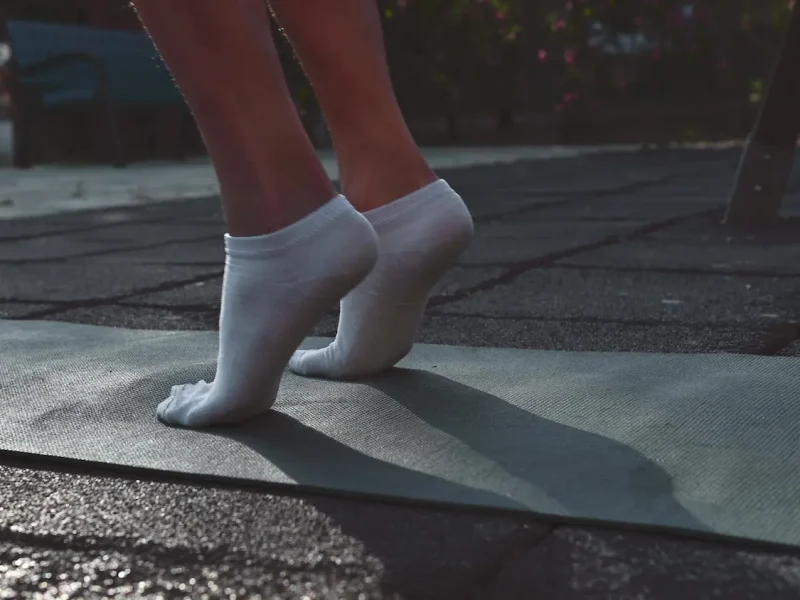
The calf raise is an isolation exercise in which you stand with the balls of your feet on a raised surface (or flat on the floor for beginners), then push up onto your toes by contracting the calf muscles, pause briefly at the top, and lower under control. The motion is pure plantarflexion — pointing the toes downward against resistance.
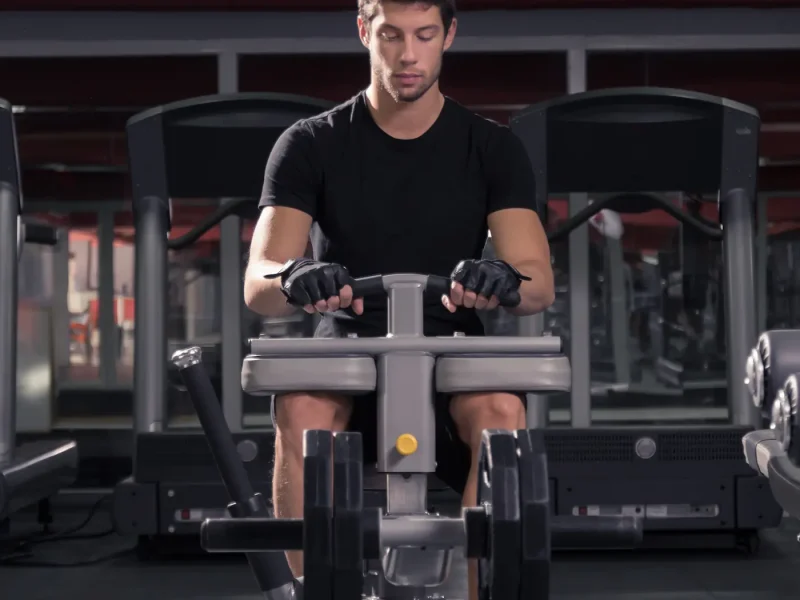
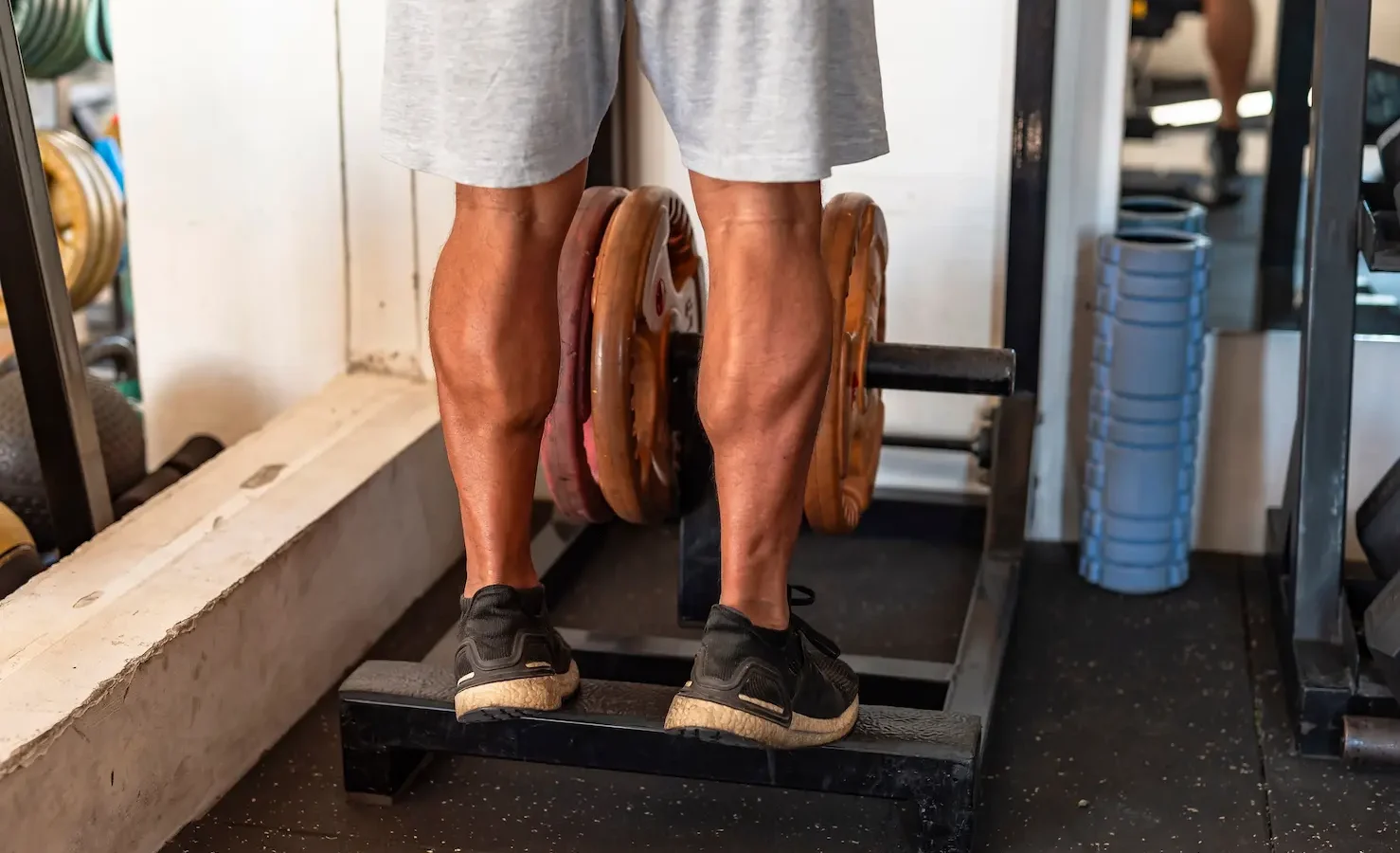
The standard version is the standing calf raise — performed standing with bodyweight or holding dumbbells. Variations include the seated calf raise (more soleus emphasis), donkey calf raise (bent over with weight on the lower back), and single-leg calf raise. All train the same basic motion at slightly different angles.
Muscles worked
| Muscle group | Role | Contribution |
|---|---|---|
| Gastrocnemius | Primary mover (standing version) | ~60 % |
| Soleus | Plantarflexion (more in seated version) | ~30 % |
| Tibialis posterior · Foot stabilisers | Stabilisation, balance | ~10 % |
The two main calf muscles have different fiber profiles. The gastrocnemius is more fast-twitch — responds best to moderate reps (8-12) with heavier loads. The soleus is more slow-twitch — responds best to high reps (15-25) at lighter loads. Best practice: train both with different rep ranges across your sessions.
How to calf raise: 5 steps
-
Set up on a raised edge
Stand with the balls of your feet on the edge of a step or weight plate, heels hanging off. Hold dumbbells at your sides, or use a calf raise machine. Heels can drop below the platform for a stretch at the bottom.
-
Set the body position
Stand tall, knees soft (slight bend, not locked). Brace the core. Look forward. Body in a straight line from head to heels.
-
Lower into the stretch
Slowly drop the heels below the level of the toes. **Feel a strong stretch in the calves at the bottom.** This is the most important part of the rep — don't skip it.
-
Push up onto the toes
Drive up explosively (or controlled, depending on the protocol) by pushing through the balls of the feet. Rise as high as possible — the heels should end well above the toe level.
-
Pause and squeeze at the top
Half-second pause at the top, calves fully contracted. Lower in 2-3 seconds with control. Reset, repeat.
Common mistakes to avoid
Calf raise variations
- Seated calf raise. On a dedicated machine. Knee bent at 90°. More soleus emphasis. Excellent complement to standing variations.
- Single-leg calf raise. One leg at a time. Doubles the load and exposes asymmetries. Brutal at high reps.
- Donkey calf raise. Bent over a bench, weight loaded on the lower back. Greater stretch and bigger range of motion.
- Leg press calf raise. On a leg press machine, push through the balls of the feet only. Allows very heavy loads safely.
- Smith machine calf raise. Bar across the upper back, fixed path. Good for heavy loading.
- Dumbbell calf raise. Holding a dumbbell at one side. Easy home variation.
Sample workout: 4-week calf block
Calves 3 times per week. Mix high-rep and moderate-rep work for both muscle fibre types.
| Week | Day 1 (gastrocnemius) | Day 2 (soleus) |
|---|---|---|
| 1 | Standing CR: 4 × 12 | Seated CR: 3 × 20 |
| 2 | Standing CR: 5 × 10 | Seated CR: 4 × 18 |
| 3 | Single-leg CR: 4 × 8 | Seated CR: 4 × 15 |
| 4 (deload) | Standing CR: 3 × 12 | Seated CR: 3 × 15 |
Frequently asked questions
Why won’t my calves grow?
Three usual reasons. First: insufficient volume — calves can take 12-20 sets per week before they grow visibly. Second: cut range of motion — most lifters bounce calf raises and never get the stretch at the bottom. Third: genetics — some people simply have short calf muscle bellies and long Achilles tendons. Train hard, eat enough protein, and accept what you can’t change.
Standing or seated calf raise?
Both. Standing biases the gastrocnemius (the bigger calf muscle), seated biases the soleus (sits beneath). For full calf development you need both — they have different fibre types and respond to different rep ranges.
How heavy should calf raises be?
Heavy. Calves carry your body all day; they’re highly conditioned. For machine standing calf raises: 100-200 % of your bodyweight is normal for sets of 10-15. Lighter dumbbell variations: 15-25 kg per hand for 15-20 reps.
Should I do calves on leg day or every day?
Calves recover fast and benefit from frequency. Many lifters who chase calf size do calf work 3-5 times per week, often as a finisher to other workouts (back day, shoulder day, etc.). 1-2 times per week works for maintenance.
Why does my Achilles tendon hurt during calf raises?
Either you’re bouncing at the bottom (forcing the tendon to absorb load violently) or you’re going too heavy. Slow the eccentric to 3 seconds, pause briefly at the bottom stretch, and reduce the load. If pain persists, see a physio.
Related exercises
- Seated Calf Raise: soleus emphasis
- Single-Leg Calf Raise: unilateral, asymmetry-fixing
- Donkey Calf Raise: greater stretch
- Leg Press Calf Raise: heavy loading
- Jump Rope: dynamic calf conditioning
Published by: Jay — Writer covering calf exercises
Reviewed, corrected and approved by: Martin Wood — Editor-in-chief
Updated on May 8, 2026