
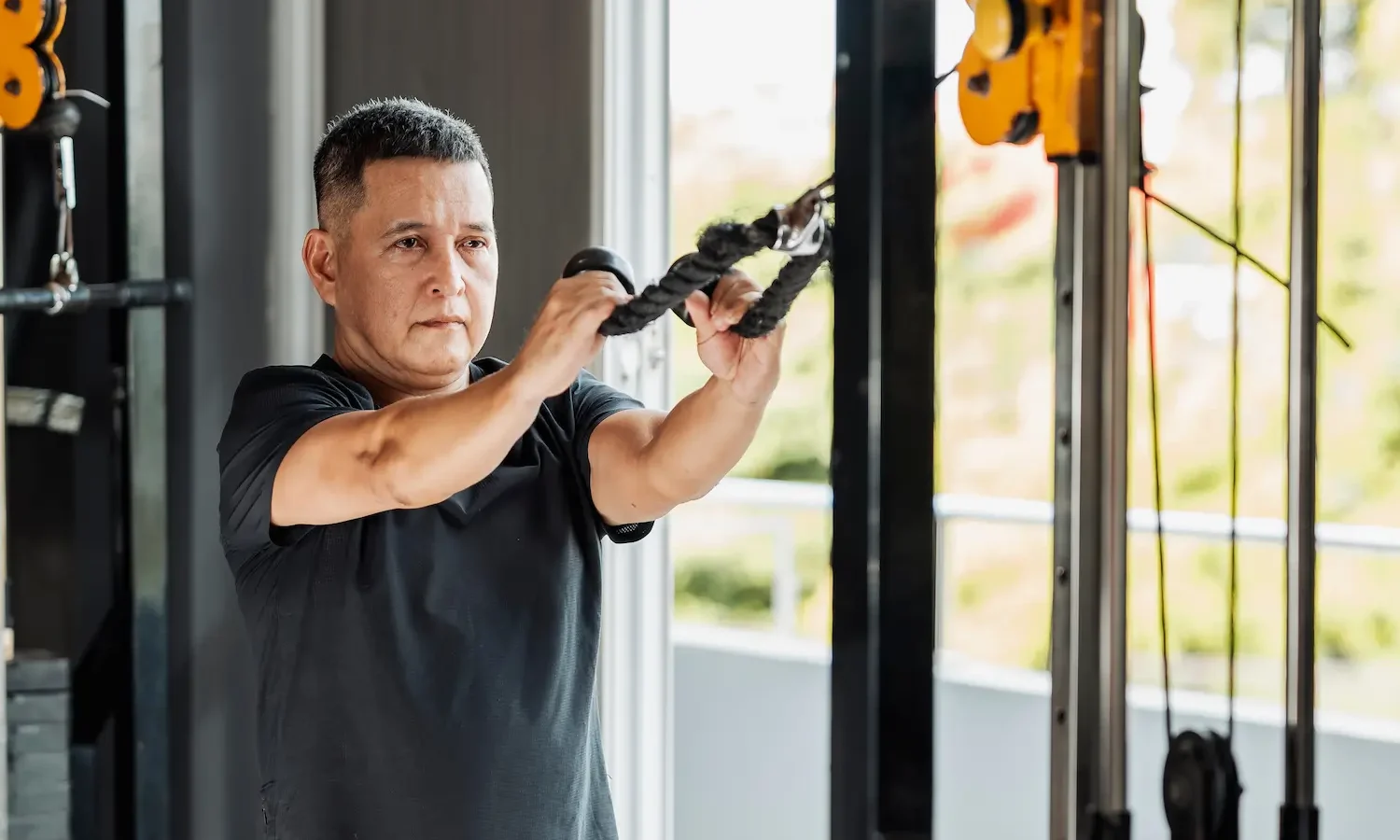
The standing cable row is the free-standing version of the seated cable row — same horizontal pulling pattern, but performed upright with no bench support. The legs and core have to fight to keep the body still while the back does its work. The result: same back hypertrophy stimulus as the seated version, plus serious core stabilisation training.
For lifters who want functional back work that carries over to real-world pulling (and don’t have a long bench seat available), the standing cable row is a strong default.
What is the standing cable row?
The standing cable row is a horizontal pulling cable exercise performed standing in front of a low or mid-height pulley. You grip a V-handle, rope, or straight bar attachment, lean slightly forward with a hinged hip position, and row the handle toward the lower chest by retracting the shoulder blades and bending the elbows.
The exercise hits the same primary muscles as the seated row — lats, mid-traps, rhomboids, biceps — but adds significant core and lower-back stabilisation because there’s no chest pad or bench to brace against. It’s a more athletic, free-standing variation.
Muscles worked
| Muscle group | Role | Contribution |
|---|---|---|
| Latissimus dorsi | Primary mover, shoulder extension | ~35 % |
| Mid trapezius, rhomboids | Scapular retraction | ~25 % |
| Biceps brachii, brachialis | Elbow flexion | ~15 % |
| Posterior deltoid | Shoulder extension assist | ~10 % |
| Core, erector spinae, glutes | Body stabilisation, hinge support | ~15 % |
The standing cable row trains all the major back muscles with the bonus of significant core and hip-hinge support work. Roughly 15 % of the work goes to stabilisation — work the seated version doesn’t require.
How to standing cable row: 5 steps
-
Set up the cable
Attach a V-handle, rope, or straight bar to a **low or mid-height pulley**. Stand facing the cable column, far enough back that the cable is taut at full arm extension. Feet shoulder-width or staggered.
-
Set the hip hinge
**Hinge forward at the hips 30-45°** with a neutral spine. Slight knee bend. Grip the handle with both hands, arms fully extended forward. **Brace the core hard, squeeze glutes.** Back flat, chest up.
-
Pull the handle to the lower chest
**Row the handle toward the lower chest/upper abdomen.** Lead with the elbows — drive them back and slightly down. **Retract the shoulder blades** during the pull. 2 seconds. Maintain hinge position.
-
Squeeze at the back
1-second pause at peak contraction with the handle at the body. **Squeeze the mid-back hard** — feel the shoulder blades pinched together. Elbows tucked at the sides.
-
Return with control
Reverse in 2-3 seconds back to arm-extended position. **Maintain the hinge and core brace** — don't let the body unhinge or rotate. Reset, repeat.
Common mistakes to avoid
Variations
- Single-arm standing cable row. One arm at a time. Identifies asymmetries, allows more rotation.
- Rope standing cable row. Rope handle, neutral grip. Slightly different elbow path.
- Wide-grip cable row. Straight bar wide grip. Upper-back emphasis.
- High cable row. Cable from a high pulley. Hits the upper back from a downward angle.
- Seated cable row. Bench-supported version (this guide’s seated counterpart).
- Barbell row. Free-weight horizontal pull, more compound loading.
Sample workout: 4-week back block
Standing cable rows 1-2 times per week, on pull days, as a main or secondary back movement. Pair with pull-ups and/or barbell rows for a complete back day.
| Week | Sets × reps | Tempo |
|---|---|---|
| 1 | 3 × 10 | 2 sec pull + 1 sec squeeze + 2 sec return |
| 2 | 4 × 8 | 2 sec pull + 2 sec squeeze + 3 sec return |
| 3 | 3 × 12 | 1 sec pull + 2 sec squeeze + 3 sec return |
| 4 (deload) | 3 × 10 | Smooth |
Frequently asked questions
Standing or seated cable row?
Both work. Seated wins for max-load back work — the chest pad eliminates stabilisation cost. Standing wins for functional carryover and core training. Most balanced programs use both. If your back day already has heavy barbell rows, standing cable rows are a nice complement.
How deep should the hip hinge be?</h3
30-45° forward lean from upright. Too upright = the cable line of pull becomes too horizontal and the upper traps take over. Too deep = the lower back fatigues fast and form breaks. 30-45° is the sweet spot.
Should I use a staggered or parallel stance?</h3
Both work. Parallel stance is symmetrical and standard. Staggered (one foot back) gives a more stable hinge for heavier loads. For single-arm rows, always staggered with the opposite foot forward.
Why does my lower back feel it more than my upper back?</h3
Either the hinge is too deep, the load is too heavy, or you’re extending the lower back to add range. Brace the core, keep the spine neutral. If lower-back fatigue persists, switch to the seated version for a few weeks to build the upper-back mind-muscle connection first.
How heavy should the standing cable row be?</h3
Typically 70-85 % of your seated row load. The body-stabilisation cost means you can’t use the same weight you would seated. Use form quality (strict hinge, no jerk, controlled tempo) as the gauge, not just the stack number.
Related exercises
- Seated Cable Row: bench-supported version
- Barbell Row: compound free-weight
- Dumbbell Row: unilateral pull
- Pull-Up: vertical bodyweight pull
- Lat Pulldown: vertical cable pull