
The leg curl is the only exercise that loads the hamstrings under knee flexion — the second of two functions the hamstrings perform (the other being hip extension, trained by Romanian deadlifts). Without leg curls, your hamstrings get half a training stimulus.
This guide covers the standard prone (lying) leg curl machine. Variations include seated leg curls, standing leg curls, and Nordic curls. The movement is simple but easily butchered — use the right load and slow tempo.
What is the leg curl?
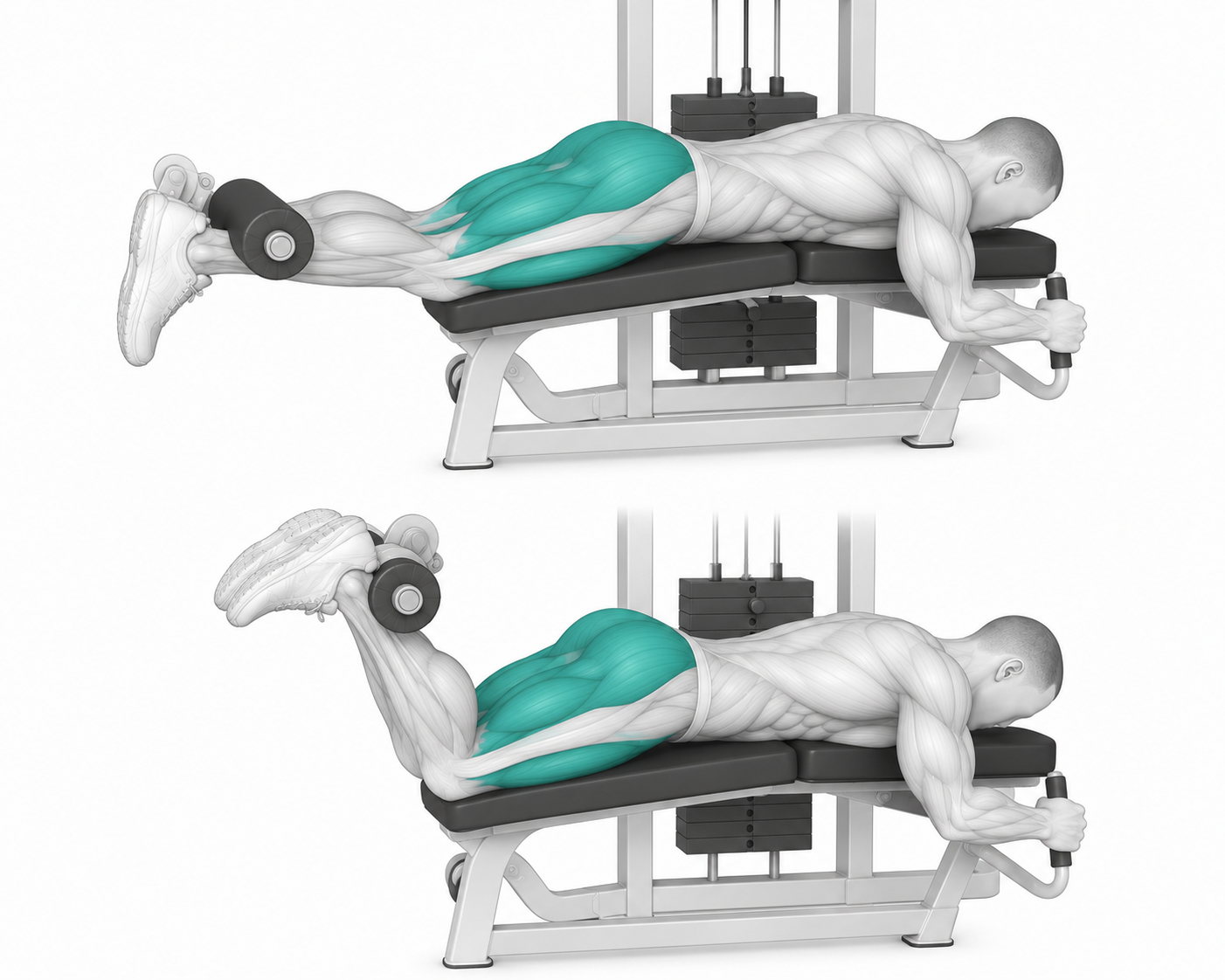
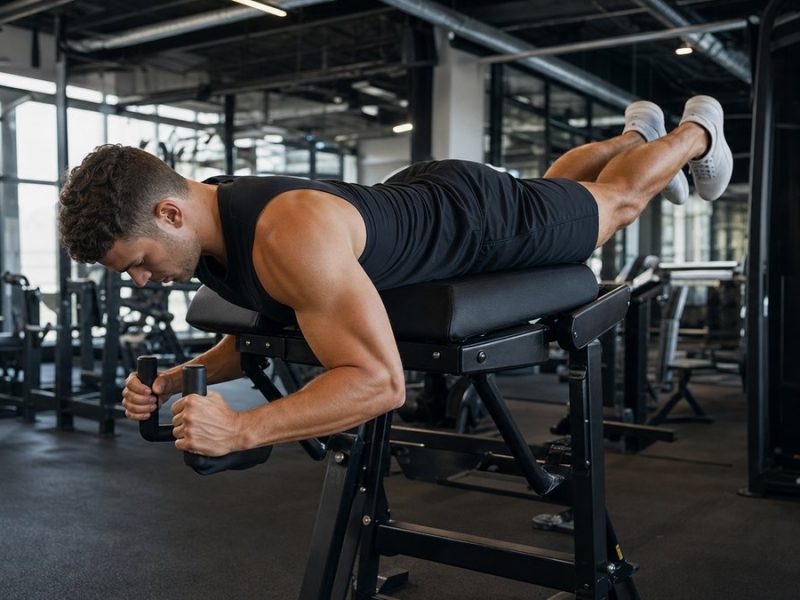
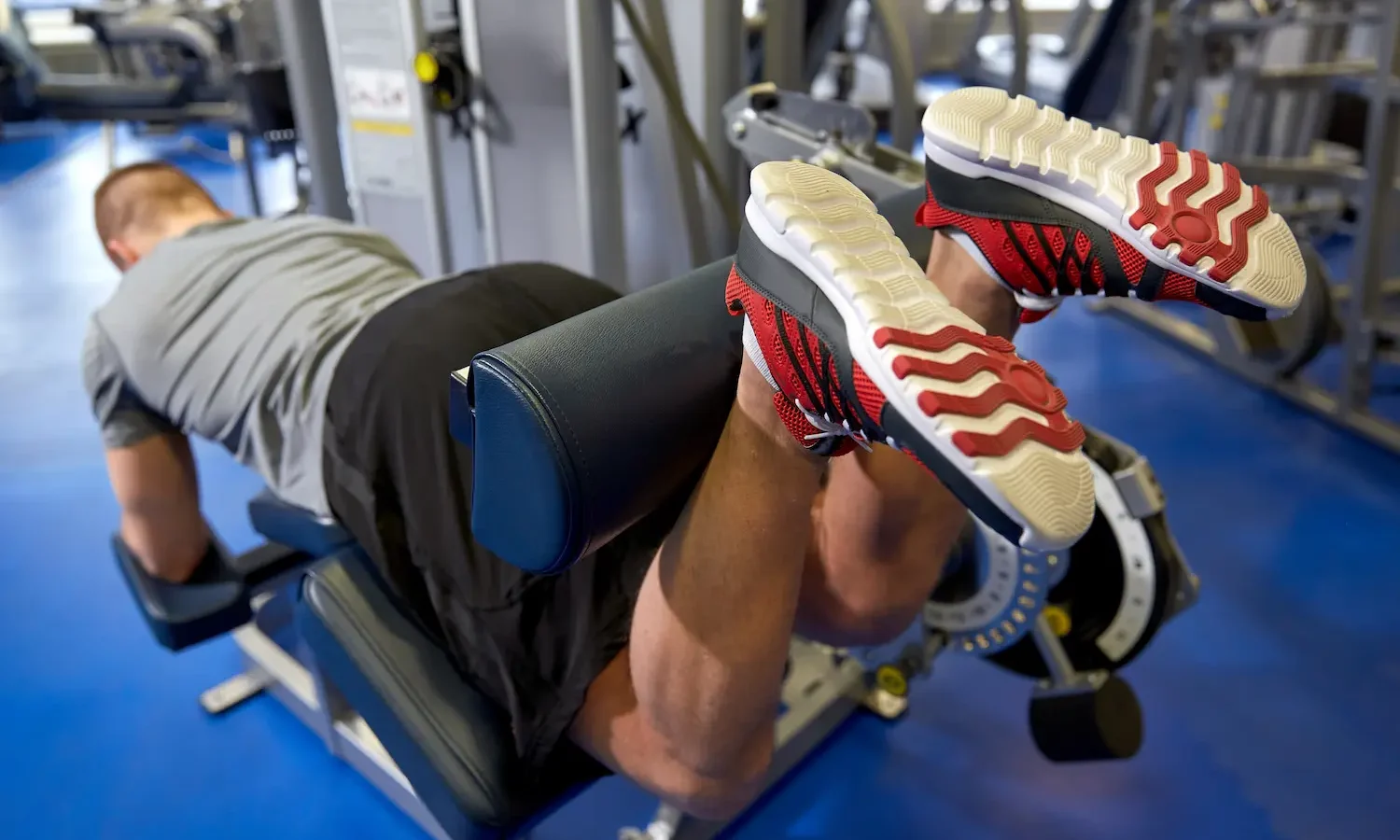
The leg curl is a knee-flexion exercise performed on a leg curl machine, in which you lie face-down (prone) or sit (seated) with your ankles under a padded roller, then bend your knees to bring the roller toward your glutes. The motion is a pure knee curl — no hip movement.
The hamstrings have two main functions: knee flexion (curling) and hip extension (hinging). The Romanian deadlift trains hip extension; the leg curl trains knee flexion. For complete hamstring development, you need both.
Muscles worked
| Muscle group | Role | Contribution |
|---|---|---|
| Hamstrings (biceps femoris, semitendinosus, semimembranosus) | Primary mover, knee flexion | ~85 % |
| Gastrocnemius (calf) | Knee flexion assistance | ~10 % |
| Glutes (slight) | Stabilisation | ~5 % |
The leg curl is one of the most isolated exercises in the gym — almost all the work is on the hamstrings, with minimal contribution from other muscles. That makes it ideal as a hamstring finisher after compound work.
How to leg curl: 5 steps
-
Set up on the machine
Lie face-down on the leg curl machine. Adjust the pad so the roller sits just above your Achilles tendons (not on the calf). Knees should be just past the edge of the bench.
-
Set the body position
Hold the handles at the front of the bench. Hips pressed firmly against the pad — they do not lift during the rep. Engage the core, head neutral.
-
Curl the heels toward the glutes
Bend the knees to curl the roller toward your glutes. **Squeeze the hamstrings** at the top. Don't arch the lower back to help — only the knees move.
-
Pause at the top
Half-second pause at the top, hamstrings fully contracted. The roller should be near or touching the glutes.
-
Lower in 2-3 seconds
Controlled eccentric. Fully extend the knees at the bottom (without locking out hard). Don't let the weight crash down — control the whole way.
Common mistakes to avoid
Variations
- Seated leg curl. Seated machine. Knees flexed at 90° at the start, roller under the calves. Often a stronger position than prone.
- Standing leg curl. One leg at a time. Single-leg work. Excellent for asymmetry-fixing.
- Single-leg curl (prone). One leg at a time on the standard machine. Same as bilateral, but doubles the focus.
- Nordic curl. Bodyweight version, kneeling with feet anchored. Brutal eccentric work. Often considered the best hamstring exercise.
- Swiss ball leg curl. Lying on the floor, heels on a swiss ball, curl the ball toward you. Bodyweight option.
- Glute-ham raise. On a GHR machine. Combined hip extension + knee flexion. Advanced.
Sample workout: 4-week hamstring block
Leg curls 2 times per week, after compound posterior chain work like RDLs or deadlifts.
| Week | Sets × reps | Tempo |
|---|---|---|
| 1 | 3 × 12 | 2 sec eccentric |
| 2 | 4 × 10 | 3 sec eccentric |
| 3 | 4 × 8 | 3 sec eccentric + 1 sec pause at top |
| 4 (deload) | 3 × 10 | Smooth |
Frequently asked questions
Leg curl or Romanian deadlift?
Both. RDL trains the hamstrings under hip extension (and stretch); leg curl trains them under knee flexion. Different stimuli — most balanced programs include both.
Prone or seated leg curl — which is better?
Seated for many lifters because the hamstring is in a more lengthened position at the start, which produces more growth stimulus. But prone is fine and what most gyms have. Use what’s available.
How heavy should I leg curl?
Hamstrings respond well to moderate loads in the 8-15 rep range. Most lifters never need extreme loads on leg curls — the right weight is one that lets you do strict, slow-tempo reps without using hip flexion to cheat.
Why do my hips lift off the pad during prone leg curls?
The load is too heavy or the tempo is too fast. Lighten the load, slow the tempo, focus on isolating the knee flexion. Hips should stay glued to the pad throughout — if they lift, you’re using hip flexors instead of hamstrings.
How often should I train hamstrings?
Twice a week is the sweet spot for most lifters. Hamstrings recover in 48-72 hours. Pair leg curls with RDLs on alternate days for ~12-15 weekly sets total.
Related exercises
- Romanian Deadlift: hip-hinge hamstring complement
- Seated Leg Curl: seated machine variant
- Nordic Curl: bodyweight eccentric
- Glute-Ham Raise: combined hip + knee work
- Single-Leg RDL: unilateral hinge
Published by: Jay — Writer covering hamstring exercises
Reviewed, corrected and approved by: Martin Wood — Editor-in-chief
Updated on September 29, 2026