
The glute bridge is the foundational exercise for learning to fire the glutes properly — and you’d be amazed how many adults struggle with that. Years of sitting weakens the glutes and turns them into reflexive sleepers. Hip extension becomes lower-back-driven instead of glute-driven, posture deteriorates, and squats start to feel like a quad-only workout.
The glute bridge fixes that. It’s simple enough to do anywhere (no equipment needed), brutal enough at high reps to build glute size, and it teaches the basic motor pattern that the heavier hip thrust builds on.
What is the glute bridge?
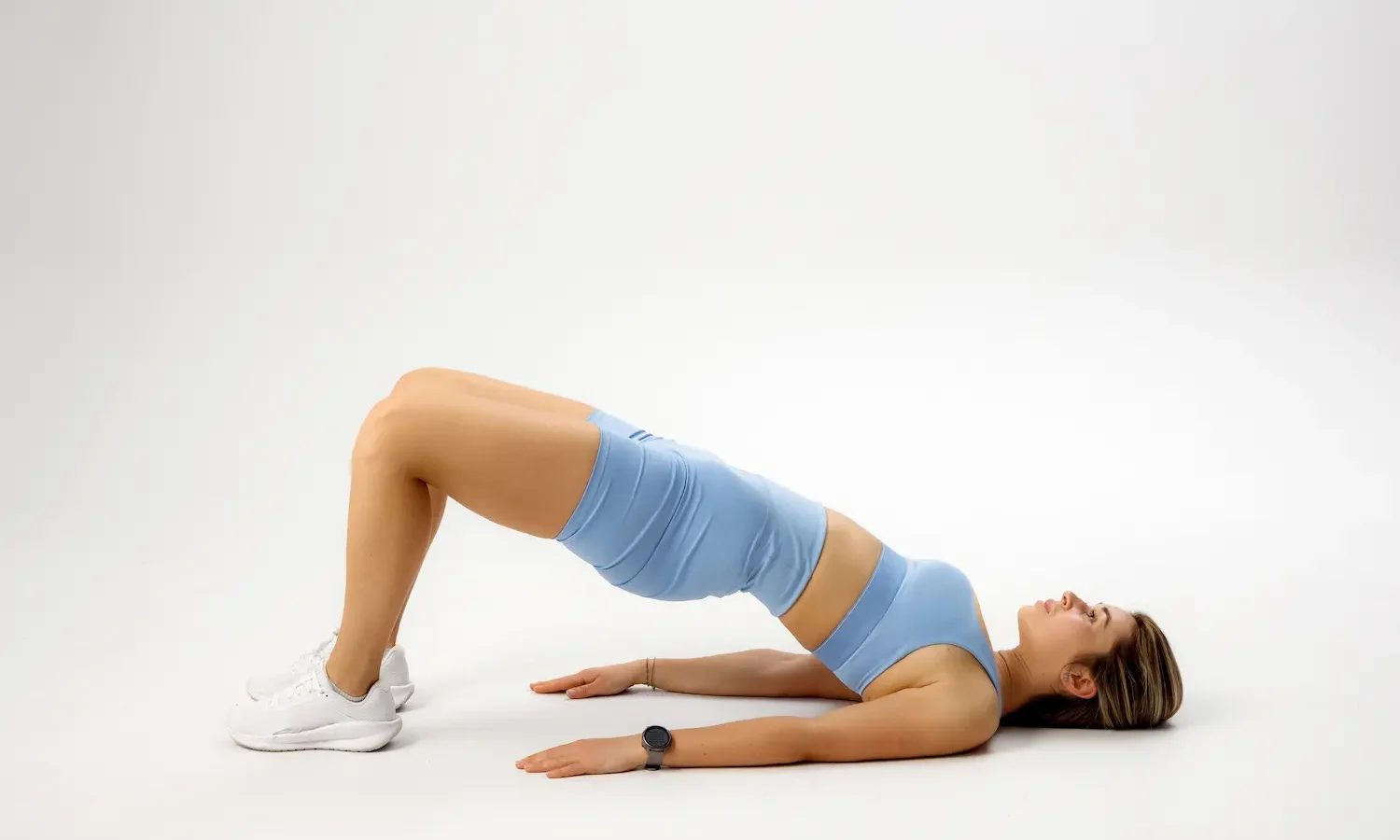
The glute bridge is a hip-extension exercise performed lying on the floor, in which you bend your knees, plant your feet, and drive your hips toward the ceiling by squeezing the glutes. The shoulders stay on the floor throughout (unlike the hip thrust, where the shoulders rest on a bench).
Compared to the hip thrust, the glute bridge has a smaller range of motion (because the shoulders don’t drop below the hips) but is much easier to set up — no bench, no barbell needed for the basic version. It’s also kinder for beginners learning to fire the glutes without help.
Muscles worked
| Muscle group | Role | Contribution |
|---|---|---|
| Gluteus maximus | Primary mover, hip extension | ~60 % |
| Hamstrings | Hip extension support | ~25 % |
| Erector spinae · Core | Posture, anti-extension | ~15 % |
The bridge primarily targets the gluteus maximus. Foot position changes the emphasis: feet closer to your hips bias the quads more; feet farther away bias the hamstrings.
How to glute bridge: 5 steps
-
Set the start position
Lie on your back on a mat, knees bent at about 90°. Feet flat on the floor, hip-width apart, heels positioned so that at lockout your shins will be vertical. Arms at your sides, palms down for stability.
-
Tilt the pelvis posteriorly
Before lifting, tuck the tailbone slightly toward the floor. This activates the glutes and prevents the lower back from over-arching. The lower back should press gently into the floor.
-
Drive the hips up
Push the floor away with your heels. **Squeeze the glutes hard** to drive the hips toward the ceiling. Lock out at full hip extension — body forms a straight line from knees to shoulders.
-
Pause and squeeze
1-3 second hold at the top. **Squeeze the glutes** as if pinching a coin between them. Don't hyperextend the lower back — body remains a straight line, no further.
-
Lower with control
Lower in 2 seconds, hips toward the floor. Don't fully relax at the bottom — keep the glutes slightly engaged. Reset, repeat.
Common mistakes to avoid
Glute bridge variations
- Single-leg glute bridge. One leg at a time, the other extended straight or bent. Doubles the load and exposes asymmetries.
- Banded glute bridge. Resistance band around the knees. Forces glute medius engagement (push knees outward against the band).
- Barbell glute bridge. Loaded with a barbell on the hips. Bridge to the hip thrust when you outgrow bodyweight.
- Feet-elevated glute bridge. Heels on a bench. Greater range of motion, more hamstring involvement.
- Marching glute bridge. Holding the bridge position, alternately lift each foot off the floor. Adds anti-rotation work.
- Hip thrust. The progression — shoulders on a bench for greater range of motion.
Sample workout: 4-week glute activation block
Glute bridges 3 times per week as warm-up activation OR as a high-rep finisher. Beginners should treat as the primary glute exercise; intermediates use it as accessory work to hip thrusts.
| Week | Sets × reps | Variation |
|---|---|---|
| 1 | 3 × 15 | Bodyweight |
| 2 | 3 × 20 | Banded |
| 3 | 4 × 12 | Single-leg |
| 4 (deload) | 3 × 12 | Bodyweight |
Frequently asked questions
Glute bridge or hip thrust?
Both have their place. The glute bridge is easier to set up and ideal for activation, beginners and high-rep work. The hip thrust has a longer range of motion and allows much heavier loading. Most balanced glute programs include both.
Why don’t I feel my glutes during bridges?
Almost certainly the lower back is doing the work instead. Tilt the pelvis posteriorly (tuck the tailbone under) before initiating the lift. **Squeeze the glutes hard** as the cue, not “lift my hips up”. The motion should feel glute-driven, not back-driven.
How many reps should I do?
For activation/warm-up: 2-3 sets of 10-15 reps. For glute hypertrophy: 3-4 sets of 12-20 reps. The glute bridge responds well to high-rep, high-frequency work. Some lifters do banded bridges daily.
Is the glute bridge enough to grow my glutes?
Bodyweight glute bridges plateau quickly for hypertrophy. Once you can do 20-25 strict reps, progress to single-leg or barbell variations, or graduate to hip thrusts. For real glute growth, you need progressive overload.
Should I add a band around my knees?
Yes — it makes the exercise meaningfully harder and engages the glute medius (which the unbanded version misses). Push the knees outward against the band throughout the rep. A standard mini-band of 10-15 kg resistance works.
Related exercises
- Hip Thrust: heavier-loaded progression
- Single-Leg Glute Bridge: unilateral variant
- Clamshell: glute medius isolation
- Romanian Deadlift: hip-hinge, hamstring focus
- Squat: bilateral compound
Published by: Jay — Writer covering glute exercises
Reviewed, corrected and approved by: Martin Wood — Editor-in-chief
Updated on May 8, 2026