
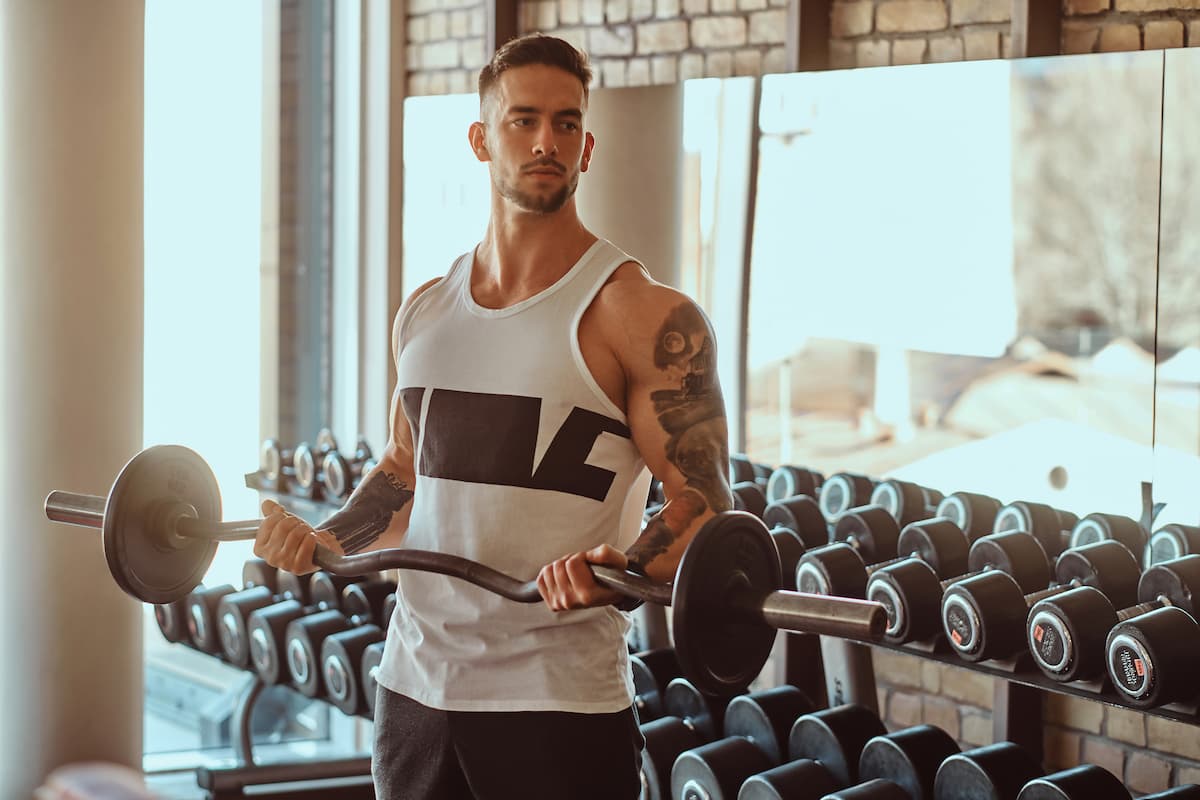
The cheat curl deliberately allows body english to handle a barbell heavier than strict form permits. Used appropriately — heavy weight, controlled descent, intentional cheating — it builds biceps strength and a thicker brachialis by overloading the eccentric phase.
What it is
The cheat curl is a heavy barbell curl performed with intentional torso swing on the concentric (lifting) phase. The lifter uses a small hip drive to get the bar moving past the sticking point, then controls the eccentric (lowering) phase strictly. The result: a heavier overall load and a brutal eccentric overload.
Muscles worked
| Muscle | Contribution |
|---|---|
| Biceps brachii | ~55 % |
| Brachialis | ~20 % |
| Forearms, brachioradialis | ~15 % |
| Core, hip flexors | ~10 % |
How to cheat curl: 5 steps
-
Load heavy
**Load the bar 10-20 % over your strict curl max.** Shoulder-width supinated grip.
-
Stand tall
Feet hip-width, **slight knee bend, core tight.**
-
Cheat the concentric
**Initiate with a small hip drive,** then complete the curl with the biceps.
-
Peak briefly
**Hold at the top briefly.**
-
Strict eccentric
**Lower over 3-4 seconds, fully controlled.** No assist on the way down.
How it differs from barbell curl
- Body english allowed on lift. Small hip and torso swing to get past the sticking point.
- Strict eccentric. Lowering phase is fully controlled — that’s where the muscle stimulus comes from.
- Heavier loads. 10-20 % over your strict barbell curl max.
- Eccentric overload tool. Trains the lowering phase under loads you can’t lift strictly.
Common mistakes
When to use this variation
Use cheat curls strategically — at the end of a heavy biceps session for 1-2 sets of 5-8 reps with overload weight. Never use them as your primary biceps exercise (form decays too quickly). Best programmed every 2-3 sessions, not every workout, to manage joint stress.
FAQ
How much cheating is okay?
Just enough hip drive to push the bar past the hardest part of the curl. If the entire rep is a swing, you’re not training biceps anymore — you’re just throwing weight.
Why control the descent strictly?
The eccentric phase (lowering) generates more muscle damage and growth signal than the concentric. By cheating the lift but slowing the descent, you overload the most growth-promoting phase.
Are cheat curls safe?
For healthy lifters, yes — when used sparingly and with controlled descent. If you have lower-back or biceps tendon issues, skip them.
Related exercises
- Barbell Curl: strict-form base
- 21s Curl: another biceps overload protocol
- Drag Curl: opposite end of strictness spectrum
- EZ-Bar Curl: wrist-friendly bar option