
The kettlebell swing is the most efficient hip-hinge conditioning exercise on earth. It hits the glutes, hamstrings and lower back hard, spikes your heart rate within 30 seconds, and trains explosive hip extension that transfers to nearly every athletic activity. It’s also one of the most badly performed exercises in any gym — most people squat the kettlebell up rather than hinging it.
This guide covers the strict Russian kettlebell swing — the version popularised by Pavel Tsatsouline. The “American swing” (overhead) exists but most strength coaches prefer the Russian version because it stops at chest height with the shoulders intact.
What is the kettlebell swing?
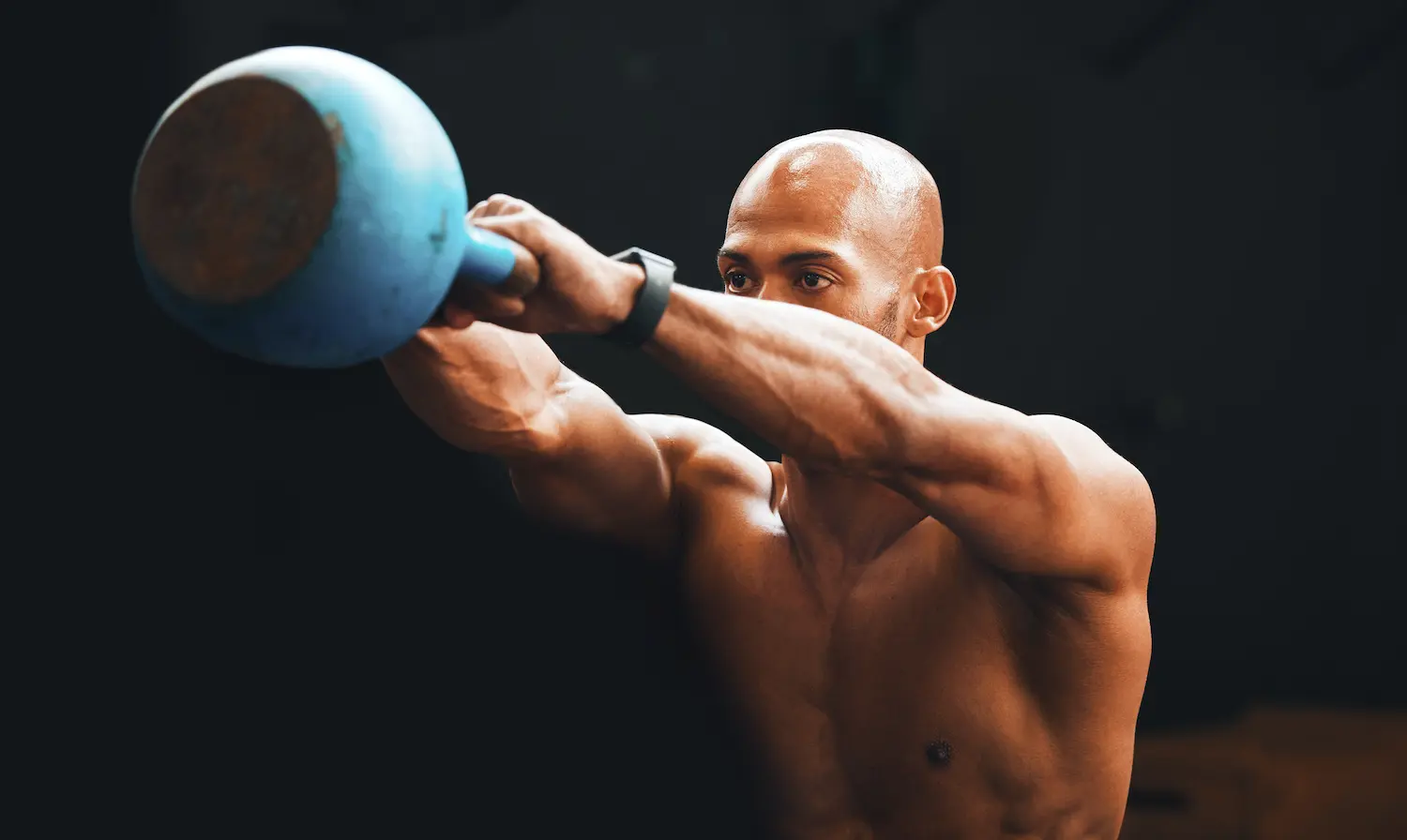
The kettlebell swing is a ballistic hip-hinge exercise performed standing, in which you hold a kettlebell with both hands, hinge at the hips to swing it between your legs, then drive the hips forward explosively to swing it up to chest height. The kettlebell is “thrown” by the hips, not lifted by the arms.
The swing is a hinge, not a squat. The knees bend slightly to follow the hip motion, but the primary movement is hip extension — like a Romanian deadlift performed explosively. Treat it as a squat and you’ll feel it in the quads instead of the glutes (and probably hurt your back).
Muscles worked
| Muscle group | Role | Contribution |
|---|---|---|
| Glutes (gluteus maximus) | Primary mover, explosive hip extension | ~35 % |
| Hamstrings | Hip extension | ~25 % |
| Erector spinae (lower back) | Postural hold under load | ~15 % |
| Lats, traps, forearms | Bar control | ~15 % |
| Core, shoulders, cardio system | Stabilisation, conditioning | ~10 % |
The swing is one of the few exercises that combines significant strength stimulus with high cardiovascular demand. Done at moderate volume (5 sets of 20-30 swings), it’s both a glute builder and a conditioning workout.
How to kettlebell swing: 5 steps
-
Set up over the kettlebell
Place the kettlebell about a foot in front of you. Stand with feet shoulder-width apart. Hinge at the hips (push the butt back) to grip the handle with both hands. Arms extended, slight bend in the knees.
-
Pre-swing the kettlebell back
Pull the kettlebell back between your legs, high — into the crease of your hips. The forearms should brush the inner thighs. **Lats engaged** — pull the shoulder blades back. Don't let the kettlebell drop low.
-
Drive the hips forward explosively
**Snap the hips forward** by squeezing the glutes hard. The kettlebell swings up because of the hip drive — the arms stay relaxed and just guide the bell. Stand fully upright at the top.
-
Stop at chest height
The kettlebell rises to about chest height (Russian style) — no higher. At the top, stand tall, glutes squeezed, abs braced. Don't lean back or extend the lower back.
-
Hinge to absorb the descent
Let gravity bring the kettlebell down. As it returns, hinge at the hips — push the butt back as the bell swings between your legs. Repeat. Maintain rhythmic breathing throughout.
Common mistakes to avoid
Variations
- Single-arm kettlebell swing. One hand at a time. Adds anti-rotation work, exposes asymmetries.
- American kettlebell swing. Swing all the way overhead. CrossFit favorite. Demanding on shoulders — skip if not used to overhead positions.
- Double kettlebell swing. Two kettlebells, one in each hand. Heavy hip-hinge work.
- Sumo kettlebell swing. Wide stance, kettlebell still between the legs. More inner thigh involvement.
- Dumbbell swing. Same motion with a dumbbell. Awkward grip but works in a pinch.
- Banded kettlebell swing. Resistance band around the kettlebell handle. Loads heavier at lockout.
Sample workout: kettlebell swing protocols
Three classic protocols depending on your goal:
| Goal | Sets × reps | Rest | Frequency |
|---|---|---|---|
| Strength + power | 5 × 10 | 2 min | 2-3×/week |
| Hypertrophy + conditioning | 5 × 20 | 60-90 sec | 2×/week |
| Conditioning (Simple & Sinister) | 10 × 10 single-arm | 30-60 sec | 3-5×/week |
| HIIT finisher | 4 × 30 sec | 30 sec | End of workout |
Frequently asked questions
How heavy should the kettlebell be?
For beginners: 8-12 kg for women, 16-20 kg for men. Intermediate: 16 kg for women, 24 kg for men. Advanced: 24 kg for women, 32 kg for men. Pavel’s “Simple & Sinister” target is 32 kg for men, 24 kg for women — represents serious strength.
Is the kettlebell swing a squat or a hinge?
A hinge. The hips drive the motion; the knees only bend slightly to follow. If you feel it primarily in the quads, you’re squatting. Push the hips back further before the knees bend.
How high should the kettlebell go?
Russian-style: chest height (about belly-button to chest level). The arms are passive — the kettlebell swings up because of the hip drive, not because you lift it. If it goes higher, you’re using the shoulders; if it goes lower, you’re not driving the hips hard enough.
Why does my back hurt after kettlebell swings?
Almost always because you’re squatting the kettlebell instead of hinging it, OR you’re extending the lower back at the top instead of squeezing the glutes. Master the Romanian deadlift first to learn the hinge pattern, then swing with the same mechanics.
Can I do kettlebell swings every day?
Yes, in moderation. Daily 100-200 swings at moderate weight is a famous Pavel-style program (“Simple & Sinister”). Past that, recovery is the limiting factor. Heavy swings (32 kg+) need more rest.
Related exercises
- Romanian Deadlift: foundational hip-hinge teaching
- Conventional Deadlift: heavy bilateral pull
- Single-Arm Kettlebell Swing: unilateral variant
- Turkish Getup: kettlebell full-body
- Hip Thrust: heavy bilateral glute
Published by: Jay — Writer covering glute exercises
Reviewed, corrected and approved by: Martin Wood — Editor-in-chief
Updated on September 29, 2026